
News
CMU’s Holocaust Awareness Series Opens with Stirring Flag Installation After Campus Uproar

Thousands of small flags fluttered across a Grand Junction field Sunday, each one a haunting reminder of lives lost — and a quiet stand against recent tension on campus.
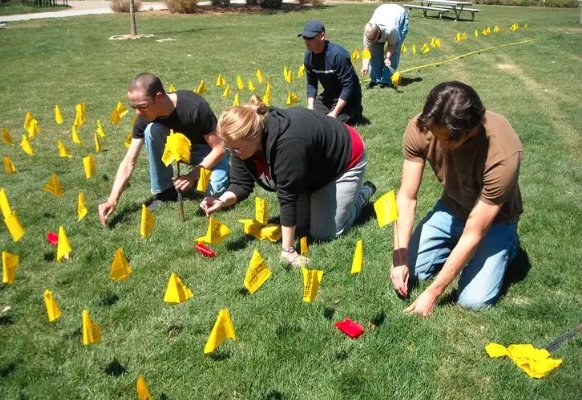
Colorado Mesa University kicked off its 22nd annual Holocaust Awareness Series with a powerful visual tribute: 2,509 miniature flags planted by students, symbolizing the magnitude of the Holocaust. Each flag stood for 5,000 individuals murdered under Nazi rule. Together, they represented over 12.5 million souls.
A field that speaks louder than words
Sunday morning wasn’t just about numbers. The field of flags wasn’t quiet. It whispered, waved, and moved with the wind.
Vincent Patarino, who started the Holocaust Awareness Series more than two decades ago, stood near the installation and paused.
“On one hand, you recognize each flag is 5,000 people,” he said. “On the other hand, the flags actually look aesthetically beautiful… That contradiction hits hard. It’s moving.”
He’s not wrong. Blue, yellow, pink — each color representing a persecuted group. Jews. Roma. LGBTQ+ victims. Political prisoners. The colors created both a visual harmony and a disturbing sense of scale. It’s one of those things you have to see to fully grasp.
Why it matters more than ever right now
CMU has been through it recently.
On March 27, just ten days before the start of the awareness series, the university hosted a controversial speaker — Jared Taylor, a known white nationalist. That event rattled the campus. Protesters showed up. Students were hurt. Some walked out. Others wept.
Patarino didn’t mince words:
“Our campus went through a really, really very difficult and I would even say for some people a traumatic time,” he said.
“I think our campus needs to heal from that.”
For him, the Holocaust series wasn’t just timely — it was necessary. And maybe, in a strange way, even more powerful because of the recent turmoil.
“This is education. This is learning. This is community,” he said. “It’s what a university is supposed to be.”
A week of reflection, emotion, and dialogue
The series isn’t just the flag display. It runs April 6–11, and it’s packed with panels, films, student discussions, and survivor testimonies.
Here’s what students and locals can expect throughout the week:
-
A screening of Night and Fog, the harrowing 1955 documentary on Nazi death camps
-
Open forums for student-led Holocaust reflections
-
Presentations by historians on rising antisemitism in the U.S.
-
A candlelight remembrance vigil on the final night
Not everything will be comfortable. And that’s the point.
“There will be tension,” Patarino admitted. “Some of these discussions get intense. But that’s the kind of thing that needs to happen on a college campus. That’s how learning sticks.”
A community event, not just a campus one
One paragraph. One sentence. That’s all it takes to say something big:
This isn’t just about CMU.
Patarino made it crystal clear that this week-long series belongs just as much to Grand Junction as it does to the students.
“This is not just for the CMU community,” he said. “It’s for the city we’re in.”
Grand Junction, a city that sometimes finds itself on the edge of larger national debates, has shown up for past events. Teachers bring students. Locals attend lectures. Holocaust survivors — or their families — quietly listen in the back.
There’s something deeply intimate about that shared space. A small town, a university, a week to remember what happens when we forget.
The message in numbers — a glimpse at the scope
It’s easy to forget just how massive the Holocaust was. That’s why the flag field hits so hard. But it’s also why some context matters:
| Group Targeted | Approximate Death Toll | Represented by Flag Color |
|---|---|---|
| Jews | 6 million | Blue |
| Soviet POWs | 3.3 million | Red |
| Ethnic Poles | 1.8 million | White |
| Roma (Gypsies) | 250,000–500,000 | Yellow |
| Disabled Individuals | 250,000 | Green |
| LGBTQ+ Individuals | 10,000+ | Pink |
| Political Dissidents | Unknown, estimated 1M+ | Orange |
Those are just estimates. The actual numbers? Lost to history. But standing in front of 2,509 flags brings it home.
Students plant more than just flags — they plant meaning
Some students said nothing while they planted the flags. Others prayed. A few cried. One simply stood back and whispered, “That’s a lot of people.”
There were no speeches. No music. Just hands pushing plastic poles into the ground, one by one.
“I’ve learned about the Holocaust since middle school,” said freshman Emma Lowry. “But actually doing something like this? It makes it real.”
CMU staff gave students full creative control over the display. It was organized by student volunteers from various departments — history majors, sociology students, even some art students who helped with layout.
They didn’t just want accuracy. They wanted empathy. And they got it.










Spotify Running Mode hits Android and revives its old tempo experiment

Galaxy Tab S12 Ultra Renders Keep the Notch Fans Hate

Novato Spinning Round House Sells With Six Neighbors for $3.3 Million

Crop Tour Finds Indiana and Nebraska Corn Yields Lagging 2025

Best Buy 60th sale brings Android deals back to its roots

American Airlines reverses seatback screen bet years too late

Iran Hormuz Strikes Force Gulf Oil Onto Costlier Paths

Plague Tale Prequel Day One Joins Game Pass Wave 2 as Witcher Exits

NBA 2K27 opens The City to everyone and rewrites career eras

iOS 26.6.1 Patches 29 Flaws as AI Forces Faster Apple Updates

Double Fine Cuts 23 Jobs Weeks After Xbox Independence

Day-One Big Walk Lifts PS Plus August Beyond Recycled AAA

John Hight Exits Wizards After Digital Reckoning Hits

Curtis Mead’s Red Sox Debut Ends With Fractured Wrist

Red Sox Squander Hot Streak Chance in 4-3 Loss to Athletics

Moesch and Dressel Rewrite Night One at 2026 U.S. Nationals

Boutte’s Quiet Camp Takeover Forces Patriots Receiver Choices

Take-Two CEO Pushes Netflix Subs for GTA 6 Extended Look

Halo Campaign Evolved Skulls Meet Death Barriers That Kill the Hunt

Wildlands Free Update Hands Players the Tools They Already Invented
-

 TECHNOLOGY3 years ago
How to Adjust a Bulova Watch Band – An Easy Guide
-

 News3 years ago
Fred Pentland: Athletic Bilbao’s English mentor who changed the essence of Spanish football
-

 FINANCE3 years ago
Tax Planning for Every Season: Guide to Maximizing Your Tax Benefits
-

 Education3 years ago
African Ministers New Education Plan
-

 BUSINESS3 years ago
What is Entrepreneurial Operating System? A Comprehensive Guide to EOS
-

 Education3 years ago
Innovate Your Learning Journey with Technology and Enhance Education
-

 News3 years ago
Russians formally out of World Athletics Championships
-

 BUSINESS3 years ago
Top 9 Most Expensive American Cities to Rent an Apartment