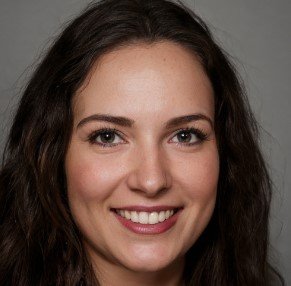
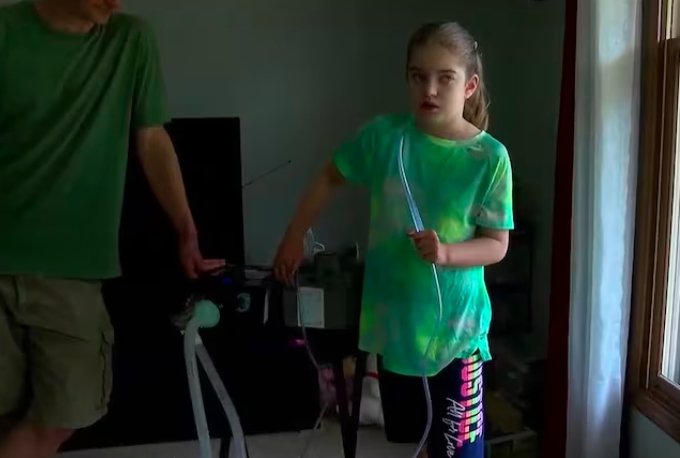
Ellie Price doesn’t cough like other kids. Her lungs are too weak for that. So a machine does it for her—every few minutes. It’s become part of her rhythm, part of her life. And her mom, Krista, isn’t just watching. She’s fighting.
Dressed in a mitochondria costume, Krista Price isn’t trying to be quirky. She’s trying to be seen. Because when your child is battling a disease most doctors don’t even talk about, being invisible is not an option.
The long, painful road to a diagnosis
Ellie’s story isn’t just heartbreaking—it’s terrifyingly familiar to parents of kids with ultra-rare diseases.
Krista remembers the moment clearly. That phone call. That helpless feeling. “She referred us out,” Krista says quietly. “Cleveland Clinic was a great option… so, that’s where we’ve kind of been at ever since.”
It wasn’t a smooth ride. Before Cleveland, there were questions with no answers. Symptoms with no names. Appointments that ended in shrugs.
Leigh’s Disease, also known as Leigh Syndrome, is a rare genetic neurological disorder. It hits the brain and spinal cord, causing degeneration. There is no cure. And the damage? Often irreversible.
What is Leigh’s Disease?
To understand what Krista is up against, you need to understand the disease. Not in abstract terms—but in lived reality.
It’s not just a diagnosis. It’s feeding tubes. It’s physical therapy. It’s mobility devices. It’s managing seizures. And in Ellie’s case, it’s a cough-assist machine, because her lungs can’t do it on their own.
Here’s what Leigh’s Disease typically brings:
-
Loss of motor skills
-
Muscle weakness and pain
-
Difficulty breathing or swallowing
-
Seizures and developmental regression
-
Life expectancy often under 7 years, though some live longer with intensive support
The cause? Mitochondrial failure. The tiny engines inside our cells break down. And when those engines stop, so does everything else.
A mother on a mission, in costume
Krista’s mitochondria costume isn’t a gimmick. It’s a cry for attention—for recognition. Because this disease gets almost none.
“Globally, there’s not a lot of medical research,” she explains. “There’s no funding going toward it… it needs to be put on the map.”
Her advocacy isn’t just emotional—it’s practical. She wants to push institutions, researchers, and government bodies to act. And for a disease as rare as Leigh’s, that’s a steep hill to climb.
She doesn’t want sympathy. She wants movement.
The funding gap and research vacuum
Rare diseases often fall through the cracks. Leigh’s is no exception.
According to data from the National Institutes of Health, over 7,000 rare diseases affect roughly 1 in 10 Americans. Yet less than 10% of these conditions have any FDA-approved treatment.
A 2024 report by Global Genes showed that:
| Metric | Value |
|---|---|
| Number of Rare Diseases | ~7,000 |
| % with FDA-Approved Treatments | ~5-7% |
| Leigh’s Disease Research Trials | Fewer than 10 active worldwide |
| Estimated Global Cases | Fewer than 5,000 children |
Most funding goes toward common conditions. Understandable, maybe—but tragic for families like the Prices.
Machines are helping Ellie—but only just
Every beep in Ellie’s room matters. The cough-assist machine. The feeding pumps. The meds lined up like a miniature pharmacy.
They don’t cure Leigh’s. They just slow it down.
Some days are harder than others. Talking has become tougher. Eating? Sometimes impossible.
But Ellie keeps going. And so does her mom.
The isolation of ultra-rare disease parenting
For Krista, the emotional toll is massive. Watching one child suffer is hard enough. But this disease is genetic. And she’s got two daughters.
This isn’t just one diagnosis. It’s a family restructured around survival. Around hospital visits. Around therapies. Around grieving the loss of a “normal” childhood—before it’s even over.
Parents of children with rare diseases often speak of the isolation. The lack of community understanding. The endless Googling in the middle of the night.
Support groups exist—but they’re small. The Leigh’s Disease Facebook support group, for instance, has just over 3,000 members globally.
Fighting for tomorrow—today
Krista isn’t just campaigning for Ellie. She’s fighting for other kids too. Because this disease doesn’t care about zip codes or health insurance. And because research into mitochondrial diseases could help unlock treatments for a lot more people—across a range of neurodegenerative disorders.
“I’m doing this because nobody else is,” she says. “If I don’t scream for my daughters, who will?”
And that mitochondria costume? It’s uncomfortable. But it works.
People ask questions. They take photos. They Google the word. One more person learns. One more drop in the bucket.
For now, that’s enough.