In a land where empires rose and fell like tides, the stones still speak. And in Turkey’s ancient city of Olympos, they’ve just whispered something new.
A striking mosaic, recently uncovered at the threshold of a long-lost church, carries a clear and chilling inscription: “Only those on the righteous path may enter here.”
A city of pirates, saints, and now, stories in stone
Tucked away on the southern coast of modern-day Turkey, Olympos once thrived as a Roman necropolis before transforming into a Byzantine town. Over the centuries, it wore many faces—Greek colony, pirate haven, Roman outpost, Christian stronghold.
Excavations at the site have been ongoing since 2006, but recent years have brought renewed momentum. This summer’s breakthrough came at the steps of what archaeologists call “Church No. 1″—a once-holy place now buried under centuries of debris and growth.
And right at the front door, archaeologists found the mosaic. Ancient, yet oddly clear.
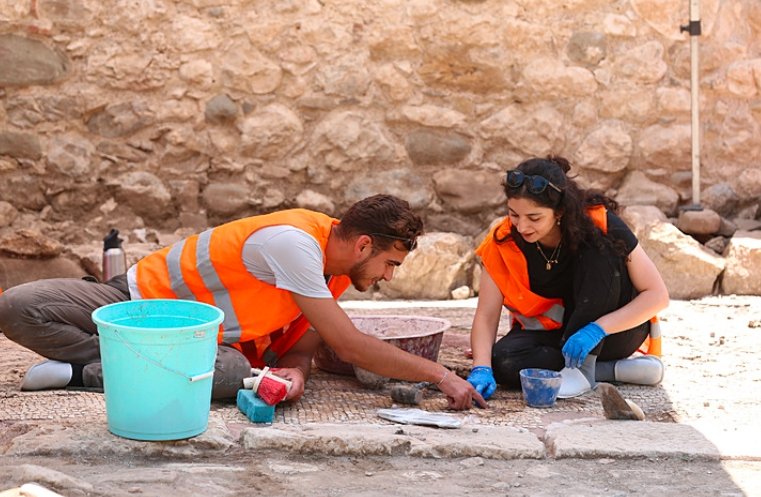
The message beneath your feet
The inscription wasn’t vague. This wasn’t a general blessing or decorative flourish. It was a warning, an instruction—etched right into the floor for every believer (or sinner) to read before stepping inside:
“Only those on the righteous path may enter here.”
Short. Clear. Unnerving.
It’s the kind of phrase that lingers in your head long after you’ve read it. And for the faithful who once walked these halls, it likely carried real spiritual weight.
One archaeologist described it as “a gatekeeper message.” It didn’t just welcome—it judged.
Digging deeper into faith and fear
Floor mosaics like this aren’t rare in Byzantine churches, but moral warnings at entryways? Those are something else. They suggest a level of theological strictness, a blending of architecture and ideology that shaped not only how people moved—but how they thought.
The mosaic hints at what kind of church this was. Not just a place of worship, but of discipline. A house where sin wasn’t simply confessed—it was kept out, right from the doorstep.
That says a lot about Olympos in the Byzantine period. This wasn’t just a town that adopted Christianity—it absorbed it, rewired itself around it.
Four years of silent discoveries
Excavation work at Olympos has continued without interruption for four years now, led by teams from Turkey’s Ministry of Culture and Tourism.
So far, they’ve found:
-
Multiple residential structures from the late Roman and early Byzantine periods
-
A necropolis filled with ornate tombs and sarcophagi
-
Several church sites, including the now-famous “Church No. 1”
-
Decorative elements including marble, painted plaster, and now, mosaics
But this inscribed floor is one of the most direct, human finds to date. It isn’t just art. It’s a sentence, a belief frozen in time.
Why Olympos still matters
Today, Olympos sits quietly in Antalya, far removed from its former power. But in its heyday, it was one of the most important cities in the ancient Lycian League.
Its ruins remain scattered across forested hills and along a river that empties into the Mediterranean. Tourists visit to see the sunken tombs, overgrown stone pathways, and a haunting beach where turtles still lay their eggs.
But mosaics like this remind us: the past isn’t just stone. It speaks.
And it doesn’t always whisper.
Not just decoration—this was doctrine
The use of church mosaics in early Byzantine culture was a lot more than aesthetic. They were statements. Lessons. And sometimes, warnings.
Here’s how floor mosaics were commonly used across the early Byzantine world:
| Mosaic Purpose | Description |
|---|---|
| Decorative Art | Scenes of flora, fauna, or symbols |
| Theological Messaging | Warnings, scriptures, or moral phrases |
| Commemorative Inscriptions | Names of donors or builders |
| Liturgical Markings | Zones for clergy, laity, or sacred objects |
The Olympos mosaic fits squarely into the “moral messaging” column—a quiet but firm demand that only the pure enter holy ground.
What comes next?
Archaeologists plan to stabilize and conserve the mosaic for further study, and possibly for public display. Turkish officials are working to increase tourist infrastructure in the area without disturbing the archaeological integrity of the site.
That’s always the dance—between preservation and presentation.
For now, the mosaic remains in situ. Still at the threshold. Still waiting.