Only four Ceratosaurus skeletons have ever been found. This one just made history — and headlines — at Sotheby’s.
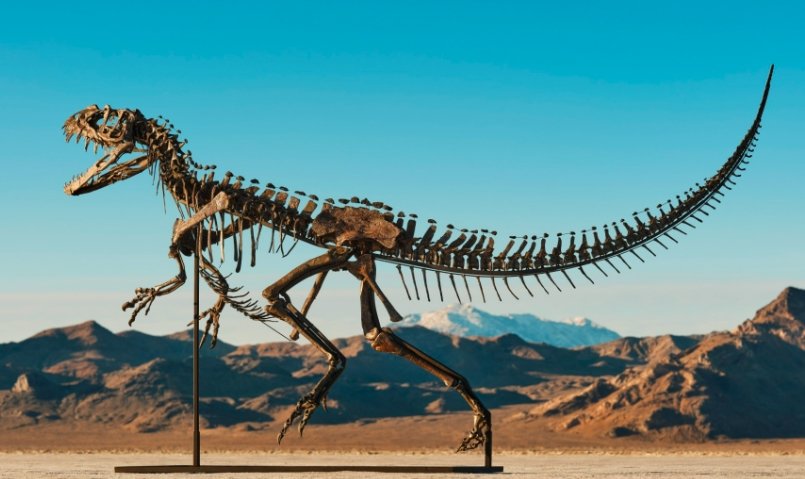
A 150-million-year-old juvenile Ceratosaurus skeleton has become the third most expensive fossil ever sold at auction, fetching a staggering $30.5 million at Sotheby’s this week. The final bid blew past pre-auction estimates and left even seasoned paleontologists stunned.
Discovered nearly three decades ago in Wyoming, the skeleton is the only known juvenile specimen of the meat-eating dinosaur species. The other three Ceratosaurus fossils found to date are all adults. That rarity — paired with its surprisingly complete structure — helped push the fossil into record territory.
“This was a once-in-a-generation piece,” said a Sotheby’s spokesperson. “There’s nothing else like it on the market, or in any museum for that matter.”
From Bone Cabin Quarry to the Auction Floor
The story begins in 1996, when paleontologists working near Bone Cabin Quarry in Wyoming unearthed a fragile set of fossilized bones. The site, already famous for yielding Jurassic-era dinosaurs, proved to be hiding something unique: a juvenile Ceratosaurus, roughly the size of a modern-day alligator, with its sharp teeth and iconic nasal horn still visible in the partially intact skull.
At the time, the bones were carefully extracted, stabilized, and stored, but remained largely under the radar.
That changed when the fossil was placed on long-term display at the Mountain America Museum of Ancient Life in Lehi, Utah. There, it quietly became a favorite among dinosaur fans — many of whom had no idea they were looking at something truly one-of-a-kind.
“We always knew it was special,” said one former museum staffer. “But we didn’t expect it to end up breaking records.”
Why the Final Price Left Experts Speechless
Before the gavel dropped, experts had predicted a final sale somewhere between $4 million and $6 million. Even that range was considered ambitious by some in the paleontology world, where prices can vary widely based on condition, completeness, and scientific value.
But when bidding opened at Sotheby’s Natural History Auction, it quickly became clear this would be no ordinary sale. Within minutes, the price jumped past $10 million. By the time the dust settled, the fossil had soared to over five times its high estimate, landing at $30.5 million.
To put that in perspective:
-
The most expensive fossil ever sold is Stan the T. rex, which went for $31.8 million in 2020.
-
Second is Sue the T. rex, purchased by the Field Museum in 1997 for $8.4 million (around $15 million today after inflation).
-
This Ceratosaurus now ranks third — a position no one saw coming.
One sentence is enough here too.
“We’ve never seen a juvenile dinosaur of this caliber,” said a paleobiologist following the sale. “It’s irreplaceable.”
What Makes Ceratosaurus So Interesting?
Ceratosaurus isn’t a household name like Tyrannosaurus or Velociraptor — but it probably should be.
The species lived about 150 million years ago during the Late Jurassic period, and roamed what is now North America. It was a mid-sized predator, measuring up to 20 feet long in adulthood, with blade-like teeth and a distinct horn on its snout.
Paleontologists believe it may have hunted smaller dinosaurs and scavenged larger kills. Its bones suggest a strong tail and muscular hind legs — built for quick, powerful sprints.
But it’s the scarcity that really drives the fascination. Only four skeletons have ever been found:
-
One partial adult in Colorado
-
Two more adult specimens in Utah and Wyoming
-
And now, this single juvenile — the only one ever documented
Because of its age and condition, the juvenile fossil offers scientists a rare look into how the species developed over time. “It’s like finding a baby photo of a celebrity we’ve only seen as an adult,” said one paleontologist.
Who Bought It? That’s a Secret
So who shelled out over $30 million for a prehistoric teenager?
Sotheby’s isn’t saying. As is standard for high-profile private sales, the buyer’s identity has been kept confidential. Some in the fossil community suspect it may be a private collector or tech billionaire with an eye for rare specimens.
Others hope — maybe wishfully — that it ends up in a public institution eventually.
The anonymity has reignited a longstanding debate over the privatization of scientifically significant fossils.
“Every time one of these ends up in a private collection, we lose potential research,” said Dr. Helena Watts, a vertebrate paleontologist. “This isn’t just art. It’s data.”
Still, there’s no law preventing such sales — and Sotheby’s has leaned into the luxury branding of natural history, increasingly listing rare fossils alongside gemstones and high-end watches.
The Growing Market for Fossils as Collectibles
In the past decade, fossil auctions have evolved from niche science sales to high-stakes luxury events. Dinosaurs are now status symbols, just like yachts or Picassos.
And the numbers reflect that shift:
| Year | Highest Auction Fossil Price | Notable Sale |
|---|---|---|
| 2013 | $1.1M | Allosaurus partial skeleton |
| 2020 | $31.8M | Stan the T. rex |
| 2025 | $30.5M | Juvenile Ceratosaurus |
“There’s a growing overlap between natural history and fine art buyers,” said an insider familiar with the auction. “Collectors want stories. This skeleton tells one.”
What Happens Next?
For now, the skeleton is expected to be shipped to its new owner’s location — wherever that is. Whether it ends up behind velvet ropes in a private showroom or eventually donated to a museum remains to be seen.
Scientists, meanwhile, continue pushing for legislation that would keep fossils of this caliber in public hands.
Until then, expect more dinosaur auctions. And probably more surprises.