
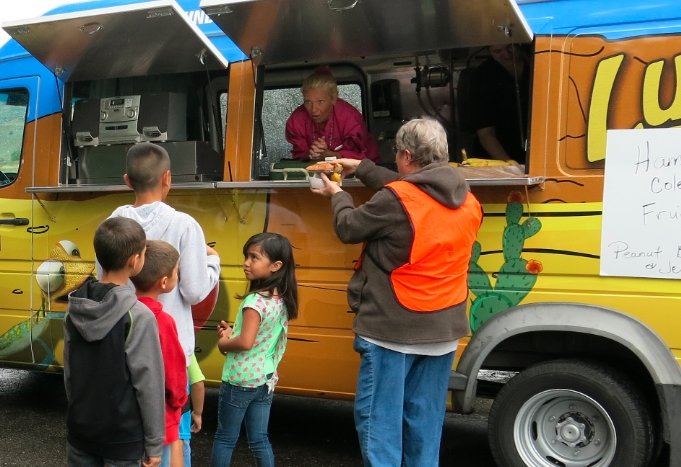
No forms. No questions. Just food. For the tenth summer in a row, kids in Mesa County can count on one thing—when the school cafeterias close, the Lunch Lizard rolls in.
The Lunch Lizard program kicked off June 2 across Grand Junction, Clifton, and Fruita, serving free meals to children and teens under 18. Operated by Mesa County Valley School District 51, the program’s goal is disarmingly simple: don’t let any kid go hungry while school’s out.
A Food Truck With a Mission, Not a Price Tag
Every summer, when classroom doors shut and playgrounds grow quiet, something less visible happens—millions of kids across the U.S. lose access to the steady meals schools provide. In Mesa County, where roughly one in five children live in poverty, that drop-off hits hard.
This is where the Lunch Lizard steps in.
One sentence is all it takes to explain it: food trucks delivering meals to kids, no strings attached.
Dan Sharp, Director of Nutritional Services for District 51, says the trucks run four days a week on three carefully planned routes. “We focus on areas with higher poverty rates,” he explained. “The idea is to bring food directly to where the need is greatest.”
No ID. No proof of income. Just show up. Eat.
Where It Goes, Who It Reaches
The Lunch Lizard routes snake through Grand Junction, Clifton, and Fruita. Each route has multiple stops—church parking lots, parks, community centers. Anywhere kids already gather.
Some of the more popular stops include:
-
Rocket Park in Grand Junction
-
Clifton Elementary
-
Reed Park in Fruita
The food trucks aren’t just convenient—they’re consistent. They operate Monday through Thursday from June 2 to July 24, covering the most food-insecure months of the year for children. Fridays are left open, mostly for staff recovery and prep work.
Each stop usually lasts 30–45 minutes. That’s just enough time to distribute dozens of meals, sometimes hundreds.
What’s On the Menu?
It’s not just PB&J and juice boxes anymore. The Lunch Lizard menu has grown more diverse over the years, in both nutrition and appeal.
Here’s a quick look at what kids can expect to see on a typical weekly rotation:
| Day | Main Item | Sides | Drink |
|---|---|---|---|
| Monday | Turkey sandwich | Carrot sticks, apple slices | Milk |
| Tuesday | Chicken burrito | Corn, fresh peach | Chocolate milk |
| Wednesday | Pizza slice | Side salad, banana | Water |
| Thursday | Pasta with red sauce | Cucumber slices, grapes | Juice box |
Meals meet USDA summer food standards. But they also meet kids’ taste buds where they are.
One mom at the Rocket Park stop said, “My daughter actually looks forward to the pasta day. She calls it ‘food truck Thursday.’ It’s fun.”
A Decade In, Still Growing
The Lunch Lizard began in 2015 with a single truck and a handful of stops. It was part of a push by the U.S. Department of Agriculture to address summer hunger.
Dan Sharp recalls how skeptical people were at first. “People didn’t think a food truck could be a serious solution,” he said. “But now we’ve got three routes, partnerships across the county, and growing demand every year.”
In 2024, the program served over 50,000 meals. This year, they’re hoping to surpass 60,000.
One sentence, again: That’s 60,000 fewer times a kid has to go hungry.
Why It Matters More Than Ever
This isn’t just a feel-good program. It’s a lifeline, especially this year.
Inflation has pushed grocery prices up more than 20% since 2021. School lunch debts soared across the U.S. during the 2023-2024 academic year, with many families struggling to keep up. For low-income parents, the summer can be downright scary.
That’s what makes the Lunch Lizard essential, not optional.
Families don’t have to sign up. There’s no paperwork. Kids just walk up to the truck, grab a tray, and eat under the shade of a nearby tree or umbrella. For some, it’s the only hot meal of the day.
Even older kids have started tagging along, not just for the food but for the atmosphere. Sharp says they’ve seen teens volunteering or even just hanging out to help the younger ones.
One staffer put it simply: “It feels like summer lunch should.”
The Community Keeps It Rolling
While District 51 leads the effort, it takes a full community to keep the wheels turning.
Volunteers, donors, and local partners step in every year to support operations—from restocking supplies to manning the trucks. Local farms often donate fresh produce. Businesses pitch in with bottled water or snack packs.
One volunteer, Amy Torres, has been handing out lunches since 2018. “It’s just an hour out of my day,” she said, “but for some of these kids, it changes the whole day.”
Others come back year after year, bringing their own children along to help.
And let’s be real—it’s not just the kids who benefit. The sight of the big blue food truck rolling into a neighborhood park is the kind of simple joy that makes the whole place feel more connected.