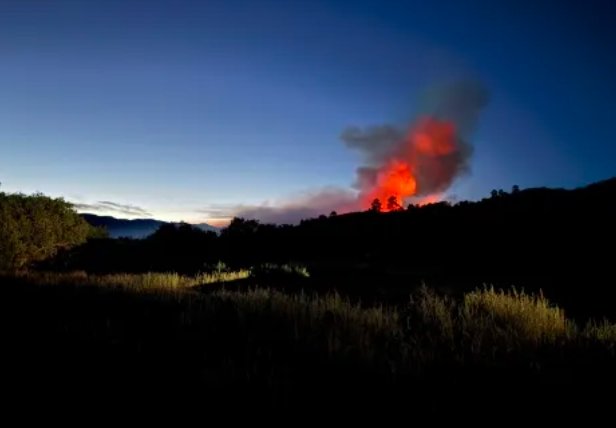
First came the smoke. Then the flames. Now, southwest Colorado is staring down two out-of-control wildfires as homes are evacuated and skies over Durango darken with haze. Both fires erupted July 26, catching officials and residents off guard and forcing a fast, full-scale response.
The Elkhorn Fire, which started as a single structure blaze, has already grown past 200 acres northwest of the city. And to the south, the Rim Road Fire is fanning out fast, devouring more than 100 acres along County Road 318.
Elkhorn Fire Leaps From Structure to Forest
The Elkhorn Fire wasn’t supposed to be a wildfire. It began as a structure fire — one building — before winds picked it up and tossed burning debris into the nearby forest.
By Sunday evening, it had spread to 204 acres, eating through the edges of the San Juan National Forest like dry paper.
Firefighters had barely blinked.
The fire is burning roughly 13 miles northwest of Durango, in rugged, forested land with steep slopes and narrow access routes. Getting there isn’t easy. Stopping a fire there? Even harder.
Officials issued evacuation orders for areas east of County Road 250 and Highway 550. Some residents left so quickly, they didn’t even shut their front doors.
The containment status? Still unknown. Crews say the terrain is slowing their progress and the wind isn’t helping.
South of Durango, a Second Fire Sparks Trouble
While resources were stretched thin up north, trouble was brewing down south.
The Rim Road Fire ignited south of Durango, along County Road 318 near Lenyx Lane. It’s burning through dry grasslands and brush, moving at a speed that’s left fire teams scrambling to keep pace.
As of the last update, it covered roughly 112 acres.
Evacuations were issued fast for nearby homes. Authorities didn’t wait.
Just hours after Elkhorn exploded, this second fire sent more residents packing.
Some were sleeping in tents outside Escalante Middle School before news even broke on local TV.
The Numbers, the Facts, and the Fireline
Here’s a look at the scope of both wildfires — what we know so far:
| Wildfire | Location | Acres Burned | Evacuations Ordered | Cause | Personnel Assigned |
|---|---|---|---|---|---|
| Elkhorn Fire | 13 miles NW of Durango | 204 acres | East of CR 250 & Highway 550 | Structure fire | 150+ |
| Rim Road Fire | County Road 318, South of Durango | 112 acres | CR 318 & Lenyx Lane | Under investigation | Shared crews |
It’s not just about size.
The fires are pushing close to homes. That’s what’s really got everyone on edge.
Fire Crews Work Day and Night
There are currently 150 personnel tackling both fires.
It’s a combined effort — local fire departments, forest service crews, and San Juan Team 8 Incident Management — all working side by side.
Daytime heat makes it worse. Helicopters can’t always fly, and tankers are often grounded by the thick smoke or gusty wind.
One firefighter from Telluride said, “We’re not sleeping much. But we’re not quitting either.”
A few crews camped out overnight in the hills, using chain saws and hand tools to cut containment lines by flashlight.
And they’re not just battling flames — they’re fighting exhaustion.
Evacuations and Uncertainty
For many, it’s the second or third time they’ve had to pack up and flee over the past few fire seasons.
Susan Keller, 68, lives just east of CR 250. She barely had time to grab her cat and medication. “I’ve lived here 40 years,” she said. “Never seen anything light up this fast.”
Evacuees have been directed to Escalante Middle School, now serving as the region’s emergency shelter. Dozens of families are sleeping on cots, waiting for word on their homes.
Some are lucky — they brought photos, documents, even a change of clothes.
Others left with only what they were wearing.
Here’s what evacuees have access to at Escalante:
-
Red Cross medical assistance and basic supplies
-
Meals and bottled water provided by local churches and businesses
-
Pet shelter coordination through La Plata County Animal Protection
A teacher at the school, who asked not to be named, said the gym was “heartbreakingly full.”
Weather: The Invisible Threat
It’s not just the fire. It’s what fuels it.
Southwest Colorado is in a severe drought. Temperatures topped 93°F on Sunday. Relative humidity hovered below 9%. Winds gusted over 25 mph in the hills above Durango.
That’s basically fire starter conditions.
What’s worse? There’s no rain in the forecast. And monsoon season — once a reliable ally in late summer — has all but disappeared in recent years.
The National Weather Service has posted red flag warnings across the Four Corners region. Dry lightning is a major concern. One stray bolt could trigger a third fire.
One sentence: this isn’t over.
Rural Communities on Edge
Durango is a town that knows fire. Locals still remember the 416 Fire of 2018 — it burned over 55,000 acres and cost more than $40 million to suppress.
But there’s something different this time.
Two fires. Same weekend. Same county. One started from a house fire.
People are wondering: how many more?
Several small communities are holding emergency town hall meetings this week, including Hermosa and Oxford. Residents want answers — and help.
Volunteers from Montezuma County have already begun bringing supplies. And firefighters from as far as Gunnison and Pagosa Springs are en route.
But there’s only so much ground 150 people can cover.