
For over a century, scientists have scoured Europe’s prehistoric caves in search of answers about how — and when — Homo sapiens first arrived on the continent. Now, buried beneath layers of rock and time at the base of Bulgaria’s Balkan Mountains, researchers have found what they were looking for: bone fragments that rewrite the timeline of human migration into Europe.
Unearthed from Bacho Kiro Cave, these bones belong to modern humans who lived between 45,820 and 43,650 years ago, with some fragments possibly dating back as far as 46,940 years ago. The findings predate previous estimates by at least 1,000 years, marking them as the earliest known presence of Homo sapiens in Europe.
“This early wave of modern peopling largely predates the final extinction of the Neanderthals in western Europe… It complicates our view of what was once thought to be a straightforward replacement,” said Jean-Jacques Hublin, a co-author of the study and director at the Max Planck Institute for Evolutionary Anthropology.
Piecing together a puzzle from fragments and proteins
The story begins not in a high-tech lab, but in a dark limestone cave. Bacho Kiro has long been known for its Palaeolithic treasures, with excavations dating back to the early 20th century. But much of the material gathered in those decades — including human remains — was lost or destroyed.
It wasn’t until 2015, during renewed excavations, that a new layer of clues came to light: hundreds of tiny, heavily fragmented bones and teeth, scattered among animal remains and prehistoric tools.
Most of the bones were too broken to identify by eye. So scientists turned to a cutting-edge mass spectrometry technique known as ZooMS (Zooarchaeology by Mass Spectrometry). This allowed them to analyze collagen protein sequences and match them to specific species — in this case, Homo sapiens.
Out of the hundreds of unidentified fragments, five were confirmed to be from modern humans.
A new timeline — and new questions — emerge
To determine just how old these bones were, researchers deployed a trio of techniques:
-
Radiocarbon dating of bone collagen
-
Mitochondrial DNA sequencing
-
Stratigraphic context analysis
The results stunned the scientific community. These modern humans arrived in Europe 1,000 years earlier than previously thought, displacing the long-held belief that our species first entered the continent around 44,000 years ago.
| Dating Method | Estimated Age Range |
|---|---|
| Radiocarbon Dating | 45,820 – 43,650 years ago |
| Potential Earliest Estimate | Up to 46,940 years ago |
| Previous Arrival Estimate | ~44,000 years ago |
This shift in the timeline carries major implications for how we understand the overlap between Homo sapiens and Neanderthals, who disappeared from Europe roughly 39,000 years ago.
Signs of interaction between species
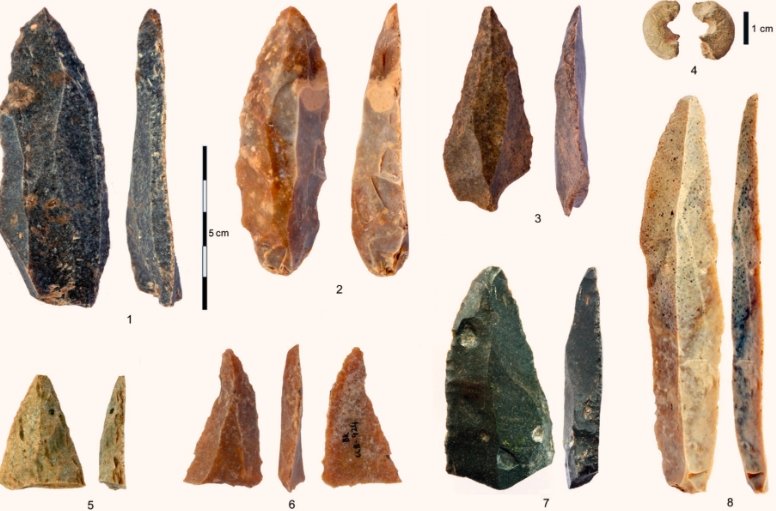
Alongside the bones, researchers also found pendants made from cave bear teeth, closely resembling those used by the last known Neanderthals of Western Europe. This resemblance suggests a cultural exchange between the two species.
“They exchanged genes but also techniques,” said Hublin. “The kind of pendants found in Bacho Kiro will later be produced by Neanderthals — indicating a much more complex interaction than simple replacement.”
In other words, the transition wasn’t a swift or violent takeover. It may have involved coexistence, contact, and even collaboration — at least for a while.
A cave rich with clues
Located near the Danube River’s southern tributaries, Bacho Kiro Cave is a treasure trove of fossil evidence from the Initial Upper Palaeolithic period. This era represents a transitional moment in European prehistory — a time when Neanderthals were fading and modern humans were beginning to settle.
What researchers found at Bacho Kiro:
-
Fragmented Homo sapiens bones (confirmed via ZooMS)
-
A modern human tooth
-
Tools made of bone and stone
-
Cave bear tooth pendants
-
Evidence of possible cultural transfer with Neanderthals
The site paints a picture of early human life filled with innovation, mobility, and interaction.
Implications for the story of human migration
This new evidence doesn’t just redraw the map of human migration — it reframes the narrative.
Until now, the dominant theory was that Homo sapiens moved into Europe rapidly, sweeping away Neanderthal populations in a relatively short period. But the Bacho Kiro discoveries hint at a more nuanced process — one that involved overlapping populations, shared technologies, and prolonged coexistence.
“Such a chronological overlap… indicates that the replacement of one species by the other was a more complex process than what has been so far envisioned,” Hublin emphasized.
More discoveries to come?
As technology continues to evolve, so too does the field of archaeology. Tools like ZooMS and advanced DNA sequencing are making it possible to extract meaning from even the smallest, most degraded specimens.
Researchers are hopeful that similar methods applied at other cave sites across Europe will further refine the timeline — and perhaps reveal even older instances of human presence.
Bacho Kiro may be the key to understanding a critical chapter in the human story — not just how we arrived in Europe, but how we lived alongside others once we did.