A sleepy Main Street found a heartbeat this Sunday — and it pulsed with color, creativity, and conversation.
As most of Grand Junction’s downtown businesses rested through the weekend lull, the Uncanny Valley Art Gallery took a different approach. It threw open its doors, set up a few tables outside, and let the artists do what they do best — create, connect, and bring the street alive.
A slow Sunday? Not if you’re near 4th and Main
Sundays aren’t exactly the busiest time for downtown Grand Junction. Most storefronts stay closed, and foot traffic thins out.
That’s exactly what pushed the team at Uncanny Valley to start something new — a live, local, low-pressure art market right on the street.
One sentence paints the picture: artists working, people chatting, the sun bouncing off canvases.
“Honestly, Sundays are just kind of a dead zone down here,” said Matt Goss, the gallery’s director. “We figured — why not make a little noise? Show that something’s happening. Give people a reason to come downtown even when it’s quiet.”
So they did. And it’s working.
Not just a gallery — a real-time art experience
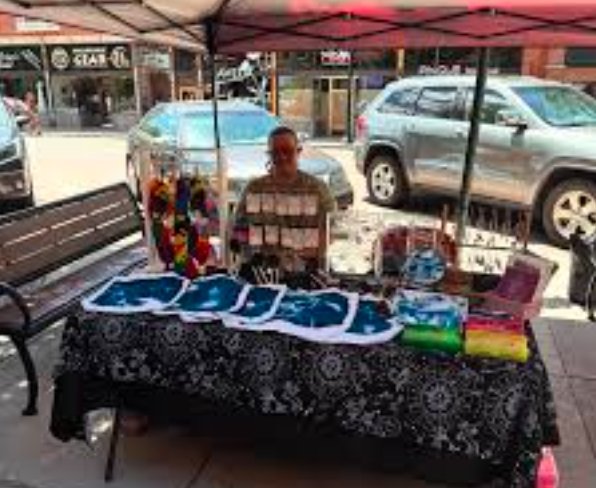
Outside the gallery this past Sunday, a handful of members from Uncanny Valley set up folding tables, easels, and little wooden crates stacked with their work. But this wasn’t just a sale — it was a demonstration.
Some sketched. Others painted. A few just talked — explaining their process, their influences, their weirdest commissions.
Goss put it best: “You actually get to meet the artists. Not in passing. Not shouting over a crowd. You stand there and you hear the story behind what they made. That matters.”
And it really did feel different from the town’s busier First Friday Art Walks. There were no food trucks. No music blasting. No shoulder-to-shoulder crowd.
Just art, artists, and a few curious strangers asking honest questions like, “Wait, how did you make this?”
The Mini Market isn’t just about art — it’s about community
Co-director Cierra Amrine sees the event as more than just a way to sell some prints or move a few paintings.
She sees it as proof that downtown Grand Junction has soul — even on a Sunday.
“One of the things we hear all the time is how quiet it is on Sundays,” Amrine said. “But having markets like this shows people that there are folks downtown who care. We’re passionate — about food, about beer, about art. We want to share that.”
This past Sunday was only the second time they’d hosted the Mini Market, and already people were asking when the next one was.
Here’s why it’s catching on:
-
You can actually talk to the artist without crowds
-
Art is being created right there in real time
-
There’s no pressure to buy — it’s chill and open
-
It fills a gap on a day that’s otherwise uneventful
“People crave connection,” Amrine added. “This gives them that.”
A personal touch makes art feel more alive
One of the quiet truths about art galleries? Sometimes, folks are too shy to walk in.
They worry they’ll be judged. That they don’t “get” art. That they’ll be pressured to buy something expensive.
The Mini Market smashes that wall down completely.
You don’t have to step into a gallery. You don’t even have to know what you’re looking at. You just walk by, see someone sketching on a canvas, and maybe — if you’re in the mood — ask what it is.
Matt Goss said those conversations are the best part.
“There was this guy,” he recalled, “he came by and said he hadn’t drawn anything in twenty years. We got to talking. Ten minutes later he’s holding a sketchbook and asking where to start again. That’s what this is about.”
A single sentence here: It’s art without the glass wall.
Plans for the future: growing the creative footprint
While this is still a small grassroots effort — no permits, no sponsors, no big marketing campaigns — the hope is to grow it.
Right now, the tables outside the gallery are mostly manned by artists who are already part of Uncanny Valley.
But that’s going to change, says Amrine.
“In the future, I’d love to invite artists from outside the gallery to participate. There are so many incredible makers in the valley — potters, weavers, sculptors, zine artists. We want this to be for everybody.”
She’s got her eyes set on expanding — more artists, more Sundays, and maybe even occasional live music or collaborative installations.
But she’s in no rush.
“This is still a baby,” she laughed. “We want it to grow naturally. Keep it meaningful.”