Grand Junction leaders are racing to protect a quiet federal lifeline that has kept radioactive waste out of backyards for decades. Without renewed funding, the Department of Energy disposal site outside the city could close by 2031, forcing residents and contractors to ship even small amounts of uranium tailings hundreds of miles at crushing cost.
The only practical place in western Colorado to get rid of this leftover Cold War poison could vanish if Congress fails to act.
A Legacy That Still Turns Up in Shovels
Most Americans have never heard of uranium mill tailings. In Grand Junction, they are part of the soil.
From the 1940s through the 1960s, the Climax Uranium Mill on the edge of town processed ore for the nation’s nuclear arsenal. The sandy waste, called tailings, was free for the taking. Builders spread it under foundations, driveways, sidewalks, and roads across the city.
By the time scientists realized the material continuously releases radon gas, thousands of properties were already contaminated.
A massive federal cleanup in the late 1980s and early 1990s removed the worst of it. But not everything. Every few months, someone digging a new basement or replacing a water line still hits the telltale yellow sand.
The Cheney Disposal Cell: Colorado’s Only Lifeline
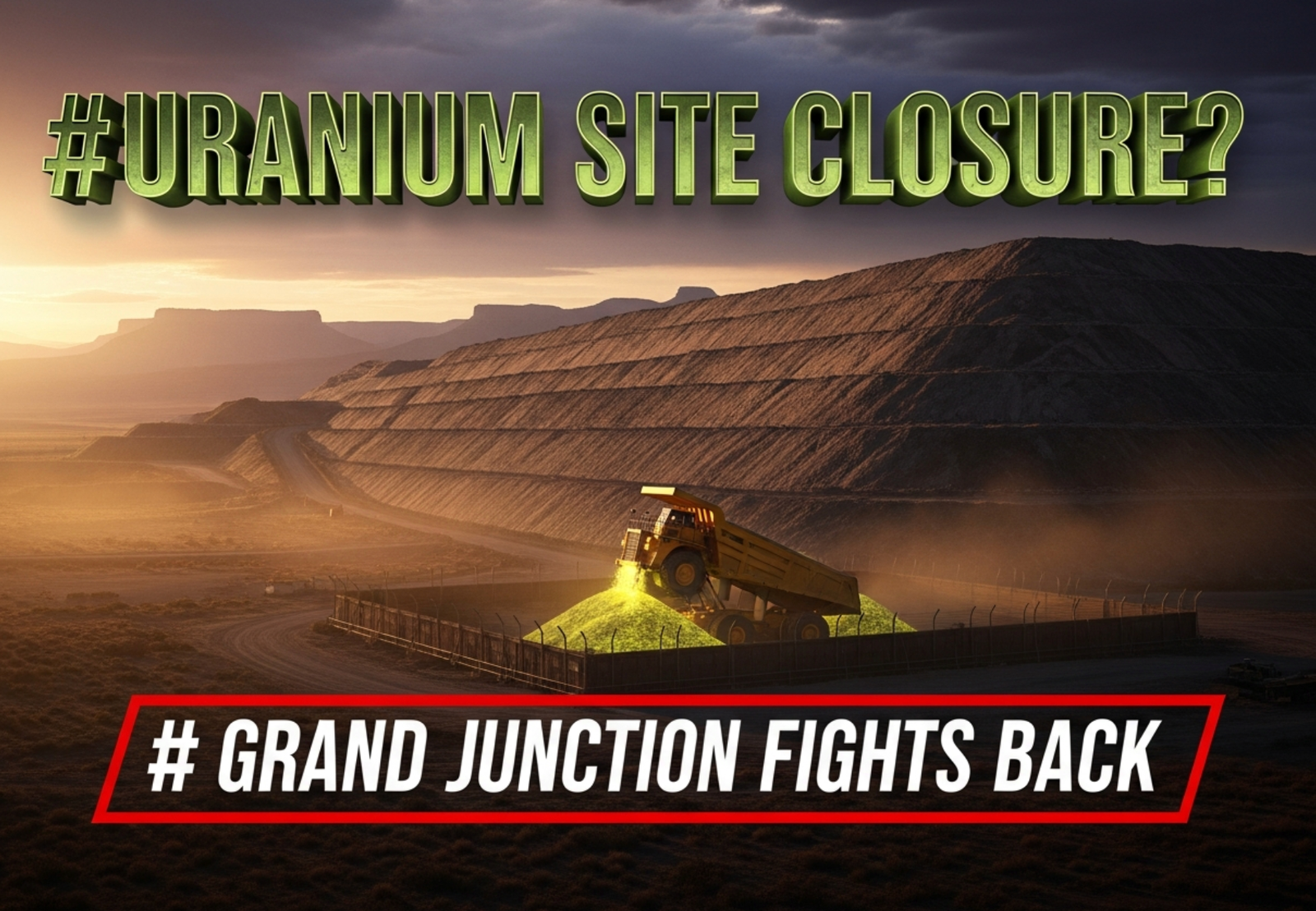
That material has to go somewhere safe. Right now, it goes eight miles south of town to the Cheney Reservoir disposal cell, run by the Department of Energy’s Office of Legacy Management.
The site is engineered to last essentially forever: tailings are buried under a thick rock-and-soil cover designed to prevent radon release and withstand floods for a thousand years.
Trent Prall, Grand Junction’s Engineering and Transportation Director, says the partnership works smoothly.
“When we find a yard or two of tailings, we load it in a city truck, drive it out to Cheney, and the DOE takes it at almost no cost to us,” Prall told reporters this week. “The state even reimburses the city for hauling.”
That simple system costs Grand Junction about $100,000 every three years.
What Happens if the Site Closes
Lose federal authorization, and every teaspoon of tailings suddenly becomes long-haul hazardous waste.
The nearest licensed alternative is the Clive facility northwest of Salt Lake City, nearly 300 miles away.
Prall crunched the numbers. Costs would jump six to eight times. A single small excavation that costs the city $2,000 today could easily hit $15,000 tomorrow.
Multiply that across dozens of projects every year, and the financial pain spreads fast: higher water and sewer rates, pricier home renovations, slower road repairs.
The Bigger Fear: Illegal Dumping
Money is not the only worry.
“When disposal gets expensive, some people start looking for shortcuts,” Prall said bluntly. “We have millions of acres of empty federal land north and south of town. It would be tragically easy for someone to back a truck up a dirt road at night and walk away.”
Illegal dumping of radioactive material is not a hypothetical. It has happened before in the West when disposal options disappeared.
City officials say proper remediation protects both public health and property values. Leaving tailings in place or hiding them on public lands keeps the risk alive for generations.
City Council Prepares Formal Plea to Congress
This week, Grand Junction city staff asked council members to pass a resolution urging Colorado’s congressional delegation to reauthorize the Cheney cell beyond 2031.
The current authorization quietly expires in seven years. DOE officials want clarity now so they can plan long-term monitoring and maintenance.
Mesa County commissioners are expected to pass a similar resolution soon. Together, the local endorsements will accompany a broader push from the Department of Energy for permanent or extended authority nationwide.
Grand Junction is not asking for new money, just permission to keep using the site that has safely contained the region’s nuclear legacy since 1995.
For a city that has spent seventy years living with the consequences of the uranium boom, the message is simple: don’t make us pay twice for the same mistake.
Residents who want to weigh in can contact Senator Michael Bennet, Senator John Hickenlooper, or Representative Lauren Boebert’s offices and ask them to support reauthorization of the Grand Junction/Cheney Reservoir uranium mill tailings disposal cell.
Because beneath the streets of this sunny Colorado town, the Cold War is still waiting to be buried properly.