
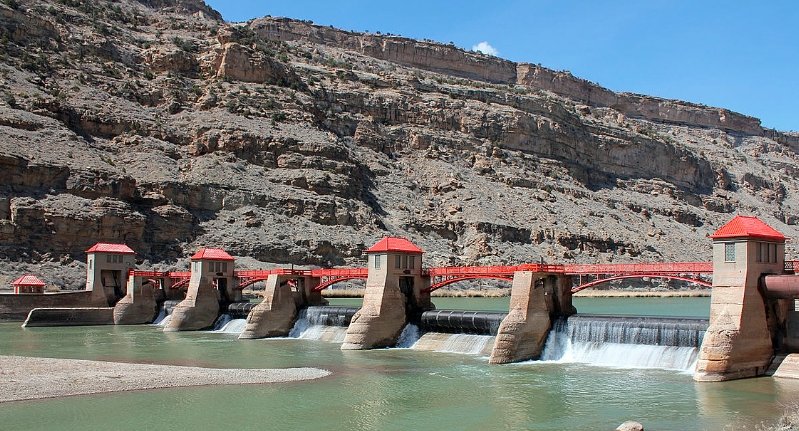
Locals gathered in Palisade this week not just to sip wine—but to honor a Colorado engineering icon that’s kept Grand Valley farms alive for more than a century.
At The Ordinary Fellow winery, the Palisade Historical Society hosted a low-key but meaningful celebration for the Grand River Diversion Dam’s 110th birthday. Attendees enjoyed historical displays, wine pours, and cake from a local bakery, all while reflecting on how the dam quietly shaped their community.
A Dam Worth Celebrating—Even if Most Don’t Think About It
The dam, built in the early 1900s and officially dedicated by Congress in 1915, doesn’t always get the recognition it deserves.
“It’s funny,” said guest speaker Tina Bergonzini, general manager of the Grand Valley Water Users Association. “A lot of people don’t really understand the significance of that dam and what it does for the Grand Valley.”
She’s right.
It’s not flashy. It doesn’t make headlines. But it’s been working nonstop for 110 years, pulling water from the Colorado River and sending it down the Government Highline Canal. That canal, in turn, feeds five others. The result? Thousands of acres of vineyards, orchards, and farms stay green.
One sentence here.
Without the dam, Grand Junction and surrounding areas would be dry, dusty, and far less fruitful.
A Toast to Water, Wine, and Old Stonework
The celebration itself was classic Palisade—charming and community-minded.
Held at The Ordinary Fellow, a winery tucked amid the town’s famous vineyards, the event blended history with hospitality. Tables were adorned with blown-up archival photos of the dam during construction, while a projector played grainy video clips of workers in wool vests and wide-brimmed hats.
Guests sipped rosé and nibbled on cake from Slice-O-Life Bakery. Bergonzini’s speech was the highlight. It wasn’t technical. It didn’t need to be. It was warm, funny, and grounded in real affection for the infrastructure most people overlook.
“This dam is part of the reason our valley looks like it does,” she told the crowd.
There were nods. Some clapped. A few even got misty-eyed.
More Than Nostalgia—The Dam Still Does the Heavy Lifting
While the event had a vintage flair, the dam’s story isn’t frozen in time.
The Grand Valley Water Users Association, which oversees its operations, continues to invest in upgrades. That includes reinforcing the structure, modernizing gates, and improving water flow efficiency.
Bergonzini emphasized that staying proactive is crucial. “You can’t just let something this important fall into disrepair,” she said. “We’ve been making the necessary updates and we’re not slowing down.”
Here’s why the dam still matters in 2025:
• It supports more than 50,000 acres of irrigated agriculture in the Grand Valley
• Local farms depend on its water for fruit production, especially peaches and wine grapes
• It reduces stress on newer water infrastructure by maintaining consistent flows
That’s a lot riding on a structure that predates World War I.
The Past and the Future Flow Together
You could feel the weight of history at the event—and not just because of the black-and-white photos.
Many of the people there had personal connections. Some were descendants of early water users. Others had worked on maintenance crews or served on the water board. For them, the dam isn’t just stone and metal—it’s legacy.
Still, the conversation wasn’t stuck in the past.
Bergonzini briefly touched on upcoming projects. Digital monitoring systems. Smarter gate controls. More collaboration with climate researchers. All aimed at keeping the dam relevant and reliable for another century.
One sentence here.
The crowd seemed reassured—not just about the dam’s future, but about the people entrusted with it.
A Quiet Workhorse in the Background of Everyday Life
Let’s be honest—most folks don’t think about where their irrigation water comes from.
And that’s kind of the point.
Infrastructure like the Grand River Diversion Dam is designed to disappear into the background. When it works well, nobody notices. But behind every peach at the farmer’s market and every glass of wine on a patio, there’s a silent partner making it all possible.
The celebration in Palisade wasn’t about grandeur. It was about gratitude. A glass raised. A photo remembered. A moment to say, “Hey, thanks for keeping things flowing.”