
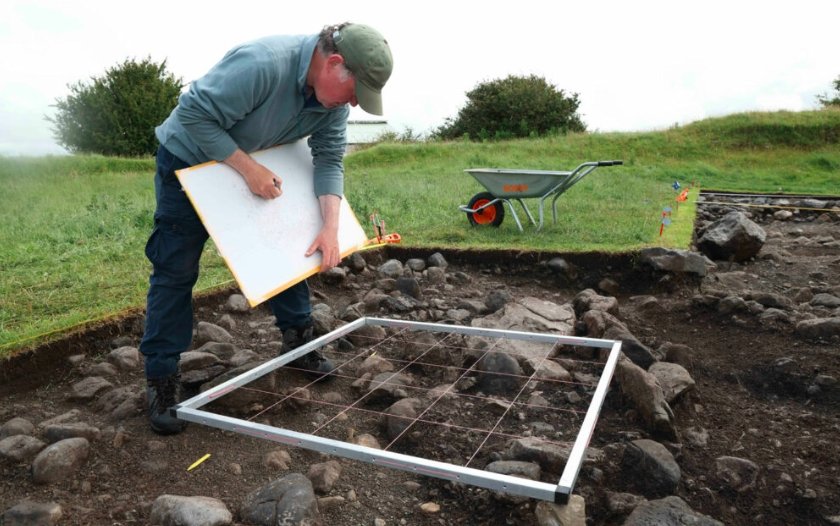
GALWAY BAY, Ireland — A windswept hillside near Galway has yielded new secrets from Ireland’s distant past — and they’re more dazzling than anyone expected. Beneath the grassy contours of the Rathgurreen Ringfort, archaeologists have uncovered layers of history that stretch from the Iron Age to the height of medieval power, painting a vibrant portrait of ancient life on Ireland’s western seaboard.
What began as a summer dig by the University of Galway has blossomed into one of the most significant discoveries in the region in decades. Over an intensive eight-week excavation, a team of students, volunteers, and seasoned professionals led by Dr. Michelle Comber and Dr. Noel McCarthy unearthed vivid clues to a forgotten age — including imported pottery, Scandinavian-style beads, and tools possibly over 2,000 years old.
A Fortress Fit for Nobility
Long suspected to be more than just a rural outpost, the Rathgurreen Ringfort is now confirmed to have once housed high-status rulers. First proposed by Professor Michael Duignan in the 1940s, the theory that the site was a noble settlement has finally been validated by the latest round of excavations.
“This was never a remote backwater,” said Dr. Comber. “This was a community deeply connected — culturally, politically, and commercially — to wider networks across Ireland, Scotland, and mainland Europe.”
Indeed, the excavation team uncovered:
-
Glass beads in blue, red, and turquoise — some dating back to the early medieval period, others possibly from the Iron Age
-
Imported pottery from northern France
-
Amber beads akin to those traded along Viking routes
-
Shells from dog-whelks, a species used to create rare purple dye, long associated with royal prestige
-
Stone and metal artifacts, including axe heads and a finely worked Iron Age knife
These discoveries suggest that the ringfort was not just reused in later centuries — it was a continuously evolving settlement, shaped by waves of elite inhabitants who layered their lives on top of earlier foundations.
Galway’s Forgotten Gateway to Europe
Far from being an isolated Celtic redoubt, the community at Rathgurreen was part of an expansive maritime web. As Comber explains, “The adjacent coast provided relatively easy access to the outside world — seaways were the motorways of their day.”
The strategic location would have allowed the inhabitants to move goods, ideas, and people across the Irish Sea and beyond. This is further underscored by the presence of foreign pottery and Scandinavian-style amber, aligning Galway’s story with wider European narratives of trade and migration.
The site’s location in Maree, a place steeped in Irish legend, only deepens its mystique. The name appears in early Irish sagas and is linked to heroic figures, suggesting the area has long held symbolic as well as strategic importance.
Layers of Continuity — From Ancestors to Empire
What makes Rathgurreen particularly compelling is its sense of temporal depth. The team found evidence not only of a vibrant medieval fortress but also of older, possibly Iron Age structures beneath.
“We’re seeing continuity and change over centuries,” Comber said. “It’s likely that later settlers intentionally chose to build on the past, connecting themselves symbolically and literally to their ancestors.”
This practice — known as “ancestor veneration” in archaeology — may have conferred legitimacy and status, linking new leaders to powerful mythologies and longstanding cultural memory.
Looking Ahead: More Digs, More Discoveries
With the summer excavation now complete, plans are already in motion to return to Rathgurreen in 2026. The team hopes to expand their work to neighboring sites and continue unraveling Galway’s forgotten chapters.
The implications go far beyond the dig site. As Comber notes, “People often think of western Ireland as remote, but Maree’s ancient remains tell a different story. This was a place of innovation, influence, and international ties.”
And with every bead, pot shard, and shell unearthed, that story is becoming clearer.
🏺 Artifact Highlights from Rathgurreen Ringfort
| Artifact Type | Likely Origin/Era | Notes |
|---|---|---|
| Glass beads | Early Medieval / Iron Age | Imported styles in red, turquoise, and blue |
| Amber beads | Viking trade routes | Scandinavian resemblance |
| Pottery fragments | Northern France | Traded ceramics, possibly luxury items |
| Iron Age knife | Indigenous | Well-preserved, finely crafted |
| Dog-whelk shells | Local, used in dyeing | Used to produce Tyrian purple, reserved for elites |