
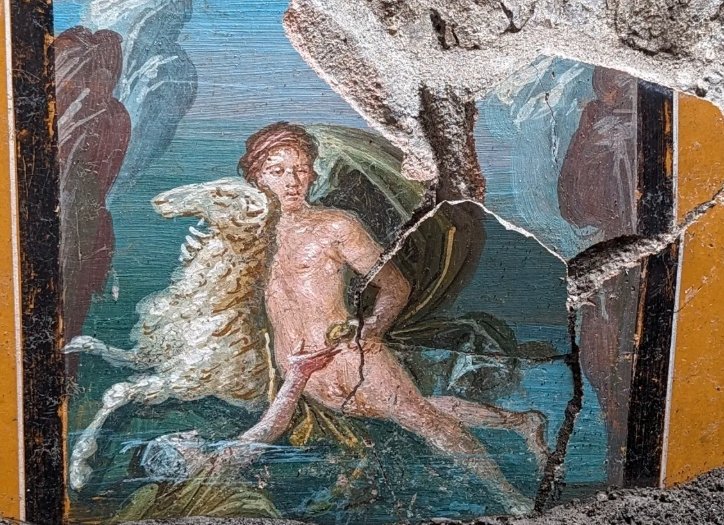
Archaeologists in Pompeii have uncovered a remarkable ancient Roman erotic fresco painting that brings the Greek myth of Leda and the Swan to life. This vibrant artwork, found in a bedroom destroyed by the eruption of Mount Vesuvius nearly 2,000 years ago, reveals unique details that highlight the site’s ongoing revelations.
The discovery happened during a restoration project in the upscale neighborhood of Via del Vesuvius. Experts note that while erotic art is common in Pompeii, this piece stands out for its preservation and artistic flair.
The Thrilling Discovery in Ancient Ruins
Workers stumbled upon the fresco while stabilizing excavation fronts in Regio V. The painting measures about 13 by 18 inches and shows Leda seated on a chair, draped in a golden cloak, with the swan nestled in her lap.
This find adds to Pompeii’s rich collection of mythological scenes. The site’s director praised the artwork for its pronounced sensuality, noting how Leda appears to welcome the swan with a direct gaze that follows the viewer.
The bedroom where it was located suggests it was part of a private home. Recent efforts have focused on protecting such fragile pieces from further damage.
Experts believe the fresco dates back to before the 79 AD eruption. Its survival under layers of ash speaks to the sudden burial that preserved so much of the city.
Unpacking the Myth of Leda and the Swan
The artwork draws from a classic Greek tale where Zeus, the king of gods, disguises himself as a swan to seduce Leda, the queen of Sparta and wife of King Tyndareus. This encounter led to the birth of legendary figures who shaped ancient stories.
Leda’s union with the swan produced an egg containing Helen of Troy and Pollux. She also bore Castor and Clytemnestra with her husband, tying into epics like the Trojan War.
Artists across history have captured this myth, from Renaissance masters like Leonardo da Vinci to poets such as William Butler Yeats. In Pompeii, it reflects how Romans blended Greek lore with their daily lives.
What makes this version special is Leda’s seated pose and inviting expression. Unlike many depictions where she stands, this one emphasizes intimacy and consent in the narrative.
The myth’s themes of desire and divine intervention resonated in Roman culture. It appeared in homes, baths, and public spaces, showing how erotic elements wove into everyday decor.
- Key figures from the myth:
- Leda: Spartan queen and mother of famous offspring.
- Zeus (Jupiter in Roman lore): God who transforms into a swan.
- Helen: Daughter whose beauty sparked the Trojan War.
- Pollux: Twin brother, one of the Dioscuri.
- Castor and Clytemnestra: Children from Leda’s mortal marriage.
Why This Fresco Stands Out in Pompeii’s Art Scene
Pompeii brims with erotic frescoes, but this one’s condition is exceptional. The colors remain vivid reds, golds, and blues, untouched by time thanks to the volcanic ash seal.
Scholars suggest the home’s owner was a wealthy merchant, perhaps a freed slave eager to display cultural sophistication. Such displays helped elevate social status in ancient Roman society.
Compared to other finds, like a nearby Priapus fresco weighing his phallus on scales, this piece is more refined. It was unveiled in a domus, or upper-class townhouse, highlighting private indulgence.
Restoration work ensures public viewing soon. A protective roof and acrylic glass will shield it from elements, allowing visitors to appreciate its details up close.
This discovery ties into broader trends in Pompeii archaeology. In 2025 alone, teams have unearthed large-scale frescoes in Regio IX and life-size sculptures, rewriting our understanding of daily life.
| Pompeii Fresco Discoveries | Year Found | Location | Description |
|---|---|---|---|
| Leda and the Swan | 2025 | Regio V, Via del Vesuvius | Erotic scene of myth with seated Leda and swan |
| Priapus with Scales | 2018 | Nearby bedroom | Fertility god in humorous pose |
| Narcissus Reflection | 2019 | Atrium of same house | Myth of self-admiration in pond |
| Large-Scale Scenes | 2025 | Regio IX | Life-size paintings of rituals and daily activities |
| Erotic Medallions | 2024 | Ceremonial chariot outside city | Satyrs and nymphs in intimate acts |
Broader Impact on Archaeology and Culture Today
These finds remind us of Pompeii’s role as a time capsule. The 79 AD eruption froze a bustling Roman city, offering glimpses into art, myths, and social norms.
In modern times, such artifacts spark debates on ancient sexuality. While some view them as celebratory, others note power dynamics in myths like this one.
Tourism surges with each reveal, drawing millions to the site yearly. Experts urge careful preservation amid climate challenges and visitor crowds.
Linking to recent events, a 2025 exhibition on Pompeii’s erotic art features similar pieces, educating on how sensuality shaped Roman homes. This includes reassembled ceilings and walls from various villas.
The fresco also inspires contemporary artists and writers. Its sensuality echoes in today’s discussions on mythology in pop culture, from films to literature.
Overall, this uncover deepens our grasp of how ancients expressed desire through high art. It solves puzzles about elite lifestyles and fuels ongoing excavations.
Pompeii’s Ongoing Excavations and Future Prospects
Efforts in 2025 have accelerated, with EU-funded projects targeting unexcavated areas. Regio IX yields have included ritual frescoes and charcoal graffiti that hint at pre-eruption history.
Archaeologists use advanced tech like ground-penetrating radar to map sites safely. This helps avoid collapses, a risk after recent rain damage.
The Leda fresco’s home may hold more secrets. Nearby rooms show marble-like walls and portrait medallions, suggesting a cultured inhabitant.
Public access improves with apps and guides for families. These tools make complex myths accessible, turning history into engaging stories.
As digs continue, expect more revelations. Pompeii’s 21.8-hectare site still hides much, promising endless wonders for years ahead.
What do you think of this ancient artwork? Share your thoughts in the comments below and spread the word on social media to keep the conversation going about Pompeii’s treasures.