
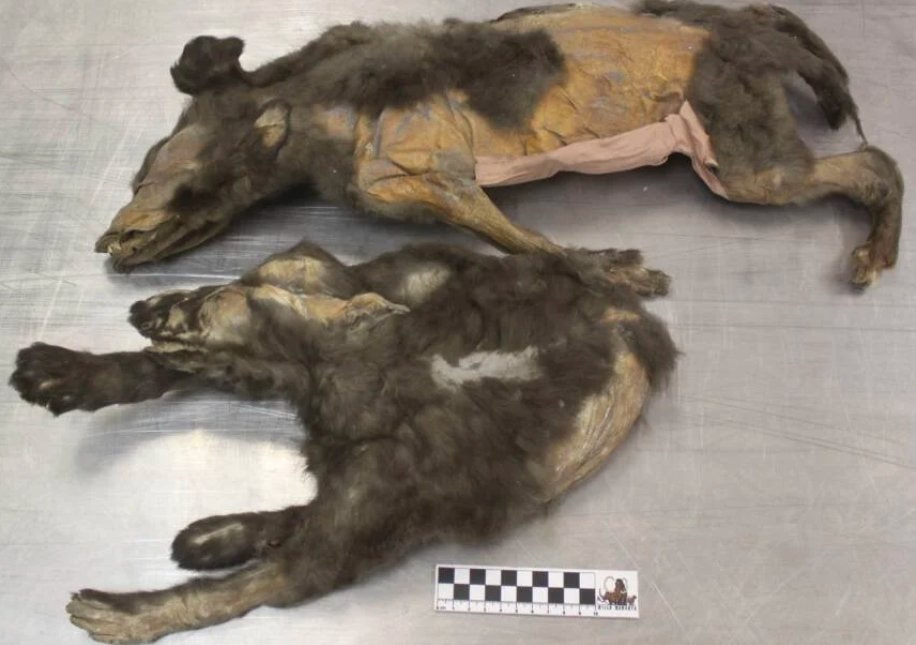
Two ancient wolf pups frozen in time under the Siberian permafrost are finally telling their story — one buried for millennia beneath ice, now uncovered by science and curiosity. Their last meals? Woolly rhino and a tiny wagtail bird. Their fate? Still a mystery.
A Sisterly Secret Hidden in Ice for 14,000 Years
The discovery didn’t happen yesterday. In fact, the first of the cubs was found in Tumat, Siberia, way back in 2011. The second turned up in 2015 — just 15 meters away.
At first, researchers weren’t even sure what they were looking at. Dog? Wolf? Something in between?
But now, more than a decade later, fresh research published by Cambridge University Press has confirmed it: these pups were wolves, not domesticated dogs, and they were sisters — possibly even littermates. Both were around eight weeks old when they died.
And they’re perfectly preserved — fur, flesh, even the contents of their stomachs still intact after more than 14,000 years locked in frozen soil.
One sentence here: It’s as if they laid down yesterday — and never woke up.
Their Last Meal: Woolly Rhino and Wagtail Bird
Scientists studying the pups didn’t just stop at DNA. They looked inside. What they found? A Paleolithic feast.
One pup’s stomach contents included:
-
Woolly rhinoceros meat — from a species that went extinct nearly 10,000 years ago
-
Remnants of a wagtail bird — a small, delicate creature still fluttering across Eurasia today
This diet confirms something big. These pups weren’t scavenging off human scraps. They were part of a wild ecosystem teeming with Ice Age giants.
It also suggests they may have shared meals with their pack — possibly dragged back to the den after a hunt, or perhaps fed by adults.
And it’s this natural diet, rather than grain or human-provided food, that tipped scientists off: they weren’t domesticated.
Still a Mystery: How Did They Die?
Even with all this information, one question remains stubbornly unanswered.
How did they die?
No trauma. No sign of violence. No hint of illness.
One theory holds that the den they lived in collapsed — possibly due to melting permafrost or shifting earth. The puppies may have been trapped, their bodies shielded from decay by the freezing temperatures almost immediately.
Sergey Fedorov of the Mammoth Museum at North-Eastern Federal University, who led the excavation, believes this scenario is “entirely plausible.”
“We see this kind of collapse in fox dens even today,” he noted. “It can happen suddenly. And for young animals, there’s no escape.”
Another possibility: they died in their sleep due to environmental exposure, then were frozen rapidly — a perfect preservation event.
Why It Matters: More Than Just Cute Fossils
This isn’t just a story about two baby wolves. These pups help fill a major gap in the evolutionary timeline of canines.
Until recently, much of what we knew about prehistoric wolves came from bone fragments or artistic depictions. But with these pups, scientists have access to:
-
Muscle tissue
-
Stomach content
-
Intact fur and whiskers
-
DNA from brain, skin, and liver
And they’re using it to compare with both modern wolves and domestic dogs. The goal? To understand how dogs diverged from wolves — and what that relationship looked like 14,000 years ago.
Also, their preservation allows researchers to study ancient viruses and bacteria frozen in the pups — a side benefit in understanding how prehistoric animals coped with pathogens.
A Snapshot of Siberia’s Ice Age Ecosystem
The world these pups lived in was wild, cold, and dangerous — but also astonishingly diverse.
Here’s a glimpse at what roamed northern Siberia when they were alive:
| Ice Age Species (Circa 14,000 B.C.) | Status Today |
|---|---|
| Woolly Mammoth | Extinct |
| Woolly Rhinoceros | Extinct |
| Saber-Toothed Cats | Extinct |
| Bison and Musk Oxen | Survive in fragments |
| Wolves | Still roaming, evolved |
| Wagtail Birds | Still common across Asia |
So those little pups, whose soft snouts now rest in museum freezers, once opened their eyes in a world that no longer exists.
Now, they’re teaching us how it worked — one frozen rib bone and tuft of fur at a time.