
A trove of silver artifacts — possibly hidden during a moment of panic or offered to ancient gods — has just been pulled from the earth near Germany’s Schlei River. And it wasn’t a professional archaeologist who found it. It was a guy with a metal detector.
Found by Chance, Preserved for a Millennium
Arjen Spießwinkel isn’t new to this. As a member of a trained volunteer metal detecting group in Schleswig-Holstein, he’s made plenty of finds before. But this one? This one was special.
While scanning near the banks of the Schlei River, close to the Viking stronghold of Haithabu, Spießwinkel’s detector started beeping like mad. Beneath the soil was something unexpected: silver glinting through time — over 200 Viking-age objects, all dating back to the 10th century.
He did the right thing — called it in. Soon, a team from the Schleswig-Holstein State Archaeological Office (ALSH) was on site, unearthing what may be one of the most significant Viking hoards found in northern Germany in recent years.
One sentence here: What began as a hobbyist’s walk in the mud turned into a peek into the past.
What Did They Find in the Hoard?
Archaeologists quickly realised this wasn’t just a random scattering of lost trinkets. It was a deliberate stash.
Here’s what they pulled from the earth:
-
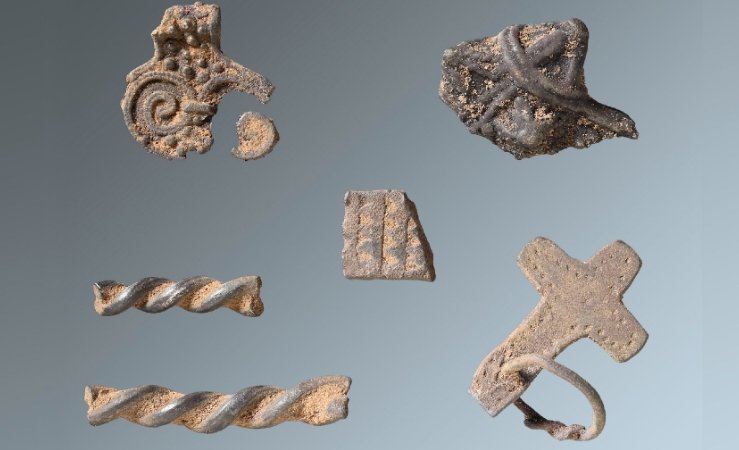
Silver jewelry including twisted wire arm bands and rings
-
Hacksilver — chunks of silver intentionally cut up for trade
-
Arab dirhams — silver coins from as far as Central Asia
-
Pieces of ingots likely used for trade or crafting
-
A whetstone, probably for sharpening blades
-
A ceramic shard, possibly from a local settlement
-
And most curiously, a small pendant — either an early Christian cross or an unfinished Thor’s hammer
The mix is wild. Islamic coins, Norse symbols, utilitarian tools. It paints a picture of a world where cultures collided, blended, and bartered along ancient trade routes.
Why Was It Buried?
That’s the million-euro question.
Spießwinkel found the hoard right at the river’s edge — a location that raises eyebrows.
“Why here?” asked ALSH spokesperson Birte Anspach. “Was the owner on the run? Did they bury it as an offering? Or was it simply a safe spot in troubled times?”
The truth is, we may never know.
But we can guess. The 10th century wasn’t exactly chill in northern Europe. Viking society was undergoing big changes. Some were converting to Christianity. Some were clashing with invading forces. And raids — even among rival Viking clans — were common.
So this hoard? It could’ve been:
-
A stash buried in haste before fleeing a raid
-
A ritual offering to the gods for safe passage
-
A merchant’s hidden cache lost to time
We’ll probably never get the full story.
The Pendant That Could Tell Us Everything
Among all the items, one tiny pendant has caught the most attention.
It’s got a strange shape — halfway between a Christian cross and Mjölnir, the hammer of Thor.
Was it meant to represent both? Was it left unfinished? Or was it worn by someone straddling two worlds — one foot in Norse paganism, the other in rising Christianity?
This pendant could symbolize a transitional moment in belief, showing how 10th-century Vikings wrestled with new gods while still honoring the old.
Hints of a Hidden Settlement?
The inclusion of a ceramic shard and a whetstone adds a twist to the story.
These aren’t the kinds of things typically buried with treasure. Instead, they point to something else — daily life.
ALSH experts believe the hoard’s location might sit near a yet-undiscovered settlement, possibly a seasonal Viking camp or trading post.
That could mean this riverbank wasn’t just the site of a burial — it might have been a lively hub for trade, travel, and contact with distant lands.
| Key Items Found in the Schlei River Hoard | Possible Significance |
|---|---|
| Hacksilver and ingots | Trade currency |
| Arab dirhams (silver coins) | Far-reaching trade |
| Jewelry and rings | Wealth display |
| Pendant (cross or hammer) | Religious fusion |
| Whetstone and ceramic | Settlement clues |
Local Legends Meet Real History
The area around Haithabu — also known as Hedeby — has long been known for Viking activity. Once a powerful trading hub, it connected Scandinavia with Europe and beyond.
This hoard adds another layer to that history — a personal one.
Somewhere, sometime in the 900s, a person buried this treasure. Maybe they meant to come back. Maybe they didn’t. But they left behind a story written in silver, silently waiting to be found.
And now, after a thousand years, we’re listening.