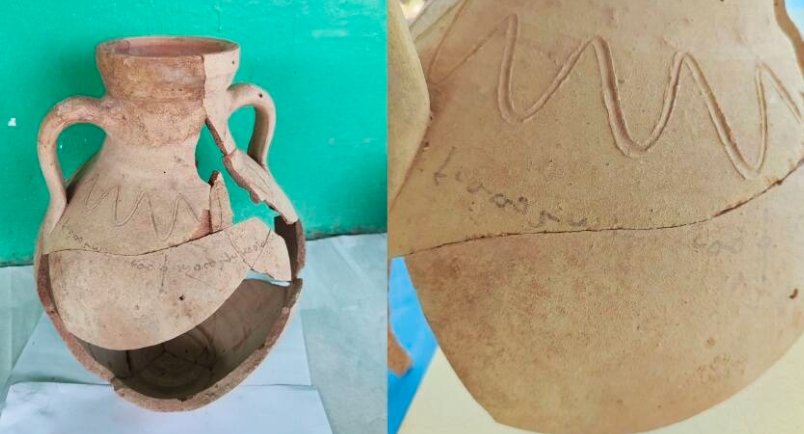
In a remarkable peek into everyday life nearly two millennia ago, archaeologists in Tajikistan have uncovered a clay water jug inscribed with its owner’s name — a simple message that’s speaking volumes to historians today. The find, made at the Khalkhajar site near Sarband, connects us to a woman named Sagkina, whose name has survived 2,000 years etched in clay.
A Personal Message From the Past
It’s not every day you hear the voice of an ancient world whispering so directly. The jug, a “rare two-handled” type from the Kushan Empire era, was pieced back together by experts from the National Museum of Tajikistan after being found in fragments.
One line: Turns out, ancient folks had name tags too — just in clay instead of plastic.
The inscription in ancient Bactrian reads: “This water jug belongs to the woman Sagkina.” A short sentence, yet historians say it’s priceless for what it reveals about literacy, everyday life, and even gender roles under the Kushans.
The Kushan Empire’s Everyday Artifacts
The Kushan Empire ruled vast swaths of Central Asia from around 30 to 375 C.E., and the Khalkhajar site has been a goldmine for glimpses into that era. Alongside Sagkina’s jug, archaeologists have uncovered:
• Clay and brick walls of ancient dwellings
• Household pottery fragments
• Tools and coins pointing to trade networks
Each piece adds another layer to the story of a culture that mixed Greek, Persian, and local traditions into something uniquely Central Asian.
Why This Little Jug Matters So Much
So why is this tiny clay vessel making headlines? For starters, inscribed everyday objects from that period are rare. And the fact that Sagkina’s name is written so plainly suggests that writing was used by ordinary people — not just kings and priests.
One short line: It’s like finding a 2,000-year-old Post-it note.
Experts say the name Sagkina shows how women were identified then — a clue about naming conventions and possible family structures. It also hints at a society where women could own household goods in their own right.
What the Bactrian Inscription Tells Us
Deciphering the faded script was no easy feat. Written in ancient Bactrian, the phrase is a small but mighty example of how languages evolve and endure.
A local linguist explained, “Every letter on that jug is like a fossil — it preserves the sound of a world that’s long gone.” The text reads: “eiado gō(l)z[o ]sido finzo sagkino ol(o) mo(.)”, which experts translated to the simple but powerful “This water jug belongs to the woman Sagkina.”
One-sentence paragraph: A name scratched in clay — and suddenly, we’re not so different from them.
More to Come From Khalkhajar
The Khalkhajar site, near the village of Sarband, keeps turning up surprises. In addition to household goods, archaeologists have unearthed traces of ancient settlement structures, including:
| Find | What It Tells Us |
|---|---|
| Clay & brick walls | Clues about domestic life and building styles |
| Coins | Evidence of trade routes and economic ties |
| Pottery | Daily household activities, food storage, water transport |
Local historians believe the settlement was likely an important stop along the Kushan trade network — connecting Central Asia with the Silk Road routes that reached far-off cities.
A Tangible Connection to Sagkina
While Sagkina herself is long gone, her jug now sits safely in the National Museum of Tajikistan. Conservators are keeping a close eye on it — it survived centuries underground, but its inscription could fade without proper care.
A museum curator summed it up: “It’s humbling to hold an object like this. It belonged to an ordinary woman, not royalty, but it tells us so much more than any golden crown.”
And maybe that’s what makes this little jug so captivating. It’s a reminder that the past isn’t just grand battles and mighty kings. Sometimes it’s one woman’s water jug — inscribed so no one would mistake it for their own.