
Toucan Beak, Macaw Feathers Among Rare Grave Goods from Caral Civilization
In a groundbreaking discovery at the coastal ruins of Áspero in Peru, archaeologists have unearthed the 5,000-year-old grave of a high-status woman from the ancient Caral civilization—one of the oldest complex societies in the Americas. What makes the find even more extraordinary is the exceptional preservation of her remains and the exotic nature of the artifacts buried alongside her.
Unveiling a Lost Legacy: The Caral Woman
The woman’s burial site was found within a public ceremonial structure known as Huaca de los Ídolos, nestled in the Áspero archaeological complex. The Caral civilization, which flourished between 3000 and 1800 B.C.E., is known for its sophisticated architecture, social stratification, and early development of agriculture and urban planning in the Americas.
The woman, estimated to have been between 20 and 35 years old at the time of her death, was found wrapped in layers of cotton fabric, reed mats, and netting. A headdress made of natural fibers adorned her head. But what stunned archaeologists most was the condition of the body: she still had intact skin, fingernails, and hair, a rarity for remains dating back five millennia.
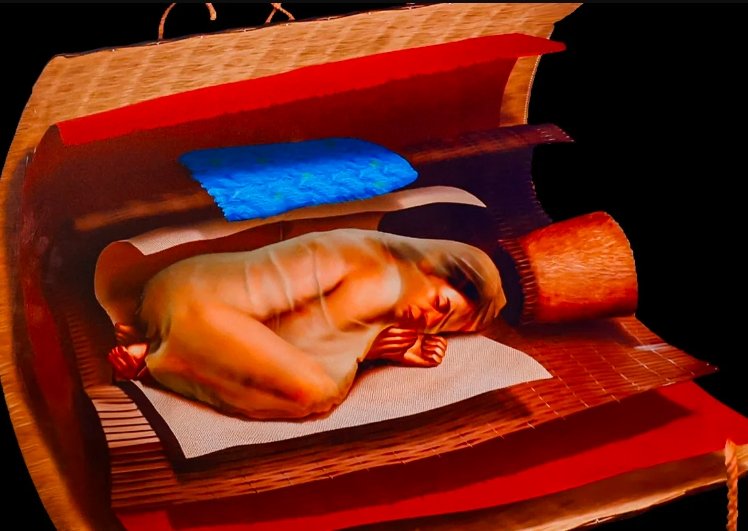
A Burial Rich in Symbolism and Status
Accompanying the body was a remarkable assemblage of grave goods that signaled her elevated status:
-
A toucan’s beak inlaid with green and brown beads
-
A panel decorated with macaw feathers, suggesting connections to the Amazon basin
-
An Amazonian snail shell, a non-local item that likely symbolized trade or cultural exchange
-
Intricately woven textiles and ceremonial items
Such items, sourced from distant rainforest regions, suggest the Caral people engaged in far-reaching exchange networks across ecological zones. These artifacts were not merely decorative—they likely held deep ritual or symbolic meaning, perhaps related to status, identity, or spiritual roles within the society.
Ancient Lives, Modern Questions
This discovery opens a rare window into the role of women in early Andean civilizations. While most previous elite burials in Caral have been male, this find challenges long-standing assumptions about gender roles in early complex societies. It also raises new questions:
-
Was she a priestess, healer, or community leader?
-
What spiritual or ceremonial role did the toucan beak and feathered panel play?
-
How did her society view death, the afterlife, and the importance of burial practices?
Peru’s Ministry of Culture has confirmed that a multidisciplinary team is now conducting detailed analyses of the remains. Experts will investigate her cause of death, dietary habits, general health, and the materials used in her burial. Genetic testing and isotopic analysis may also provide insight into her origins and mobility.
Áspero and the Caral Civilization
Áspero, located along Peru’s central coast, was a vital fishing town within the Caral civilization. It functioned as part of a broader urban network that included inland cities like Caral itself—home to some of the oldest pyramids in the Americas.
This discovery reinforces Caral’s status as a cradle of Andean civilization. Although often overshadowed by later cultures such as the Inca, Caral was already thriving over 1,000 years before the Egyptian pyramids were built.
A Rare and Remarkable Preservation
Mummification was not common in Caral, making this natural preservation particularly significant. Most remains from this era in coastal Peru consist only of bones, eroded by the arid climate and centuries of exposure. In contrast, the preservation of this woman’s skin and soft tissue offers a unique scientific opportunity.
It could allow researchers to analyze:
-
Tattooing or body art practices
-
Disease markers such as lesions or infections
-
Diet and chemical exposure through skin and hair samples
This level of preservation could dramatically expand what archaeologists understand about the lived experiences of individuals in early Andean societies.