
Scientists exploring the rainforest canopy in northern Queensland have uncovered a giant stick insect that weighs nearly as much as a golf ball — and no one knew it even existed until now.
In a country already known for its monstrous spiders and terrifying critters, this newly discovered bug has taken entomologists by surprise. Not because it’s the longest. But because it’s so heavy, it’s in a league of its own.
Big Bug in a Hidden Habitat
The insect, now named Acrophylla alta, was found lurking in the cool, misty treetops of a high-altitude rainforest. It’s over 15 inches long — about the size of a subway sandwich — but what really shocked researchers was its weight.
“This thing is dense,” said Professor Angus Emmott from James Cook University, one of the lead scientists behind the discovery. “We’ve got stick insects that are longer, but none that are this heavy. From what we know so far, this is the heaviest insect in Australia.”
Found in a remote region of northern Queensland, the species had gone undetected for centuries, tucked away in the kind of place where humans rarely venture.
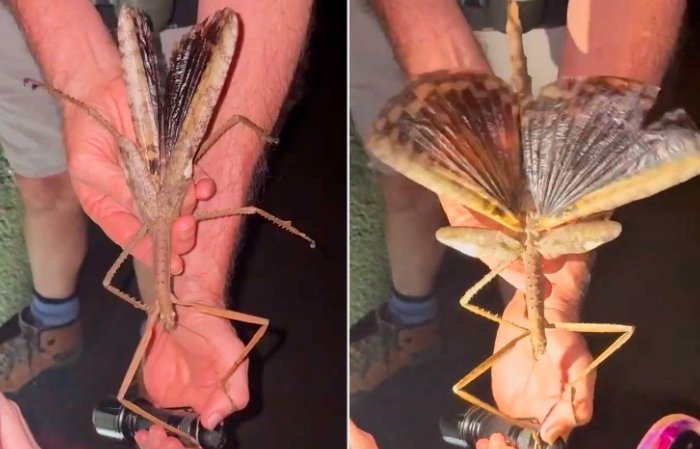
Not Just Long — This Insect Is Built Like a Tank
At first glance, Acrophylla alta might look like any other stick insect — twiggy, camouflaged, and slow-moving. But it’s got a surprising bulk to it. Weighing nearly the same as a regulation golf ball (which is about 45 grams), it’s essentially a tank in disguise.
Ross Coupland, a wildlife expert who co-authored the peer-reviewed study in Zootaxa, said the insect’s stocky build is likely tied to its chilly habitat.
“This is a cool, wet place,” Coupland explained. “Big-bodied animals tend to do better in colder environments. The extra mass helps them retain heat — it’s an evolutionary advantage.”
So while Acrophylla alta isn’t the longest stick insect in Australia — that title still goes to Ctenomorpha gargantua — it takes the crown for sheer mass.
What’s with All the Huge Insects in Australia?
If you’re thinking, “Why is it always Australia?” — you’re not alone. The continent has a reputation for producing bizarrely large creatures, and insects are no exception.
There’s the Goliath stick insect, the Lord Howe Island phasmid, and of course, the infamous “bird-eating spider” — a tarantula so big it can kill small animals.
And now:
-
Acrophylla alta, 15+ inches long
-
Denser than any other native insect
-
Found in high-altitude, low-traffic rainforest
According to evolutionary biologists, Australia’s long isolation from the rest of the world — along with its diverse microclimates — has led to a kind of “megafauna effect” in bugs.
“Insects get bigger when they can,” said Emmott. “And in a place like this rainforest, there’s little competition, few predators, and stable conditions over millions of years.”
Just How Rare Is This Thing?
The team’s discovery isn’t just a fluke. It points to a broader mystery: how many other massive insects might be hiding in these high canopies?
So far, only a handful of Acrophylla alta specimens have been recorded. And that’s after months of painstaking observation.
Here’s how rare it is compared to similar species:
| Insect Species | Max Length (inches) | Average Weight (grams) | Habitat |
|---|---|---|---|
| Acrophylla alta | 15+ | ~45 (estimated) | Northern Queensland Rainforest |
| Ctenomorpha gargantua | 22 | ~20 | Northeastern Australia |
| Eurycnema goliath | 10 | ~30 | Subtropical Australia |
This new insect isn’t breaking records in length, but its mass makes it stand out in Australia’s creepy crawly hall of fame.
Researchers Are Still Piecing Together Its Life
Despite the buzz around its size, much of Acrophylla alta‘s life cycle remains unknown.
“We’re not even sure what they eat yet,” Coupland admitted.
What they do know is that:
-
It’s a master of disguise, blending seamlessly with tree branches
-
It likely feeds on native eucalyptus and acacia leaves
-
Females appear to be significantly heavier than males
-
Eggs are large and heavy compared to other stick insects
And here’s a kicker: They’re so well camouflaged that even trained biologists often miss them, even when standing just inches away.
Conservation and Curiosity Collide
The discovery has sparked interest beyond the academic world. Conservationists are now worried that Acrophylla alta might already be under threat from climate change, habitat loss, or even invasive predators.
Northern Queensland’s rainforests are already shrinking due to agricultural expansion and extreme weather events. For an insect that may take years to mature and reproduce, any environmental disturbance could be devastating.
Still, there’s hope that the media attention will help push for better protection of the area.
“There’s so much we don’t know about these forests,” said Emmott. “And they’re shrinking faster than we can study them.”