DENVER — A pigment more durable than time itself, Maya blue has captivated archaeologists and chemists alike for nearly a century. Now, nearly 100 years after its modern rediscovery, researchers believe they’ve fully unlocked the ancient Mesoamerican formula that gave Maya murals, pottery, and ritual artifacts their signature sky-blue hue.
At the Society for American Archaeology’s 2025 annual meeting in Denver, cultural anthropologist Dean Arnold announced a new method for recreating the pigment — adding a crucial piece to the puzzle he began solving nearly two decades ago. The formula, long a mystery, now reveals not just a chemical process but a window into sacred rituals, trade practices, and technological sophistication of the pre-Columbian Maya.
“This pigment is more than a color — it’s a cultural artifact,” said Arnold, whose new book Maya Blue details the multi-decade research effort. “Its resilience is astonishing. After 2,000 years, it hasn’t faded, even in the tropical heat and humidity of Mexico.”
A Color That Defied Time — And Science
First identified on artifacts at Chichén Itzá in 1931, Maya blue’s chemical resilience has made it a holy grail for both chemists and art historians. For decades, researchers knew what it was made from — the plant-based indigo dye and the clay mineral palygorskite — but couldn’t replicate its fabled durability.
In 2008, Arnold’s team revealed that the secret ingredient was copal, a sacred tree resin burned in Maya ceremonies. Heated with indigo and palygorskite over an open fire, this blend produced the pigment’s molecular bond — effectively baking the indigo into the clay matrix, making it chemically resistant to water, sunlight, and oxidation.
At the 2025 conference, Arnold unveiled a second method for producing Maya blue, based on fieldwork and ethnographic analysis. While details remain limited pending peer-reviewed publication, he indicated the discovery could point to regional variations in Maya pigment production and possibly even a broader network of sacred knowledge passed across generations.
Sacred Symbolism and Grisly Rituals
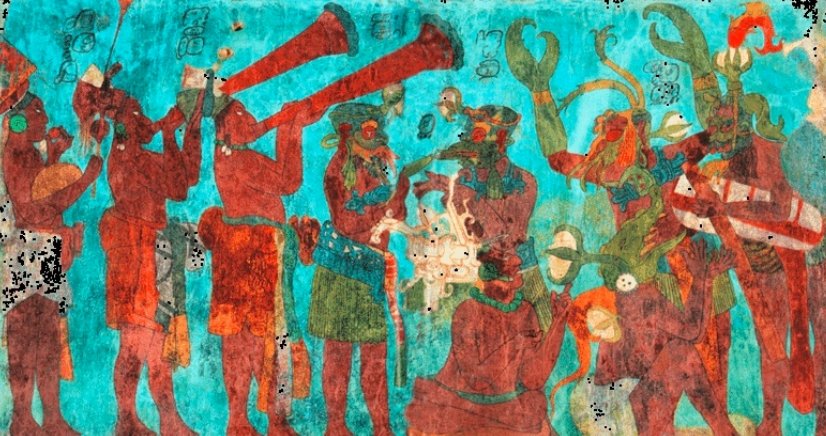
Unlike many ancient pigments used for decoration alone, Maya blue carried deep religious meaning. It was closely tied to Chaak, the rain god — and, in certain rites, the god of human sacrifice.
Ceremonial victims were often painted entirely in Maya blue before being offered to Chaak, especially during times of drought. The pigment thus served not only aesthetic purposes but also symbolized fertility, rainfall, and divine connection — an essential thread in the agricultural cycles of ancient Mesoamerica.
The pigment’s composition — natural, sacred, and locally sourced — mirrors the Maya worldview, in which cosmic balance was achieved through material offerings rooted in the earth and environment.
A Rare Technological Edge
The discovery places Maya chemical knowledge in rare company. Only a few ancient civilizations — including the Egyptians with their iconic blue frit and the Phoenicians with Tyrian purple — managed to produce colors that endured for millennia.
But Maya blue stands out for its combination of durability, vividness, and spiritual utility. Unlike Tyrian purple, which was extracted from sea snails and used primarily by royalty, Maya blue was democratized across ceramics, murals, and religious tools, albeit with sacred significance.
Researchers say the newly identified second method may reveal variations in production based on geography or purpose — whether for wall paintings, ritual adornment, or offerings.
“This isn’t just a technological breakthrough,” said one conference attendee. “It’s a cultural one. We’re beginning to see just how sophisticated and spiritually integrated Maya science was.”