
LEUVEN, Belgium — A rare and remarkably intact Roman wooden water pipe has been unearthed beneath a city street in Leuven, shaking assumptions about the scale and sophistication of Roman infrastructure in what was once considered a minor outpost of the empire.
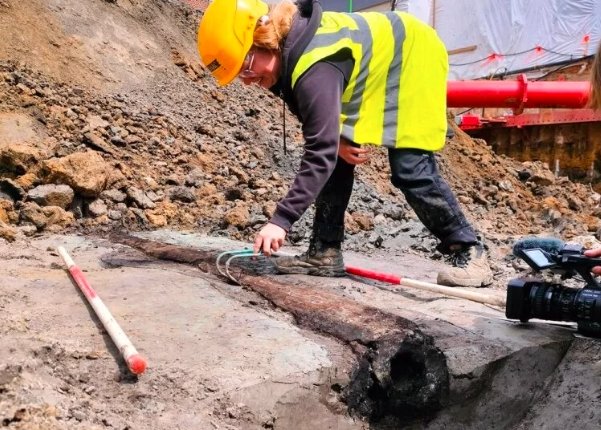
Discovered 13 feet below Brusselsestraat during a routine excavation ahead of student housing construction, the 65 to 100-foot-long pipe, built from hollowed tree trunks, was buried in marshy soil that preserved its form for nearly 2,000 years.
This is the first fully intact Roman-era wooden water pipe ever found in Flanders — and it may force a rethinking of Leuven’s role in the Roman Empire.
“This is a unique archaeological find for Flanders,” said Dirk Vansina, the city’s councillor for public works. “Its preservation was only possible thanks to the permanently wet soil near the Dyle River, which acted like a natural time capsule.”
An Infrastructure Discovery Hidden in the Mud
According to archaeologists and city officials, the newly uncovered pipeline was constructed during the first to third centuries C.E., a period when Leuven was believed to be a diverticulum — a small settlement near a Roman road linking Cologne and Boulogne.
The pipe consists of sections of hollow tree trunks, each approximately six feet long. Their seamless interlocking design suggests a knowledge of pressure flow and leak prevention — a hallmark of Roman hydraulic engineering, which more commonly involved ceramic or lead piping in major cities.
Its exceptional preservation is attributed to constant groundwater saturation in the Dyle River valley, where fluctuations in moisture — the main cause of wood decay — were absent. This level of survival is rare, especially in northern Europe, where organic materials usually disintegrate over centuries.
Leuven’s Hidden Roman Importance
While Leuven has long been recognized as a minor Roman outpost, the pipe’s presence suggests it may have held greater strategic or civic value than previously understood. At a minimum, it implies Roman investment in infrastructure — unusual for a settlement not classified as a colonia or municipium.
“For a long time, Leuven was viewed as a Roman backwater,” said one archaeologist at the dig site. “But this pipeline suggests a more sophisticated and planned water supply system than we imagined for a place this size.”
The pipe could indicate a network supplying a villa complex, bathhouse, or military site, though further excavations are needed to confirm the destination and origin of the system.
Scientific Work Still to Come
Archaeologists will now conduct dendrochronological testing — analyzing the tree rings of the timber — to pinpoint the year the trees were felled, potentially offering a precise construction date. Researchers also plan to analyze wear patterns and water sediment residue, which could shed light on the flow rate, usage patterns, and even water quality.
Meanwhile, Leuven’s city council is exploring options for preserving the pipe for public display. If successful, it would become a centerpiece for understanding Belgium’s Roman-era urbanization, offering tangible evidence of engineering practices once thought limited to southern Europe.
“Roman engineering is often associated with aqueducts in Italy or Gaul,” said a spokesperson for the Leuven City Council. “But this pipe reminds us that even the fringes of empire were touched by Roman planning and ingenuity.”