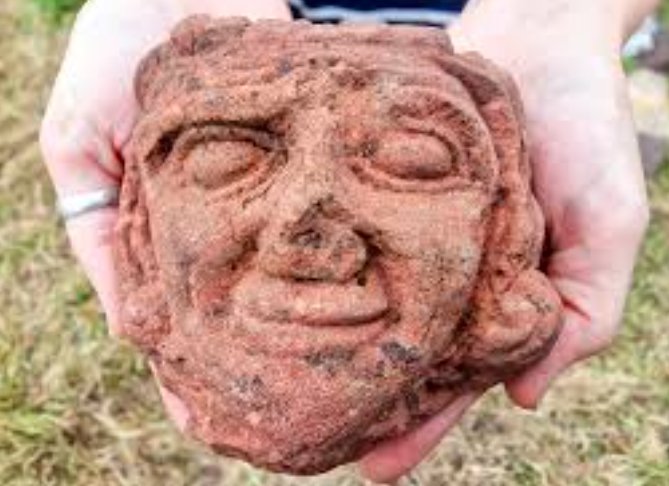
What started as a routine student excavation in Orkney has turned into one of the most exciting archaeological finds in recent years — a carved stone head, believed to date back over 900 years to the Viking Age, was unearthed by a young archaeology student during a dig on the remote Scottish island of Rousay.
The artifact has stunned experts and thrilled locals, not just for its age but for its unexpected presence at a site that’s already earned the nickname “the Egypt of the North.”
A Stone Face Emerges From Orkney’s Ancient Walls
The moment Katie Joss, an undergraduate student, felt something solid in the wall, she had no idea she was holding history in her hands.
Digging at Skaill Farmstead — a centuries-old Norse site in Rousay — Joss was working alongside a team from the University of the Highlands and Islands when the small carved object popped free from a medieval wall.
It turned out to be a stone head. Human-like. Deliberate. Definitely not natural.
And it didn’t match anything they’d ever pulled from this site before.
A Site Steeped in Norse History
Skaill Farm isn’t new to archaeologists. The site has been under excavation for over a decade. But even seasoned researchers were caught off guard by the find.
Rousay — part of the Orkney Islands — is packed with history. From Iron Age brochs to Viking farms and Pictish remains, it’s basically a museum in the wild. That’s why some call it “the Egypt of the North.”
But this head? Completely unexpected.
“There’s been lots of bone, pottery, and metalwork,” said project co-leader Dr. Ingrid Mainland. “But nothing quite like this carved head. It’s a first for us at Skaill.”
Small Object, Big Impact
Though the artifact is physically small, its implications are huge. The carved head could reshape how researchers understand daily life in the Norse settlements of Orkney.
Here’s why it matters:
-
It’s stylistically consistent with Viking-era carving, suggesting symbolic or decorative use.
-
Its location inside a wall may point to ritualistic placement or secondary use during construction.
-
It’s one of the few sculptural human representations ever found in domestic Norse architecture in the British Isles.
One archaeologist compared it to a kind of early medieval graffiti or shrine object, hinting at the blend of pagan and Christian beliefs during the late Viking period.
Student-Led Find That’s Making Headlines
Joss, the student who found the head, said she was shocked.
“I thought it was just another stone,” she said. “But as soon as I saw the shape and the face, I knew it was different.”
She handed it over to the team immediately. Within minutes, word spread across the dig.
For a student still finishing her undergraduate degree, it’s the kind of discovery most archaeologists only dream about.
And it’s not just turning heads locally.
Media outlets from Edinburgh to Oslo have already picked up the story, and the artifact has even sparked discussions on Viking forums and academic groups across Europe.
What Might the Head Have Represented?
So far, experts are hesitant to make sweeping claims, but there’s no shortage of speculation.
One theory? It could’ve been part of a household idol or protective charm, placed within the walls to watch over the home.
Another suggests it might’ve had more practical use — possibly the end of a tool, staff, or even a furniture fitting, carved to resemble a human.
Dr. Mainland emphasized the need for more analysis but added: “It’s tempting to wonder if this was someone’s ancestor, or a figure of folklore, or something entirely symbolic.”
A Century of Secrets Still Buried Beneath Skaill
This isn’t the first time Rousay has surprised archaeologists, and it won’t be the last. The Orkney Islands have been called one of the most archaeologically dense regions in all of Europe.
Just in the past 50 years, digs on Rousay have unearthed:
-
A massive Iron Age roundhouse complex
-
Viking longhouses and farm structures
-
Pictish-era burial remains
-
Medieval churches and Norse chapels
And yet, researchers say they’ve only scratched the surface.
The carved head is now being cleaned, catalogued, and prepared for 3D scanning at a lab in Kirkwall. Further dating and material analysis will follow, though initial assessments place the object between 900 and 1,000 years old.