
News
Hercules Falls to Dionysus in Marble: Roman Sarcophagus Depicting Drinking Contest Unearthed in Israel
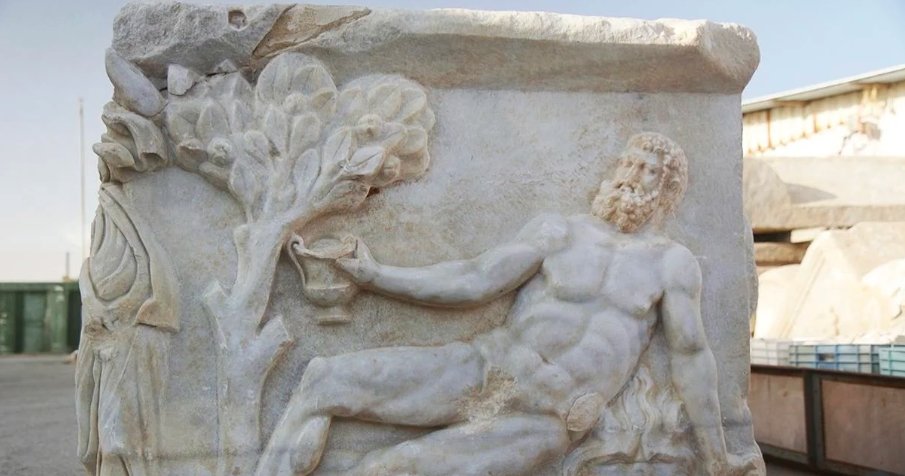
Archaeologists working in the sun-drenched sands of Caesarea, a coastal town in northern Israel, have uncovered a striking piece of Roman funerary art: a marble sarcophagus etched with a mythological drinking contest between Hercules and Dionysus.
The discovery, described by experts as the first of its kind in Israel, offers an exuberant yet deeply symbolic look at how Romans perceived death — not as a mournful finality, but as a spirited passage into the next world.
“It was like a scene out of a movie,” exclaimed archaeologists Nohar Shahar and Shani Amit, who led the excavation for the Israel Antiquities Authority (IAA). “As we cleared more sand, we couldn’t believe what we were seeing — gods, animals, and trees. Each uncovered fragment was more impressive than the last.”
From Sand Dune to Marble Masterpiece
The sarcophagus was discovered almost by accident. While conducting a routine excavation in the dunes near Caesarea — far outside the ancient city’s known boundaries — the archaeological team stumbled upon the tip of a marble slab. Intrigued, they began carefully removing the soft sand.
“In the very last hour of the excavation came the climax,” said Shahar. “An entire intact side of the sarcophagus was revealed, showing Hercules reclining on a lion skin, raising a wine cup.”
As the image emerged, the narrative became clear: Hercules, the demigod of brute strength, was engaged in a drinking contest with Dionysus, the god of wine and ecstatic celebration — known to the Romans as Bacchus.
But this wasn’t just a duet. The scene swirled with motion and mythological excess. Dionysus was surrounded by his characteristic entourage: Maenads, satyrs, and other fantastical creatures including Pan, Hermes, and an array of wild animals — lions and tigers etched in motion.
A Symbolic Farewell
While depictions of Dionysian revelry are common in Roman art, their presence on a burial sarcophagus in Israel is unprecedented. The detail and symbolism hint at more than mere artistic flair.
“These aren’t just party scenes,” explained Shahar. “They reflect a philosophy of death — a belief that the soul, upon departing the body, transitions joyfully into another existence. Drinking, dancing, myth — these are transformed into metaphors for liberation.”
Such sarcophagi were common across the Roman Empire during the second and third centuries CE, especially among wealthy citizens who could afford intricately carved marble coffins imported from workshops in Italy or Greece. This particular coffin likely belonged to a high-status Roman who died in Caesarea, then a bustling Mediterranean port and administrative capital of the province of Judea.
Artistic Layers and Historical Insight
While artistic depictions of Hercules and Dionysus are found elsewhere — from Pompeian frescoes to Turkish mosaics — this particular configuration offers a regional first and hints at wider Roman cultural integration in the Levant.
Even in death, the Romans saw value in comedy, competition, and myth. The use of Dionysus — a god associated with emotional abandon — suggests a deliberate reframing of mortality.
“This sarcophagus is a vivid reminder that Roman views of death were as complex as they were theatrical,” said Dr. Michal Dayagi-Mendels, curator of classical archaeology at Tel Aviv University. “They embraced contradiction — joy at the threshold of loss, myth as memorial.”
The carving itself, while partially buried, is exceptionally well-preserved. Conservation teams are now carefully cleaning the marble and preparing it for eventual museum display.
Rethinking Caesarea’s Scale
Beyond its artistic significance, the sarcophagus is also expanding archaeological understanding of Caesarea itself.
“We found this outside the known city walls,” noted Shahar. “This suggests the urban footprint of Caesarea was wider than previously believed, with burial grounds, residences, or perhaps even villas extending beyond the historic core.”
Founded by Herod the Great in the first century BCE and named in honor of Augustus Caesar, Caesarea was a jewel of Roman architecture and governance in the eastern Mediterranean. The site is already known for its aqueducts, amphitheater, and seafront palace, but this latest find may spur new exploration of the city’s outer rings.
Who Won the Contest?
As for the eternal question: who won the legendary drinking match immortalized in stone?
Shahar laughed as she pointed to the sculpted Hercules — sprawled sideways, barely able to lift his cup.
“Hercules’ condition, depicted on the sarcophagus as someone who is no longer able to stand, points to the obvious answer,” she said. “Dionysus.”
And with that, the wine god claims another victory — not just over his mythological rival, but over time itself, leaving behind a scene as lively in the 21st century as it was nearly two millennia ago.













Spotify Running Mode hits Android and revives its old tempo experiment

Galaxy Tab S12 Ultra Renders Keep the Notch Fans Hate

Novato Spinning Round House Sells With Six Neighbors for $3.3 Million

Crop Tour Finds Indiana and Nebraska Corn Yields Lagging 2025

Best Buy 60th sale brings Android deals back to its roots

American Airlines reverses seatback screen bet years too late

Iran Hormuz Strikes Force Gulf Oil Onto Costlier Paths

Plague Tale Prequel Day One Joins Game Pass Wave 2 as Witcher Exits

NBA 2K27 opens The City to everyone and rewrites career eras

iOS 26.6.1 Patches 29 Flaws as AI Forces Faster Apple Updates

Double Fine Cuts 23 Jobs Weeks After Xbox Independence

Day-One Big Walk Lifts PS Plus August Beyond Recycled AAA

John Hight Exits Wizards After Digital Reckoning Hits

Curtis Mead’s Red Sox Debut Ends With Fractured Wrist

Red Sox Squander Hot Streak Chance in 4-3 Loss to Athletics

Moesch and Dressel Rewrite Night One at 2026 U.S. Nationals

Boutte’s Quiet Camp Takeover Forces Patriots Receiver Choices

Take-Two CEO Pushes Netflix Subs for GTA 6 Extended Look

Halo Campaign Evolved Skulls Meet Death Barriers That Kill the Hunt

Wildlands Free Update Hands Players the Tools They Already Invented
-

 TECHNOLOGY3 years ago
How to Adjust a Bulova Watch Band – An Easy Guide
-

 News3 years ago
Fred Pentland: Athletic Bilbao’s English mentor who changed the essence of Spanish football
-

 FINANCE3 years ago
Tax Planning for Every Season: Guide to Maximizing Your Tax Benefits
-

 Education3 years ago
African Ministers New Education Plan
-

 BUSINESS3 years ago
What is Entrepreneurial Operating System? A Comprehensive Guide to EOS
-

 Education3 years ago
Innovate Your Learning Journey with Technology and Enhance Education
-

 News3 years ago
Russians formally out of World Athletics Championships
-

 BUSINESS3 years ago
Top 9 Most Expensive American Cities to Rent an Apartment