
News
Hidden for Centuries, One of Gaul’s Largest Roman Villas Emerges Near Auxerre

Beneath the rolling countryside of central France, archaeologists have unearthed one of the largest and most opulent Roman villas ever discovered in ancient Gaul — a sprawling 43,000-square-foot complex near the modern-day city of Auxerre.
Though first partially uncovered by gravel pit workers nearly 60 years ago, the true scale and grandeur of the site remained hidden until now. What was long considered a standalone aristocratic home has revealed itself to be just a fragment — a mere outbuilding — of a much grander Roman estate that spanned the equivalent of eight basketball courts.
“The discovery forces us to rethink the scale of elite life in Roman Gaul,” said an archaeologist with INRAP, the French National Institute for Preventive Archaeological Research. “This wasn’t just a house. It was a palace.”
A Modest Discovery Grows into a Monumental Find
In 1966, a crew digging for gravel near Auxerre unearthed remnants of what appeared to be a luxurious Roman residence. Mosaics, stone walls, and heating elements hinted at wealth, and the structure’s 7,500 square feet already placed it in the upper echelons of Roman domestic architecture.
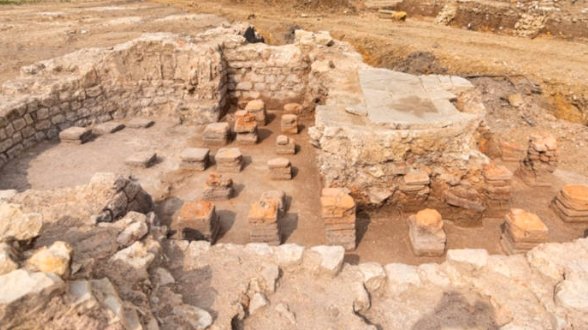
But according to a June 2025 press release from INRAP, that structure turns out to be only a secondary wing — possibly a guest residence or service area — of the newly excavated central complex. The full villa, now mapped in its entirety, clocks in at over 43,000 square feet and features a network of residential quarters, thermal baths, kitchens, reception halls, and intricate water systems.
“It’s a discovery of exceptional magnitude,” said INRAP’s excavation lead. “We now believe this villa rivaled some of the finest in southern Gaul and even parts of Italy.”
Two Wings, Two Eras
The villa is divided into two primary parts:
-
Pars Urbana: the residential sector, reserved for the landowning family and their guests
-
Pars Rustica: the agricultural and service areas, likely used for production, storage, and housing of workers
The new excavation revealed a perimeter wall, courtyards, a quadrangular basin to the north, and a fountain to the south — all features typical of wealthy Roman estates. But perhaps most revealing is the heated eastern wing, which houses private thermal baths connected to underfloor heating systems — a luxury feature indicative of elite Roman taste.
According to researchers, there’s also evidence suggesting phased construction: the secondary wing found in 1966 may have been added later, as part of a villa expansion. This suggests sustained wealth and possibly a multi-generational estate, in operation from the 1st through 4th centuries C.E., shortly before the collapse of the Western Roman Empire.
Living Large in Roman Gaul
The villa’s elite status is unmistakable. Romans in Gaul — especially the provincial aristocracy — adopted the habits of the empire’s urban elite: extravagant feasts, complex architecture, and an obsession with bathing.
“Private baths weren’t merely for hygiene,” noted a cultural historian at the University of Dijon. “They were social, performative, and deeply symbolic. To have them in your home was a statement of power and sophistication.”
The baths in Auxerre’s villa include a caldarium (hot bath), tepidarium (warm room), and frigidarium (cold plunge), all likely fed by sophisticated plumbing networks and heated by hypocausts — subfloor channels that circulated hot air from a furnace.
Decorative fragments — including marble, painted frescoes, and mosaics with geometric and floral motifs — are being preserved for further analysis. Some rooms, archaeologists believe, may have been used for philosophical gatherings, business meetings, or banquets.
A Rare Glimpse Into Roman Domestic Power
This newly uncovered estate doesn’t just shift the scale of known Roman settlements in France. It also reshapes our understanding of rural elite identity during late antiquity.
Unlike Rome’s grand civic buildings, villas like this offer a lens into the private wealth and daily rhythms of imperial elites — how they curated their space, practiced Roman values, and dominated both land and labor in the provinces.
“This wasn’t just a country home,” said INRAP’s lead. “It was an economic hub, a cultural stage, and a political signal.”
These estates often functioned as autonomous micro-kingdoms, producing wine, grain, or wool while serving as social anchors in their region. Their owners — typically senators, retired generals, or imperial administrators — used such villas to demonstrate allegiance to Rome while projecting dominance locally.
A Public Glimpse This Summer
INRAP has announced that the site will be open to the public via shuttle tours throughout the summer, offering visitors a rare chance to witness archaeology in action. Interpretive panels, guided walks, and digital reconstructions are also planned.
The long-term vision includes museum display of key artifacts and possible integration into a regional Roman heritage trail, joining sites in Lyon, Nîmes, and Vienne.
For now, researchers remain on-site, carefully excavating, cataloging, and analyzing what they hope will yield further surprises.
“There’s still much to uncover,” said one team member. “A villa like this doesn’t exist in isolation. It’s part of a story — one we’re just beginning to tell.”













Walmart’s $50 Million Opioid Settlement Closes Case Without Admission

California Sues Over $120 Million Morro Bay Wind Lease Buyout

Gilead Bixlenvo FDA Nod Opens Single Pill Path for Complex HIV Cases

Meta’s $18B Kids Deal Forever Shields Data Used to Spot Under-13s

Lettuce Outbreak Drove Record Cyclospora Spike Across 20 States

Amazon Shaves $20 Off M6 Mac Mini Before It Even Ships

SpaceX Louisiana Port Tests Debt Markets on Orbital AI Scale

Microsoft High Lifts Indexes as Small Caps Crack Support

Apple Replays 2015 Saturday Midnight Preorder for iPhone 18 Pro

Updated COVID Shots Clear FDA but Access Friction Hits High-Risk Groups

Take-Two CEO Pushes Netflix Subs for GTA 6 Extended Look

Wildlands Free Update Hands Players the Tools They Already Invented

Destiny 2 Fans Unlock Vaulted Maps After Live Service Ends

Quake Gets 19 Free Maps From MachineGames Quake Club

Quordle Monday Delivers Gavel Crush Speed Ethos Cleanly

Stripe Bid Shows PayPal Moat Cracked After Years of Slide

Tyson’s Five-Year Utah Plant Falls to Cattle Shortage Reckoning

Silver Lake Workday Talks Signal Private Floor for Software

Kennedy Lewis Takes Majority Control of The Greenbrier in $500M Deal

Best Buy Marks 60 Years With Sale That Echoes Its Audio Shop Roots
-

 TECHNOLOGY3 years ago
How to Adjust a Bulova Watch Band – An Easy Guide
-

 News3 years ago
Fred Pentland: Athletic Bilbao’s English mentor who changed the essence of Spanish football
-

 FINANCE3 years ago
Tax Planning for Every Season: Guide to Maximizing Your Tax Benefits
-

 Education3 years ago
African Ministers New Education Plan
-

 BUSINESS3 years ago
What is Entrepreneurial Operating System? A Comprehensive Guide to EOS
-

 Education3 years ago
Innovate Your Learning Journey with Technology and Enhance Education
-

 News3 years ago
Russians formally out of World Athletics Championships
-

 BUSINESS3 years ago
Top 9 Most Expensive American Cities to Rent an Apartment