
News
Mesa County Locks In 2025 Road Report: What It Means For Your Tax Dollars

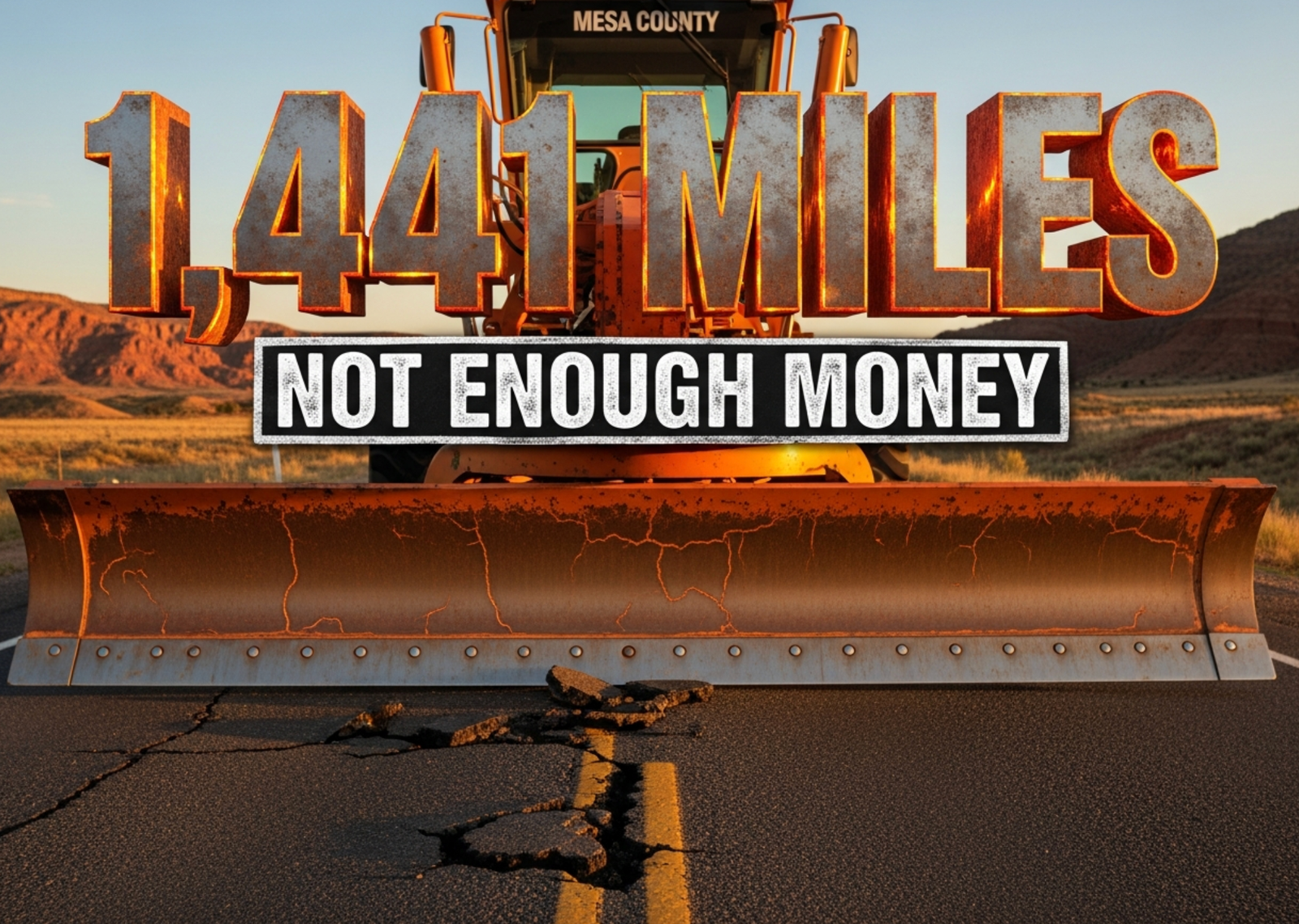
Mesa County commissioners quietly approved the 2025 Highway Users Tax Fund report this week, a document that decides exactly how many millions in state gas-tax money flow back to local roads. The numbers are in: the county now maintains 1,441.845 miles of eligible roads, and every pothole you hit next summer depends on this report.
1,441 Miles and Counting: The Real Size of Mesa County’s Road Network
For the first time, Mesa County has crossed the 1,441-mile mark in roads that qualify for Highway Users Tax Fund (HUTF) money.
Out of that total, 726.773 miles are paved and 715.072 miles remain gravel or dirt. That near-perfect split shows why drivers on the west end curse washboards while Grand Junction residents complain about crumbling asphalt. Both groups are right.
A private contractor spent weeks driving every single eligible road with specialized equipment to measure pavement condition, width, and surface type. Those scores go straight to the Colorado Department of Transportation and determine Mesa County’s slice of the $1.4 billion HUTF pie.
Your Gas Tax Dollars Are On The Line
The Highway Users Tax Fund is fueled by state gasoline taxes, vehicle registration fees, and other transportation charges. Every time you fill up in Clifton or Loma, a chunk of that money comes back home, but only if the county proves it still has the roads to justify it.
This year’s approved report locks in funding levels for 2025. Miss a mile or fail to update the inventory, and the county permanently loses that revenue.
“That’s our bread-and-butter money,” says Travis Cole, deputy road supervisor for Mesa County Road and Bridge. “It pays for pothole patching, crack sealing, blading gravel roads, and keeping signs standing. Without it, we shut down.”
Costs Are Exploding, Funding Is Flat
Here’s the problem nobody wants to say out loud: road maintenance costs have jumped more than 40% in the last four years while HUTF distributions barely budged.
Asphalt prices soared after the 2022 supply-chain mess. Diesel for county trucks now costs double what it did in 2019. Even gravel has gone up 60% in some pits.
The result? Mesa County has shifted hard into preservation mode.
Instead of full repaves that cost $500,000 per mile, crews now lean on chip seals ($50,000 per mile) and slurry seals ($25,000 per mile) that buy five to ten extra years of life.
“We’re not rebuilding roads anymore. We’re keeping them from dying,” Cole told me bluntly.
Growth Without the Cash to Match
New subdivisions in north Fruita, Redlands, and along the Whitewater corridor added dozens of lane-miles in the last decade. Every new street accepted into the county system increases the maintenance burden, but state funding formulas lag years behind.
The 2025 report shows a net gain of just over 11 center-line miles since 2021. That sounds small until you realize each mile costs roughly $18,000 a year to maintain on pavement alone.
County officials admit they’re playing catch-up and still falling behind.
What Happens Next For Your Roads
With the report now submitted and approved, CDOT will calculate final 2025 distributions by early spring. Mesa County expects roughly the same $11-12 million it received in 2024, maybe a few hundred thousand more if gas-tax collections beat projections.
That money will stretch thinner than ever.
Priorities for 2025 already include:
- Heavy chip sealing on Patterson Road corridors
- Major gravel maintenance on the Glade Park and Gateway routes
- Crack sealing and pothole blitz across Grand Junction’s older neighborhoods
- Continued blade work on high-traffic rural roads like 32 Road and K Road
If inflation doesn’t cool and fuel taxes stay flat, expect more gravel roads to stay gravel and more chip seal than fresh asphalt.
Mesa County drivers know the roads could be better. This week’s report proves the county is at least fighting like hell to keep them from getting worse.
What’s your worst road in Mesa County right now? Drop it in the comments and tag a friend who needs to see this. If you’re fed up enough, use #MesaCountyRoads on X or Instagram, the conversation is already heating up over there.










Geekbench 7 Launches and Erases Three Years of Scores

Google’s Selfie Video Sign-In Arrives as Deepfake Fraud Surges

Samsung’s New Galaxy Z Fold 8 Undercuts Its Own Ultra

Kroger and Brookshire’s Recall Over 19 Million Eggs for Salmonella

Mortgage Rates Hit an 11-Month High as Oil Fears Bite

Oil’s Price Shock Collides With Wall Street’s AI Spending Boom

Parsley and Cilantro Emerge as Cyclospora Suspects in North Carolina

Walmart Dresser Recall Reveals a Wider Furniture Safety Sweep

Apple’s iOS 27 Speed Fixes Echo Its 2018 Playbook

Cheshire Medical Center Cyclospora Cluster Exposes a Wider Outbreak

Pokémon GO Developer Niantic Rebrands as Scopely Explore

Persona 4 Revival Hands All Anime Cutscenes to Studio MAPPA

Doom Studio id Software Cuts Half Its Staff in Xbox Layoffs

Jaylen Brown Traded to 76ers for Paul George and Four Draft Picks

Nintendo Switch Online Adds Four Classics and One Japan-Only Title

Jordan Henderson Hospitalized After Wrist Injury at the Azteca

Meta’s Muse Image Lets Anyone Use Your Instagram Photos in AI

Mexico’s World Cup Run Ends at Azteca as England Hold On 3-2

Louis Vuitton Beats Molly Tea in China, Triggers Cultural Backlash

Pink Bearista Cup Returns July 13 as Starbucks Pink Vibes Drops
-

 TECHNOLOGY3 years ago
How to Adjust a Bulova Watch Band – An Easy Guide
-

 News3 years ago
Fred Pentland: Athletic Bilbao’s English mentor who changed the essence of Spanish football
-

 FINANCE3 years ago
Tax Planning for Every Season: Guide to Maximizing Your Tax Benefits
-

 Education3 years ago
African Ministers New Education Plan
-

 BUSINESS3 years ago
What is Entrepreneurial Operating System? A Comprehensive Guide to EOS
-

 Education3 years ago
Innovate Your Learning Journey with Technology and Enhance Education
-

 News3 years ago
Russians formally out of World Athletics Championships
-

 BUSINESS3 years ago
Top 9 Most Expensive American Cities to Rent an Apartment