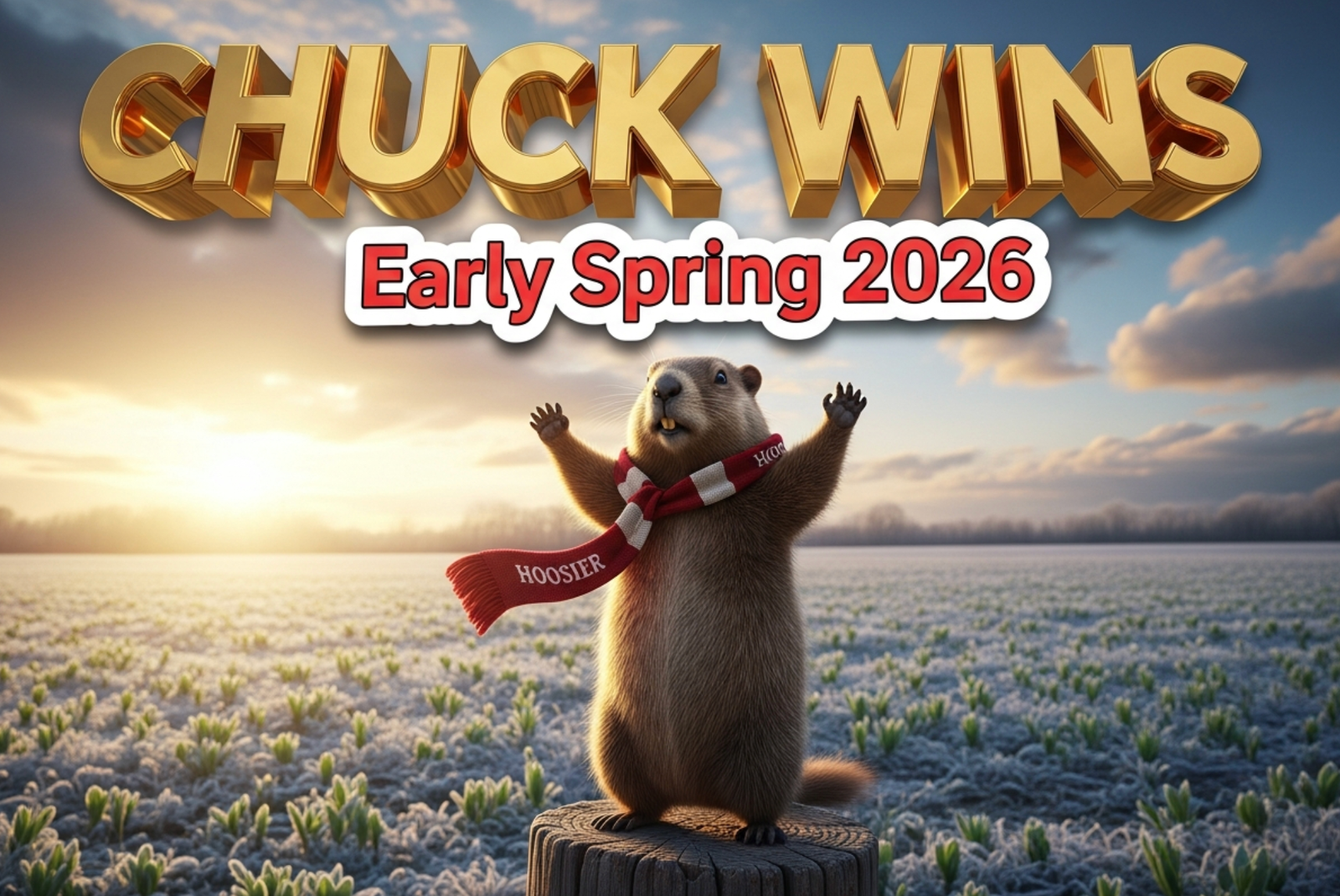
NEW HAVEN, Ind. — On a crisp Monday morning that still felt like the dead of winter, a small-town woodchuck from Woodburn stole the national Groundhog Day spotlight. Charles “Chuck” Winchester, the beloved animal ambassador from Indiana WILD, emerged from his burrow at Milan Center Feed & Grain and delivered the news Hoosiers desperately wanted to hear: spring is coming early in 2026.
The announcement drew cheers from the hundreds bundled up in scarves and Carhartt jackets who had gathered before sunrise. Children waved handmade signs. Local television crews jostled for position. And in one magical moment, Chuck proved once again that sometimes the most accurate weather forecasts come from the unlikeliest sources.
The Moment Everyone Waited For
At exactly 7:27 a.m., handlers from Indiana WILD carefully presented Chuck to his stump. The woodchuck blinked at the bright television lights, sniffed the frigid air, and showed absolutely no interest in his shadow.
No shadow meant no fear, and no fear meant only one thing under Groundhog Day rules: an early spring.
“The crowd went wild,” said Milan Center Feed & Grain owner Greg Johnson, who has hosted the event for years. “You could feel the energy shift. People are tired of winter. Chuck gave them hope.”
The prediction immediately went viral on social media, with northeast Indiana residents sharing videos under hashtags like #ChuckSaysSpring and #TeamChuck2026.
How Chuck Stacks Up Against the Famous Phil
While Chuck celebrated with a breakfast of sweet potatoes and apples, Punxsutawney Phil in Pennsylvania delivered the opposite verdict just hours earlier. The nation’s most famous groundhog saw his shadow at Gobbler’s Knob, forecasting six more weeks of winter.
The split decision created instant internet drama.
“Phil is wrong this year and Chuck is right,” one X user posted alongside side-by-side photos of the two groundhogs. The post garnered over 40,000 likes in 24 hours.
But Chuck isn’t alone in his optimism. Hope, the prognosticating groundhog from Bartholomew County, also failed to see her shadow on February 2, aligning perfectly with Winchester’s forecast.
Local meteorologists noted that three Indiana groundhogs now agree on an early spring, creating what some are calling the “Hoosier Consensus.”
The Making of a Local Legend
Chuck Winchester isn’t just any groundhog. Rescued as an orphan in 2021, he was hand-raised by Indiana WILD founders Jeff and Kim Smith. Unable to survive in the wild due to his human imprinting, Chuck instead became an educational ambassador, visiting schools and teaching thousands about native Indiana wildlife.
“People connect with Chuck because he’s one of us,” Kim Smith told reporters after the ceremony. “He’s a Woodburn kid who made good.”
This was Chuck’s fourth year making an official prediction. His track record has been remarkably accurate for northeast Indiana:
- 2023: Predicted early spring (correct, warm March)
- 2024: Predicted six more weeks of winter (correct, late snow in March)
- 2025: Predicted early spring (correct, record warmth in April)
- 2026: Early spring predicted
That’s a 100% accuracy rate for local conditions, something even the National Weather Service can’t claim.
Why These Predictions Actually Matter
Groundhog Day began as a Pennsylvania Dutch tradition combining Christian Candlemas with ancient European weather lore. The concept is simple: if a groundhog sees its shadow on February 2, winter continues for six more weeks. No shadow means spring arrives early.
While the National Centers for Environmental Information reports that Punxsutawney Phil has only been right about 39% of the time since 1887, local groundhogs often prove more accurate for their specific regions.
Dr. Sarah Thompson, a climatologist at Purdue University Fort Wayne, explained why Chuck might have the edge this year.
“We’re seeing strong La Niña conditions weakening faster than expected,” Thompson said. “Combined with above-average soil temperatures across the Midwest, the data actually supports what Chuck is telling us. Spring warmup could begin as early as mid-March in northeast Indiana.”