
News
Art Finds Its Footing in Grand Junction’s Industrial South

GRAND JUNCTION, Colo. – On the first Friday of each summer month, Grand Junction’s downtown doesn’t just host an art walk—it reimagines what local creativity looks like, and where it can thrive.
From book cliff landscapes to mixed media abstraction, the First Friday Art Walks are transforming bars, galleries, and even dispensaries into unconventional showcases of the city’s rising artists. And in 2025, that reach is stretching farther than ever before.
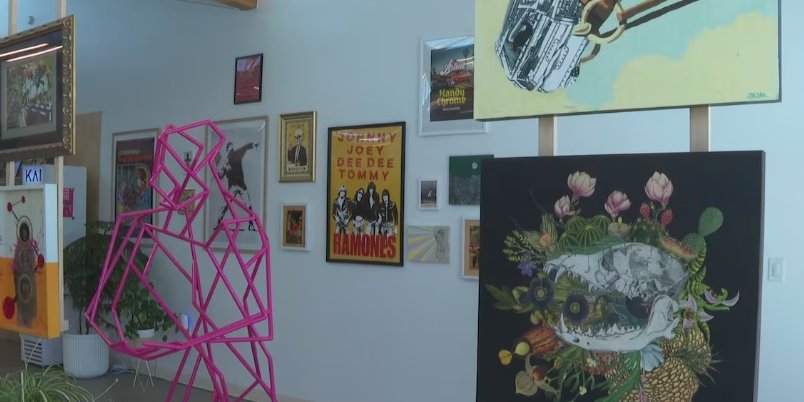
At KAI Dispensary, located in a traditionally industrial section of Grand Junction, art now lines the walls alongside cannabis products—part of a growing collaboration between local businesses and the creative community.
“You go to all these different places,” said Joey Coleman, owner of KAI. “One shop you might see landscapes of the Book Cliffs. One, you might see sculptures. We went abstract and mixed media.”
Beyond Main Street: A Shift in the City’s Cultural Gravity
For Coleman, a Grand Junction native, the transformation is personal. “I grew up here. I didn’t think of anything south of Pitkin as anywhere you’d go to see art—or even go shopping,” he said. “Bringing more of that over here is really important for Grand Junction.”
Coleman’s venue is currently displaying work by Luke Sorrick, a local artist whose eclectic pieces are helping redefine what it means to be “local” in a city long known more for its natural beauty than its gallery walls.
At its core, the First Friday series is not just a celebration of art—it’s a cultural intervention, one that brings visibility to artists in a region where exposure is hard-won and income even harder to secure.
A City-Supported Spotlight
Downtown Grand Junction’s First Friday Art Walks have become an increasingly important part of the summer calendar—both for creators and businesses. Each participating venue offers a distinct flavor: sculpture gardens, vibrant abstract installations, and regionally inspired landscapes all coexist within walking distance.
“Being an artist is hard,” Coleman emphasized. “It’s hard to get your work seen. It’s hard to make any capital money off of your work. That’s why it’s so important that other industries collaborate with artists and help highlight that work.”
For KAI, whose business model already includes a focus on aesthetics and visual storytelling, the synergy with the arts community was almost inevitable.
“This collaboration just works so well,” Coleman said. “Everything we do—art is important to us. Design is important to us. So a partnership with what’s essentially an art festival? Perfect fit.”
A Grassroots Movement with Institutional Backing
The Art Walk isn’t only symbolic—it’s also drawing economic and civic interest. As foot traffic grows in neighborhoods that previously saw little nightlife or gallery activity, the event is quietly redistributing attention and investment.
It’s a reminder that art doesn’t just live in museums or polished galleries—it can flourish inside shops, industrial corners, and anywhere a wall can hold a canvas.
And in Grand Junction this summer, that’s exactly what it’s doing.









Geekbench 7 Launches and Erases Three Years of Scores

Google’s Selfie Video Sign-In Arrives as Deepfake Fraud Surges

Samsung’s New Galaxy Z Fold 8 Undercuts Its Own Ultra

Kroger and Brookshire’s Recall Over 19 Million Eggs for Salmonella

Mortgage Rates Hit an 11-Month High as Oil Fears Bite

Oil’s Price Shock Collides With Wall Street’s AI Spending Boom

Parsley and Cilantro Emerge as Cyclospora Suspects in North Carolina

Walmart Dresser Recall Reveals a Wider Furniture Safety Sweep

Apple’s iOS 27 Speed Fixes Echo Its 2018 Playbook

Cheshire Medical Center Cyclospora Cluster Exposes a Wider Outbreak

Star Wars: Galactic Racer Is a Roguelite Racer With a Podracing Skin

Sega’s $49.99 Sonic Classic and Modern Bundles Hit Switch in October

Colombia Edge DR Congo as Muñoz Books World Cup Knockout Place

Warriors Take Yaxel Lendeborg, the Oldest Pick in the 2026 NBA Draft

Douze Dixièmes Closes Five Months After MIO: Memories in Orbit

Warhammer Horus Heresy Super-Heavy Tanks Share a Plastic Chassis

Pokémon GO Developer Niantic Rebrands as Scopely Explore

Persona 4 Revival Hands All Anime Cutscenes to Studio MAPPA

Doom Studio id Software Cuts Half Its Staff in Xbox Layoffs

Jaylen Brown Traded to 76ers for Paul George and Four Draft Picks
-

 TECHNOLOGY3 years ago
How to Adjust a Bulova Watch Band – An Easy Guide
-

 News3 years ago
Fred Pentland: Athletic Bilbao’s English mentor who changed the essence of Spanish football
-

 FINANCE3 years ago
Tax Planning for Every Season: Guide to Maximizing Your Tax Benefits
-

 Education3 years ago
African Ministers New Education Plan
-

 BUSINESS3 years ago
What is Entrepreneurial Operating System? A Comprehensive Guide to EOS
-

 Education3 years ago
Innovate Your Learning Journey with Technology and Enhance Education
-

 News3 years ago
Russians formally out of World Athletics Championships
-

 BUSINESS3 years ago
Top 9 Most Expensive American Cities to Rent an Apartment