
Harvard’s Long-Misidentified Magna Carta Revealed as a Priceless Original
For nearly 80 years, a stained and faded document stored quietly in Harvard University’s archives was believed to be a mere replica of the Magna Carta — the landmark 1215 charter limiting the power of English kings. Purchased in 1946 for just $27.50 (around $462 today), it was assumed to hold little historical significance beyond being a copy.
But recent research by medieval historians has dramatically changed that understanding. The document, officially catalogued as HLS MS 172, has now been confirmed as one of only seven surviving originals of the Magna Carta issued by King Edward I in 1300.
A Discovery Made by Experts Across the Atlantic
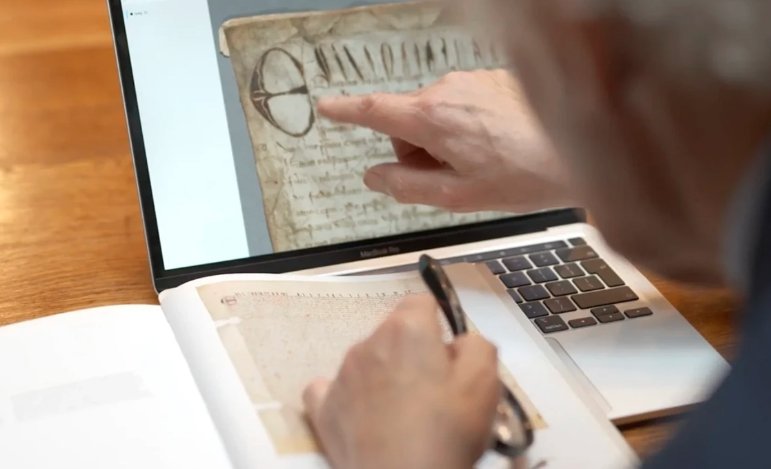
The revelation came from David Carpenter, a medieval history professor at King’s College London, who, while reviewing digitized copies of various Magna Carta manuscripts, noticed striking similarities between Harvard’s document and other known Edward I originals.
He quickly enlisted the help of Nicholas Vincent, a fellow medievalist from the University of East Anglia. Together, they confirmed what many had overlooked for decades: the Harvard Magna Carta was not a replica, but an authentic legal charter dating back over 700 years.
The Magna Carta’s Historical Importance
The Magna Carta, Latin for “Great Charter,” was originally sealed by King John of England on June 15, 1215, in Runnymede, near the River Thames. It was drafted amid rebellion from barons unhappy with the king’s heavy taxation, arbitrary rule, and military failures.
The charter’s radical principles established that the monarchy was not above the law, introducing ideas of due process and protection of rights. Its 63 clauses addressed church rights, swift justice, and limits on feudal payments. One famous clause states:
“No free man shall be seized or imprisoned… except by the lawful judgment of his equals or by the law of the land.”
The Magna Carta’s legacy deeply influenced later constitutional documents worldwide, including the U.S. Constitution and the Bill of Rights.
The Edward I Reissue and Harvard’s Document
Following King John’s death, the Magna Carta was reissued multiple times: by his son Henry III (1216, 1217, 1225) and then by Henry’s son Edward I (1297 and 1300). The Harvard document belongs to this latter batch.
Key features identified in Harvard’s copy include:
-
The large capital letter “E” for Edwardus (Edward), consistent with other originals from 1300.
-
Exact dimensions and handwriting style matching six other known surviving originals.
-
No variation in text or layout from the strict instructions given to scribes, confirming its authenticity.
Harvard’s Magna Carta is believed to be the 24th original overall, and one of the rarest surviving artifacts from the era.
How Harvard Acquired the Document and Why It Was Misunderstood
When Harvard purchased the document in 1946, experts believed it dated from 1327 and was a replica rather than an original. Because there are dozens of copies and versions of the Magna Carta, such a mistaken assumption was easy to make.
Its stains, fading, and worn condition further concealed its true significance until modern digital analysis and expert review revealed its historic authenticity.
What This Means for Historians and the Public
David Carpenter called the find “one of the world’s most valuable documents” and celebrated Harvard’s Magna Carta as a cornerstone of freedoms “past, present, and yet to be won.”
This discovery not only reclaims a lost piece of medieval history but also highlights the importance of continuous re-examination of archival materials using modern technology and scholarship.
Summary Table: Harvard’s Rediscovered Magna Carta
| Feature | Details |
|---|---|
| Document | Magna Carta (Great Charter) |
| Date Issued | 1300 (Reissued by King Edward I) |
| Original vs Replica | Confirmed original, previously thought replica |
| Acquisition | Purchased by Harvard University in 1946 for $27.50 |
| Historical Importance | Cornerstone of constitutional law and rule of law |
| Significant Features | Large “E” for Edward, precise layout and handwriting |
| Survival Status | One of only seven originals from Edward I’s 1300 issuance |
| Scholars Involved | David Carpenter (King’s College London), Nicholas Vincent (UEA) |