
News
Seventh-Century Shipwreck Discovered Off Israel’s Coast Reveals Unique Blend of Christian and Islamic Symbols

Largest Collection of Byzantine and Early Islamic Pottery Found in Israel
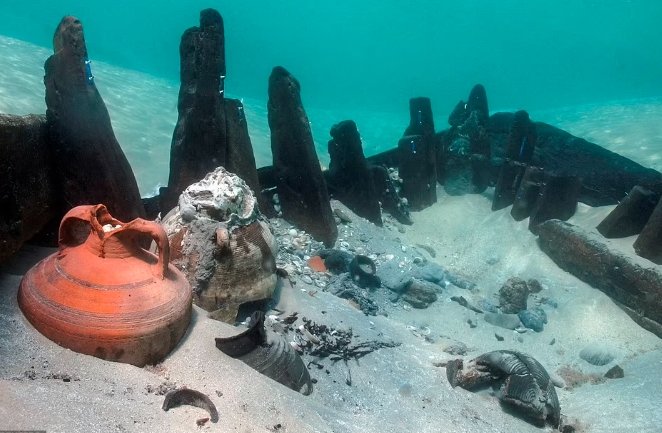
A remarkable seventh-century shipwreck, discovered off the coast near Haifa, Israel, has yielded the largest maritime cargo collection of Byzantine and early Islamic pottery ever found in the country. The ship, dating back around 1,300 years, offers a rare glimpse into a transitional period between Byzantine and Islamic rule, showcasing a fascinating mix of religious and cultural artifacts.
Discovery and Excavation
In 2015, members of Kibbutz Ma’agan Michael first spotted intriguing wreckage just offshore. Quickly buried by sand, the site was later excavated by the University of Haifa’s Institute for Maritime Studies starting in 2016. The well-preserved 85-foot vessel contained an astonishing 103 Greco-Roman amphorae—large ceramic jars filled with various agricultural products—and inscriptions in both Greek and Arabic.
Insights into Ship Construction and Trade Routes
Experts noted that the ship’s construction was notably different from earlier vessels. Built using an Egyptian “shell-first” technique, the hull was made by joining planks (strakes) along the length of the ship, a method that contributed to its structural integrity.
Archaeologist Deborah Cvikel, lead author of the study, explained, “This was an unusually large vessel, carefully built and beautifully conserved.” Its trade route likely covered the Levant region, with stops in Cyprus, Egypt, and possibly other ports along Israel’s coast.
Christian and Islamic Symbols Unearthed
What makes this find truly extraordinary is the presence of both Christian and Muslim religious symbols aboard the ship. The researchers found inscriptions carved into the wood and amphorae bearing the name of Allah alongside numerous Christian crosses, written in Greek and Arabic.
“We do not know whether the crew was Christian or Muslim, but we found traces of both religions,” Cvikel noted, emphasizing the cultural coexistence reflected in the artifacts.
Cargo Contents: Agricultural Wealth of the Region
The amphorae contained remnants of a rich agricultural cargo: olives, dates, figs, grapes, raisins, pine nuts, and even fishbones. Among six types of amphorae found, two represent typologies previously unknown to archaeologists, highlighting the diversity of the ship’s cargo.
The proximity of the wreck—less than 100 feet from shore—and the absence of human remains suggest that no lives were lost in the sinking, possibly caused by a navigational error.
Historical Significance: Challenging Assumptions About the Byzantine-Islamic Transition
This discovery sheds new light on the seventh-century Levant, a period often believed to have seen a decline in commerce due to political upheaval between Byzantine and Islamic rule.
The shipwreck’s substantial and varied cargo, combined with its mixed religious symbolism, challenges the notion that the transition severely disrupted trade in the Eastern Mediterranean.
Published in the Near Eastern Archaeology journal, the study offers vital new perspectives on cultural interaction, maritime technology, and economic continuity during a pivotal historical era.
Summary of Key Facts:
-
Date: Circa 7th century (1,300 years ago)
-
Location: Off the coast near Haifa, Israel
-
Vessel: 85-foot ship built using Egyptian “shell-first” technique
-
Cargo: 103 amphorae containing olives, dates, figs, grapes, raisins, pine nuts, and fishbones
-
Inscriptions: Greek and Arabic writing; religious symbols include the name of Allah and Christian crosses
-
Cultural Insight: Evidence of coexistence between Christian and Muslim traditions
-
Historical Impact: Challenges assumptions about decline in trade during Byzantine-Islamic transition
-
Cause of Wreck: Likely navigational mistake; no human casualties presumed













OpenAI Says Apple’s Trade Secret Lawsuit Lacks Any Merit

Lucid’s Bankruptcy Denial Can’t Quiet Wall Street’s Doubts

IBM Stock Suffers Its Worst Trading Day Since the 1987 Crash

Cheap Chinese AI Models Are Undercutting Anthropic and OpenAI

ASML’s AI Chip Forecast Lifts Futures, Deepens Market’s Big Bet

SK Hynix’s Nasdaq Shares Race Ahead of Seoul by Up to 51%

Meta Workers Sue Over AI Layoffs That Targeted Medical Leave

Taco Bell Pulls Lettuce as Michigan Cyclosporiasis Cases Top 3,300

PayPal’s Five-Year Slide Makes It a $53 Billion Target for Stripe

Mega Millions Jackpot Hits $672 Million, but Taxes Claim Nearly Half

Halo Studios Reverses PS Plus for Halo: Campaign Evolved on PS5

Black Ops 1 and 2 PS5 Ports: $40 Price Tag Has Fans Uneasy

Matt Brown Dismisses Rousey and Paul’s MVP MMA Ratings Win Over UFC

Star Wars: Galactic Racer Is a Roguelite Racer With a Podracing Skin

Julius Randle Traded to Nets as Wolves Reclaim Cap Space for Dosunmu

Sega’s $49.99 Sonic Classic and Modern Bundles Hit Switch in October

Colombia Edge DR Congo as Muñoz Books World Cup Knockout Place

Douze Dixièmes Closes Five Months After MIO: Memories in Orbit

Warriors Take Yaxel Lendeborg, the Oldest Pick in the 2026 NBA Draft

Meta’s Muse Image Lets Anyone Use Your Instagram Photos in AI
-

 TECHNOLOGY3 years ago
How to Adjust a Bulova Watch Band – An Easy Guide
-

 News3 years ago
Fred Pentland: Athletic Bilbao’s English mentor who changed the essence of Spanish football
-

 FINANCE3 years ago
Tax Planning for Every Season: Guide to Maximizing Your Tax Benefits
-

 Education3 years ago
African Ministers New Education Plan
-

 BUSINESS3 years ago
What is Entrepreneurial Operating System? A Comprehensive Guide to EOS
-

 Education3 years ago
Innovate Your Learning Journey with Technology and Enhance Education
-

 News3 years ago
Russians formally out of World Athletics Championships
-

 BUSINESS3 years ago
Top 9 Most Expensive American Cities to Rent an Apartment