
A chunk of Mars that crash-landed in the desert might soon make someone millions. The biggest Martian meteorite ever found on Earth is going under the hammer — and it’s got collectors buzzing from London to Shanghai.
A Rare Piece Of The Red Planet
There are only about 400 known Martian meteorites on Earth. That’s it. So when NWA 16788 — that’s what this giant’s called — was discovered in Niger back in 2023, the space rock community lost its mind.
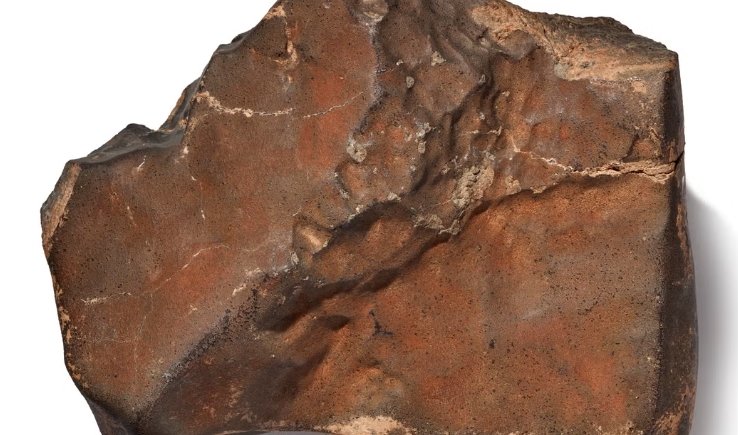
Weighing over 54 pounds, the meteorite is massive compared to its siblings. Most Martian meteorites are tiny. A pebble here, a baseball-sized chunk there. This one? It’s like finding a whole boulder.
Found By A Keen-Eyed Hunter
On July 16, 2023, in the remote Kefkaf region of Niger, an amateur meteorite hunter spotted something odd sticking out of the sand. Turns out, that odd lump was worth more than gold.
A sample was sent to the Shanghai Astronomy Museum for testing. Scientists there confirmed it wasn’t just any rock from space — it was from Mars itself. They spotted a coarse-grained texture full of pyroxene, maskelynite, and olivine. That chemical fingerprint matched perfectly with known Martian meteorites.
Why It Matters So Much
This isn’t just an expensive rock. It’s a snapshot of our cosmic neighborhood.
Martian meteorites get blasted off Mars’ surface by asteroid impacts. Then, they drift for who-knows-how-long before Earth’s gravity reels them in. When one this big survives its fiery plunge through the atmosphere, it’s a science jackpot.
Collectors, researchers, and deep-pocketed space buffs want their hands on it. Sotheby’s, which will auction NWA 16788 on July 16 as part of its annual Natural History Auction, estimates it could sell for as much as $4 million.
A Look Inside The Meteorite
Here’s what makes this thing special:
-
Weight: Over 54 pounds — easily dwarfing the average Martian meteorite.
-
Composition: Pyroxene, maskelynite, olivine — minerals that tell scientists about Mars’ volcanic past.
-
Condition: Coarse-grained but intact, meaning it wasn’t smashed to bits when it hit Earth.
One scientist put it like this: “Every chunk of Mars that lands here is a free space probe.” You can’t get that level of science without hauling samples back on a billion-dollar NASA mission.
An Out-Of-This-World Price Tag
It’s not every day a rock can pay off your house — maybe even your block. Meteorite collectors have always shelled out big bucks for rare specimens. In 2021, a Moon rock sold for $2.5 million. But this one could break records.
A quick comparison table says it all:
| Meteorite Type | Known Specimens | Record Price |
|---|---|---|
| Martian (NWA 16788) | ~400 | Est. $4 million |
| Lunar | ~650 | $2.5 million |
| Ordinary Chondrite | Thousands | Typically <$10K |
That’s some pricey space dust.
Who Buys This Stuff?
Some pieces end up in museums. Others in private vaults. A few rich collectors keep them as status symbols. And yes, a few get cracked open in labs for research. But most buyers? They want a chunk of the cosmos on their shelf.
Don’t be surprised if NWA 16788 gets its own glass case and security guard. For now, though, it’ll have its moment in the auction room, where deep-pocketed bidders will fight to own a piece of the Red Planet.