
BUSINESS
Amazon AWS Hits Fastest Growth in Years as AI Spend Pays Off
Amazon Q2 sales hit $200.6 billion with AWS up 37 percent and AI chips each past $25 billion run rates, even as free cash flow turned negative on heavier investment.

Amazon reported second-quarter net sales of $200.6 billion, up 20 percent from a year earlier and well ahead of expectations near $196 billion. AWS sales jumped 37 percent to $42.2 billion, its fastest pace in 18 quarters, while shares surged more than 9 percent after hours.
The beat rested on AI demand that also pushed free cash flow deeply negative and prompted a fresh raise in full-year capital spending.
What the Numbers Showed Across Segments
North America sales rose 16 percent to $116.2 billion. International sales climbed 15 percent to $42.2 billion. AWS matched that international total at $42.2 billion and supplied the bulk of the upside.
Operating income reached $27.5 billion, up 43 percent. AWS alone contributed $16.6 billion of operating income at a 39.4 percent margin. Net income hit $62.6 billion, or $5.75 per diluted share, but $53.4 billion of that came from non-operating pre-tax gains, primarily the mark-up on Amazon’s stake in Anthropic.
| Segment | Q2 Sales | YoY Growth | Operating Income |
|---|---|---|---|
| North America | $116.2B | 16% | $9.1B |
| International | $42.2B | 15% | $1.7B |
| AWS | $42.2B | 37% | $16.6B |
| Total | $200.6B | 20% | $27.5B |
The operating-income mix tells the story in plain terms. AWS delivered more than half of group operating profit from roughly one-fifth of sales. North America still produced solid absolute dollars at $9.1 billion, yet its margin trail sat well behind the cloud unit. International remained the smallest profit contributor even as sales matched AWS dollar for dollar.
Operating cash flow for the trailing twelve months rose 33 percent to $161.4 billion. Free cash flow swung to an outflow of $7.6 billion from an $18.2 billion inflow a year earlier. The swing tracked a $66.1 billion year-over-year jump in net purchases of property and equipment, almost all tied to artificial intelligence infrastructure.
| Cash Flow Metric | Current | Prior Year | Change |
|---|---|---|---|
| Operating cash flow (TTM) | $161.4B | – | +33% |
| Free cash flow | -$7.6B | +$18.2B | Swing to outflow |
| Net PPE purchases (YoY jump) | +$66.1B | – | AI infrastructure |
That cash-flow contrast frames the quarter. Earnings power expanded even as the company chose to convert operating cash into long-lived AI capacity rather than near-term free cash flow.
AWS Reacceleration and the $25 Billion AI Thresholds
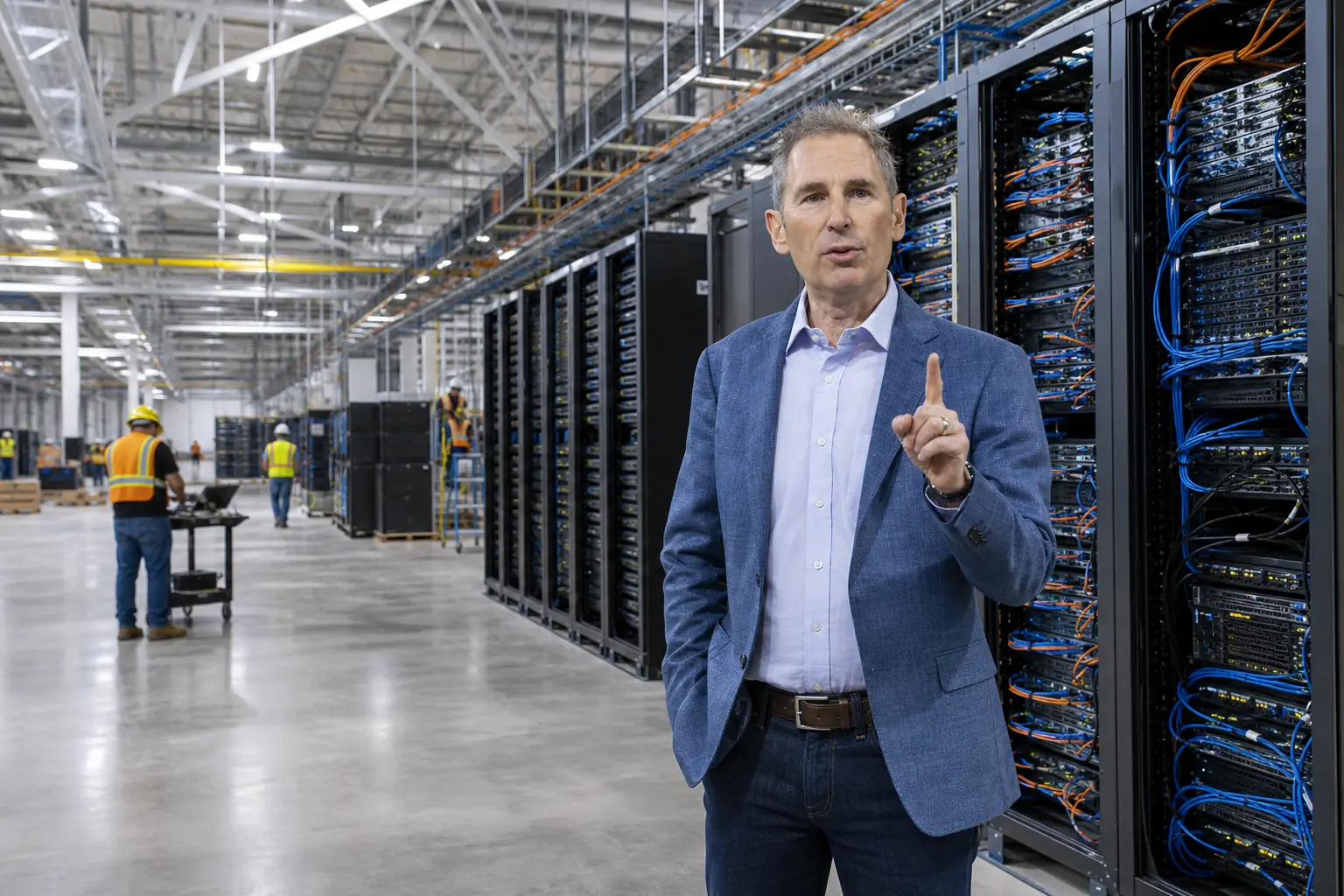
CEO Andy Jassy called the cloud unit “booming.” Growth accelerated for a fifth straight quarter. AWS now runs at a $169 billion annualized revenue rate. That figure alone would rank it 24th on the Fortune 500 if it stood alone.
Both the dedicated AI business and the custom chips business each crossed annualized run rates of more than $25 billion, both growing at triple-digit percentages. The Amazon Q2 2026 results release listed those milestones first among the post-earnings highlights.
Backlog reached roughly $496 billion and grew at triple-digit rates. Customers added more than $4.6 billion in AWS revenue quarter over quarter, about 80 percent larger than any prior sequential gain. Trainium won multi-year, multi-gigawatt commitments from Anthropic and OpenAI. Graviton5 entered general availability and is growing nearly twice as fast as its predecessor; 98 percent of the top 1,000 EC2 customers already use Graviton chips.
- Bedrock added more than 10 foundation models in the period, including OpenAI GPT-5.6, Anthropic Claude Opus 5, Google DeepMind Gemma 4 and Grok 4.3.
- Customer spending on Bedrock in Q2 exceeded all prior quarters combined.
- Hundreds of thousands of customers now use the service; more joined in the last six months than in its first two years.
- New agent tools, Lambda MicroVMs with eight-hour sessions, and a $1 billion Forward Deployed Engineering team aim to speed production agentic AI.
Core non-AI workloads also accelerated. Post-training, reinforcement learning and agent tool use still run heavily on CPUs, where Graviton’s price-performance edge helps pull broader cloud spend.
The sequential revenue step-up matters as much as the year-over-year rate. An incremental $4.6 billion in a single quarter, 80 percent larger than any earlier gain, shows demand compounding on an already large base. The $496 billion backlog, itself growing at triple-digit rates, extends that signal well beyond the current period.
Why Free Cash Flow Turned Negative
The cash outflow is the second-order face of the same demand spike. Amazon spent $53.1 billion on cash capital expenditures in the quarter alone. Full-year 2026 guidance moved from about $200 billion to approximately $220 billion, driven mainly by higher memory costs.
Jassy told investors on the call that even $220 billion will not cover all 2026 demand. The shortfall is expected to persist through 2027, with 2028 demand already strong. Power capacity is on track to double by the end of 2027 versus 2025 levels.
Management laid out a clear payback frame. Servers and networking gear typically break even in under three years on five-year contracts and then throw off free cash flow. Data-center shells last 30 years and host five or six generations of compute, compounding returns. AI margins are already visible and tracking the same profitability path the core cloud business followed at a similar stage, only faster.
That framing turned what once looked like open-ended spending into a temporary bridge. Crowd reaction on X quickly noted the shift: investors cheered the raise precisely because growth stayed ahead of capacity. The negative free-cash-flow print became proof that demand is real rather than a red flag.
- 2025 baseline: Power capacity reference point for the planned doubling.
- 2026: Capex guided near $220 billion, still short of full demand.
- Through 2027: Capacity shortfall expected to persist; power on track to double versus 2025.
- 2028: Demand already described as strong, extending the multi-year build.
The timeline compresses the investment case into a finite window. Hardware recovers capital inside a typical contract life. Buildings keep earning across multiple chip generations. The cash drain is front-loaded by design.
Anthropic Stake and the Custom Silicon Push
The $53.4 billion non-operating gain stemmed primarily from the Anthropic investment. That single mark-up more than tripled net income and produced the eye-catching EPS number. It also underscored how Amazon’s early capital and Trainium capacity have positioned it inside one of the leading foundation-model companies.
Chips themselves are no longer a side bet. The custom silicon business now generates the same $25 billion-plus annualized revenue as the AI services layer. Amazon continues a deep Nvidia partnership for customer choice while pushing Trainium and Graviton as cost and performance alternatives. Start-ups and larger firms including Uber and Pinterest have joined the Trainium roster.
Matching the AI services run rate with an in-house silicon business changes the economics of every incremental watt. Trainium commitments measured in multi-gigawatt terms from Anthropic and OpenAI lock in volume. Graviton’s reach across 98 percent of the top 1,000 EC2 customers spreads the same design advantage into the broader CPU estate that still carries post-training and agent workloads.
The dual path keeps Nvidia available for customers who want it while steadily raising the share of spend that runs on Amazon-designed silicon. That mix supports both the 39.4 percent AWS operating margin reported this quarter and the claim that AI margins are already tracking the historical cloud path at a faster clip.
Retail and Advertising Kept Pace
Stores set fresh records for Prime delivery speed in the first half. Same-day or overnight items rose more than 40 percent. Grocery and Everyday Essentials outgrew the rest of the business. Amazon Now, the 30-minute service, expanded to 80 more U.S. cities and towns plus markets in Egypt and now serves more than 250 locations across nine countries.
Advertising grew 26 percent. Alexa for Shopping, which merges Rufus and Alexa+, saw active users nearly double and interactions rise more than fivefold year over year. Customers who shop via Alexa spend over 40 percent more per order; Alexa+ trialists convert to Prime at nearly 25 percent higher rates.
- Same-day or overnight delivery volume: up more than 40 percent
- Amazon Now footprint: 250-plus locations across nine countries
- Advertising growth: 26 percent
- Alexa shopping interactions: more than fivefold year over year
- Alexa-driven order value: over 40 percent higher per order
- Alexa+ to Prime conversion: nearly 25 percent higher
Prime Video delivered solid NBA and NASCAR audiences. Amazon Leo, the low-Earth-orbit satellite network, reached nearly 400 satellites and is preparing initial service later this year. Zoox received NHTSA approval to charge for robotaxi rides.
Retail speed and advertising growth matter because they fund and reinforce the same balance sheet that is absorbing the AI build. Higher order values through Alexa and faster grocery turns improve the cash conversion cycle even as AWS soaks up capital. The 26 percent advertising gain adds a high-margin layer on top of the traffic those faster deliveries create.
How the Payback Math Supports the Spend
Management’s payback frame turns the $53.1 billion quarterly capital outlay and the $220 billion full-year guide into a set of measurable recoveries rather than an open check. Servers and networking gear reach break-even in under three years when placed against five-year contracts. Once that hurdle clears, the same assets generate free cash flow for the remainder of their contract life.
Data-center shells stretch the return further. A thirty-year building life that hosts five or six generations of compute means each shell can be refreshed repeatedly without repeating the full civil-works cost. The power-capacity plan to double by the end of 2027 versus 2025 levels simply extends the same logic to the grid side of the equation.
AI margins already visible and moving along the historical cloud profitability path, only faster, close the loop. The company is not asking investors to wait for an unproven model. It is pointing to a margin trajectory the core AWS business has already demonstrated, compressed into a shorter calendar.
That is why the raise to roughly $220 billion, and the admission that even that sum leaves 2026 demand uncovered, read as confidence rather than caution. Growth still outruns supply. The backlog at roughly $496 billion and the multi-year Trainium commitments supply the volume that makes the under-three-year hardware payback credible.
What the Guidance Leaves on the Table
Q3 sales guidance of $197 billion to $202 billion implies 9 to 12 percent growth, or roughly 400 basis points higher once Prime Day timing is stripped out. Operating income is pegged at $22.5 billion to $26.5 billion. Both ranges sit below the just-printed 20 percent sales growth and 43 percent operating-income growth, leaving explicit room for continued buildout costs.
The gap between reported momentum and guided pace is intentional. Capacity remains the binding constraint even after the latest spend increase. Guiding conservatively keeps the focus on execution of the power and silicon ramp rather than on beating a stretched near-term number.
Jassy’s longer description of a multi-year window in which AWS can become several times larger, potentially approaching a trillion-dollar annual revenue business, sits on the far side of that same constraint. Attractive free-cash-flow and ROIC characteristics appear once the current capacity wave is absorbed. Until then, the print will keep showing heavy capital intensity alongside accelerating revenue.
Capacity Race Through 2027
Q3 guidance calls for net sales of $197 billion to $202 billion, or 9 to 12 percent growth. Excluding Prime Day timing the growth rate would sit roughly 400 basis points higher. Operating income is guided at $22.5 billion to $26.5 billion. The numbers look conservative against the just-reported momentum, yet they leave room for the continued buildout costs.
Jassy described a multi-year window in which AWS can become several times larger, potentially approaching a trillion-dollar annual revenue business over a long horizon, with attractive free-cash-flow and ROIC characteristics once the current capacity wave is absorbed. The full second-quarter financial exhibit and the earnings call transcript details both emphasize that the company is still capacity-constrained even after the latest spend increase.
Peers Microsoft and Alphabet also posted solid cloud numbers in the same reporting cycle. Amazon’s reacceleration to 37 percent at this absolute scale, paired with its own silicon and the Anthropic gain, set it apart for the quarter. The market response, a roughly 9.5 percent after-hours jump, shows investors are willing to fund the next leg of the build when the growth and backlog are this visible.
The temporary free-cash-flow hole is the price of locking in that position while demand still exceeds what anyone can supply.


Halo Campaign Evolved Skulls Meet Death Barriers That Kill the Hunt

Spotify Running Mode Returns After the 2015 Experiment Failed

Amazon AWS Hits Fastest Growth in Years as AI Spend Pays Off

Amazon Bets Platform Beats Models in the AI Race

Apple C2 Modem Edges Into iPhone 18 Pro After Qualcomm Drop

Google Earth Adds Nano Banana 2 to Reimagine Real Places

Apple Upgrade Turns Phones Into Monthly Utility Bills

Asha Sharma Bets Xbox Growth on Console and Four C’s

MacBook Ultra Design Follows Apple’s Familiar Cascade Path

TAG Heuer Carrera x Team Ikuzawa Revives 1970s Roadmaster Stopwatch DNA

Pokémon GO Developer Niantic Rebrands as Scopely Explore

Persona 4 Revival Hands All Anime Cutscenes to Studio MAPPA

Jaylen Brown Traded to 76ers for Paul George and Four Draft Picks

Doom Studio id Software Cuts Half Its Staff in Xbox Layoffs

Nintendo Switch Online Adds Four Classics and One Japan-Only Title

Jordan Henderson Hospitalized After Wrist Injury at the Azteca

Mexico’s World Cup Run Ends at Azteca as England Hold On 3-2

Meta’s Muse Image Lets Anyone Use Your Instagram Photos in AI

Louis Vuitton Beats Molly Tea in China, Triggers Cultural Backlash

Pink Bearista Cup Returns July 13 as Starbucks Pink Vibes Drops
-

 TECHNOLOGY3 years ago
How to Adjust a Bulova Watch Band – An Easy Guide
-

 News3 years ago
Fred Pentland: Athletic Bilbao’s English mentor who changed the essence of Spanish football
-

 FINANCE3 years ago
Tax Planning for Every Season: Guide to Maximizing Your Tax Benefits
-

 Education3 years ago
African Ministers New Education Plan
-

 BUSINESS3 years ago
What is Entrepreneurial Operating System? A Comprehensive Guide to EOS
-

 Education3 years ago
Innovate Your Learning Journey with Technology and Enhance Education
-

 News3 years ago
Russians formally out of World Athletics Championships
-

 BUSINESS3 years ago
Top 9 Most Expensive American Cities to Rent an Apartment