
BUSINESS
Amazon Bets Platform Beats Models in the AI Race
Amazon’s $200 billion 2026 AI spend and $15 billion AWS AI run-rate show the wager on multi-model rails and custom chips is already paying.

Amazon’s AWS AI business already generates an annualized run rate above $15 billion, roughly a tenth of the cloud unit, while the company commits roughly $200 billion in 2026 capital spending mostly to AI infrastructure. That combination frames a clear corporate wager: control the rails, the chips and the multi-model platform rather than own the single best model.
Investors still debate OpenAI, Anthropic, Google and Meta for model supremacy. Amazon is collecting rent either way.
The Wager Amazon Is Making
Most of the market treats the AI race as a beauty contest among foundation models. Amazon’s posture is different. It wants every serious model to run inside AWS, on Amazon silicon when possible, next to the customer’s existing data and applications.
That stance shows up in product choices. Amazon Bedrock hosts Claude, OpenAI models and Amazon’s own Nova family side by side. Customers pick the model; Amazon keeps the workload, the storage bill, the networking fees and the agent runtime. Data gravity does the rest. Once inference sits near a company’s core systems, switching clouds becomes painful.
CEO Andy Jassy has been explicit. The company is not trying to be conservative. It is spending to lead the infrastructure layer that every AI application ultimately requires. The bet is structural: own the place where models run, not the models themselves.
- $15B+ AWS AI annualized revenue run rate as of Q1 2026
- $20B+ custom chips run rate (Graviton, Trainium, Nitro), triple-digit year-over-year growth
- $200B planned 2026 company-wide capital expenditures, predominantly AWS and AI
- 100,000+ customers already running Claude on AWS
Those figures turn the abstract “picks and shovels” story into a measurable business line that is already material. Revenue at that scale means the platform layer is no longer a side option inside a larger cloud story. It is a line item large enough to move the group’s growth rate on its own.
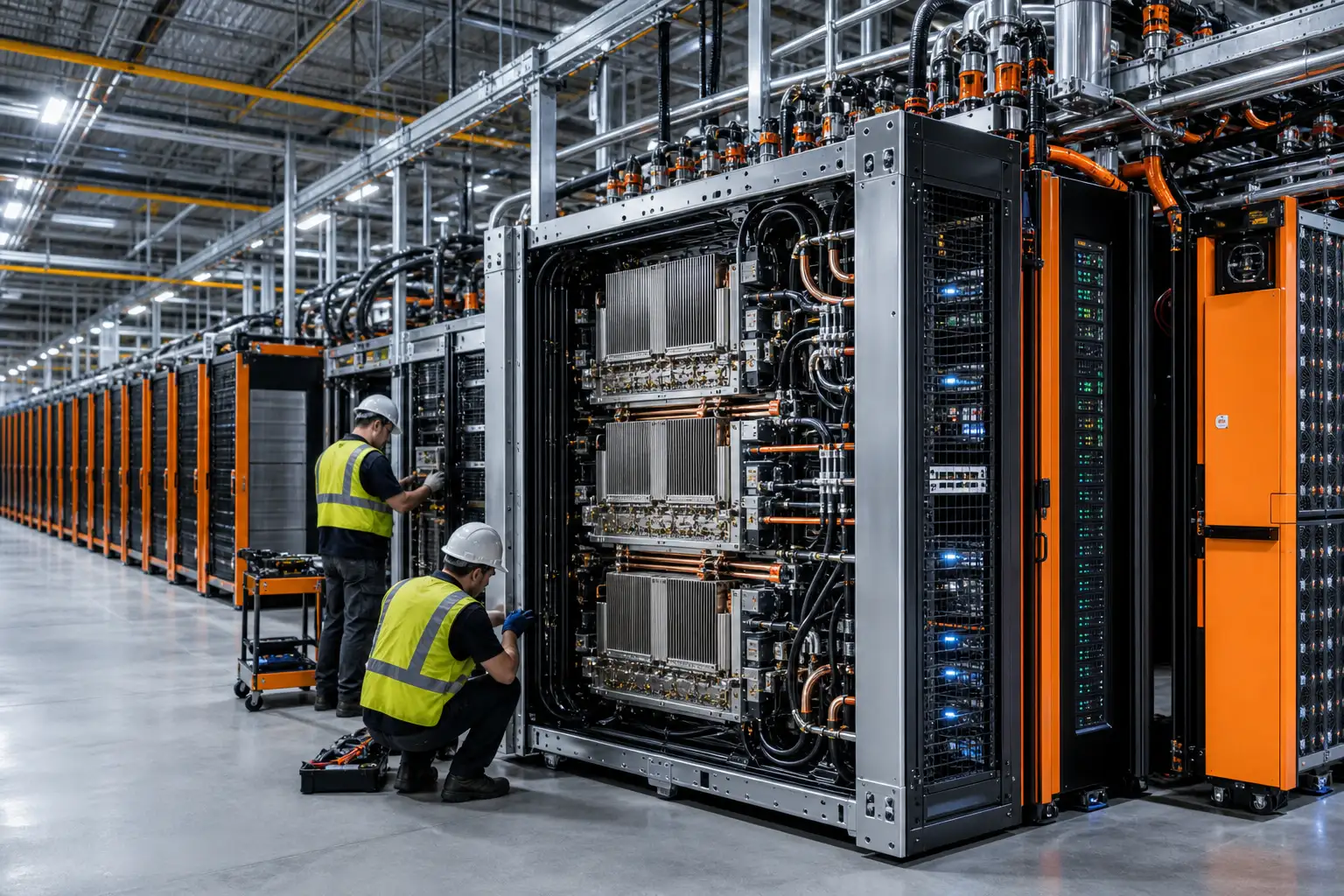
Early Scoreboard on the Platform Bet
Three years into the generative AI wave, AWS AI revenue is nearly 260 times larger than the entire AWS business was at the same age after its 2006 launch. Jassy highlighted the comparison on the Q1 call and in follow-up remarks.
| Metric | Figure | Context |
|---|---|---|
| AWS AI run rate | Over $15 billion | ~10% of AWS total run rate near $142-150B |
| Custom silicon run rate | Over $20 billion | Graviton + Trainium + Nitro; nearly 40% QoQ growth in Q1 |
| Bedrock token volume | More in Q1 than all prior years combined | 170% QoQ customer spend growth |
| AWS overall growth | Recently 24-28% YoY | Fastest stretches in 13-15 quarters at various points |
| Cloud market share (Q1 2026) | ~28% | Azure ~21%, Google Cloud ~14% (Synergy Research) |
The share number is the soft spot. AWS remains largest, yet Microsoft and Google have posted faster percentage growth for several quarters. Amazon’s absolute dollars still dwarf most competitors, but the gap is no longer widening the way it once did.
Still, the AI slice is growing far faster than core cloud. That is the part of the scoreboard that matters most for the bet. Bedrock token volume in a single quarter exceeding all prior years combined is the clearest signal that usage, not just pilots, is driving the run rate.
Why Customers Keep Choosing the Rails
Jassy listed four practical reasons enterprises stick with AWS for AI work. They form a short checklist rather than marketing slogans.
- Broader tool set: SageMaker for training (up to 40% faster claimed), Bedrock for multi-model inference, AgentCore and Strands for production agents, plus turnkey agents in Connect, Kiro and Quick.
- Data and application proximity: most enterprise data already lives in AWS, so inference stays close and latency and compliance improve.
- Breadth of non-AI services: once AI is running, customers buy more compute, storage, databases and security from the same vendor.
- Security and operational track record: governments and regulated industries still treat AWS as a default for critical workloads.
Bedrock’s token volumes exploding and AgentCore deploying agents as often as every 10 seconds give the checklist teeth. OpenAI models, including newer reasoning versions, now sit inside the same environment. That lets a developer swap or mix OpenAI models that reason step by step without leaving AWS billing or identity controls.
The checklist also explains stickiness after the first workload lands. Training on SageMaker, inference on Bedrock, and agents on AgentCore all draw from the same identity, networking and compliance perimeter. Each extra service raises the cost of a partial migration later.
Custom Silicon Turns Cost into Moat
Trainium and Inferentia are no longer side projects. The broader custom-chip business crossed a $20 billion annualized run rate and is growing at triple-digit percentages. Amazon claims superior price-performance versus merchant GPUs for many training and inference jobs.
Anthropic’s expansion crystallizes the point. The lab is securing Anthropic to secure up to 5 gigawatts of current and future Trainium capacity and committing more than $100 billion over the next ten years to AWS technologies. Amazon is investing another $5 billion immediately and up to $20 billion more later, on top of its earlier $8 billion stake.
| Commitment | Scale | Role in the bet |
|---|---|---|
| Anthropic compute commit | More than $100B over ten years | Long-duration demand for AWS tech and Trainium |
| Trainium capacity for Anthropic | Up to 5 gigawatts | Physical lock-in of frontier training on Amazon silicon |
| Amazon equity in Anthropic | $5B now, up to $20B later, after earlier $8B | Aligns chip roadmap with a top model lab |
| OpenAI-tied customer spend | More than $100B | Covers a substantial share of 2026 capex payback |
| Project Rainier | Nearly 500,000 Trainium2 chips | Live cluster already training Claude at frontier scale |
Project Rainier, built with nearly half a million Trainium2 chips, already ranks among the largest AI clusters on the planet and is actively training Claude. Anthropic engineers sit close enough to Annapurna Labs that next-generation silicon is co-designed against real frontier workloads. Other AWS customers inherit those improvements.
We’re not investing approximately $200 billion in capex in 2026 on a hunch.
Jassy wrote that line in his shareholder letter, pointing to large customer commitments, including more than $100 billion tied to OpenAI, that cover a substantial portion of the spend and should monetize mainly in 2027 and 2028.
Custom silicon therefore does double duty. It lowers Amazon’s cost to serve high-volume training and inference, and it gives large labs a reason to pre-commit capacity years ahead. The $20 billion-plus chip run rate shows the internal economics are already working at scale.
The Rest of the Flywheel Still Spins
AI is not a stand-alone AWS product. Better recommendations, inventory forecasting and route optimization lift retail conversion and lower fulfillment cost. Stronger targeting lifts advertising, already a high-margin cash engine north of $70 billion by some investor tallies. More merchants and more ad dollars generate more data and more cloud demand. The loop reinforces.
Robotics and warehouse automation ride the same capital plan. One analysis circulating among investors notes the $200 billion also funds automation that could help Amazon avoid hiring hundreds of thousands of additional workers over the next decade while volume doubles. That is a margin story, not just an AI story.
Even the competitive threat of cheaper Chinese AI models gaining traction lands differently for Amazon. If startups and some enterprises shift to lower-cost models, those models still need to run somewhere. Bedrock and Trainium can host them. The platform collects either way.
- Retail gains from better forecasting, recommendations and routing
- Advertising gains from stronger targeting on a base already north of $70 billion
- Automation gains from robotics funded inside the same $200 billion plan
- Cloud gains when cheaper external models still land on Bedrock and Trainium
Each leg feeds the others. Higher retail and ad volume creates more data. More data makes AWS the natural home for the next round of agents and fine-tunes. The flywheel does not require Amazon to win a model beauty contest.
Capex Scale and the Share Fight
Two hundred billion dollars in one year is larger than many countries’ tech budgets. Free cash flow will take a visible hit in 2026. Depreciation will rise for years afterward. Azure and Google Cloud keep posting higher growth rates and are closing the absolute gap. Oracle and specialized neoclouds are winning certain GPU-heavy niches.
Execution risk is real. If demand softens or if power and supply-chain constraints slow capacity delivery, the payback window stretches. Crowd conversation on X keeps returning to the same practical question: can the new capacity repay itself before the next hardware cycle turns over?
Amazon’s answer is volume of committed spend already on the books and the speed at which installed capacity is monetized. Jassy has said the company is installing and selling as fast as it can. Recent AWS growth re-accelerations to the mid-20s and higher give that claim some cover.
- 2023 onward: Initial Amazon-Anthropic partnership and early Bedrock Claude availability.
- Project Rainier launch: Nearly 500,000 Trainium2 chips for Claude training and inference.
- April 2026: Expanded deal, up to 5 GW Trainium capacity, Anthropic $100B+ decade commit, Amazon additional equity.
- 2026 full year: $200B company capex, majority directed at AI data centers, networking and silicon.
- 2027-2028: Expected peak monetization window for the current buildout wave per management.
That sequence is the physical timeline of the bet. The middle years matter most: capacity must come online while the large customer commits are still converting into billed usage, not just reserved options.
Multi-Model Hosting Widens the Rent Base
Bedrock’s design choice to host Claude, OpenAI models and the Nova family side by side is the mechanism behind the “collect rent either way” claim. A customer can change models without changing cloud, billing, identity or data location. Amazon keeps the storage bill, the networking fees and the agent runtime regardless of which nameplate wins the next benchmark cycle.
That architecture also explains the 100,000-plus customers already running Claude on AWS and the 170 percent quarter-over-quarter rise in Bedrock customer spend. Volume arrives because switching cost inside the platform is low, while switching cost out of the platform is high. Data gravity and the non-AI service bundle do the retention work after the first serious workload lands.
AgentCore’s pace, deploying agents as often as every 10 seconds, extends the same logic from single inference calls to production agent fleets. Once agents are wired into Connect, Kiro, Quick and the customer’s own systems, the runtime fee becomes recurring. Model choice remains flexible; the meter stays on AWS.
How Decade Deals Change Capex Math
The OpenAI-tied commitments above $100 billion and Anthropic’s more than $100 billion decade commit to AWS technologies are not marketing color. They are the demand side of Jassy’s claim that 2026 capex is not a hunch. Together they cover a substantial portion of the spend and point monetization mainly at 2027 and 2028.
Long contracts also change how investors should read free-cash-flow pressure in 2026. A one-year cash outflow looks different when multi-year, multi-gigawatt capacity is already spoken for by named frontier labs. Project Rainier’s nearly half a million Trainium2 chips already training Claude is proof that at least one of those commits has moved from paper to silicon under load.
The remaining variable is share. AWS still holds about 28 percent of the cloud market against Azure near 21 percent and Google Cloud near 14 percent, yet rivals have grown faster for several quarters. Absolute AI dollars can rise while percentage share slips. The platform bet still works if production agents and inference traffic stay inside the perimeter; it weakens if faster-growing rivals peel off the next wave of greenfield AI workloads before data gravity sets in.
Where Holders Sit if the Bet Pays
If AI adoption keeps compounding across enterprises, Amazon does not need Claude or any single model to finish first. It needs the majority of production agents, fine-tunes and inference traffic to stay inside its perimeter. Custom silicon then improves gross margins on that traffic. Retail and ads capture second-order lift. The result is a wider, stickier economic engine than a pure model company can build.
The AWS AI revenue run rate over $15 billion already proves the first leg of the wager is working. The Anthropic and OpenAI capacity commitments prove large customers are willing to lock in for a decade. The remaining test is whether 2026’s historic capital outlay converts into durable free-cash-flow growth by 2028 without permanent share loss to faster-growing rivals.
Amazon has made this kind of long-cycle infrastructure bet before. Cloud itself was one. The early numbers say the company is treating AI the same way, only larger and faster.


Spotify Running Mode hits Android and revives its old tempo experiment

Galaxy Tab S12 Ultra Renders Keep the Notch Fans Hate

Novato Spinning Round House Sells With Six Neighbors for $3.3 Million

Crop Tour Finds Indiana and Nebraska Corn Yields Lagging 2025

Best Buy 60th sale brings Android deals back to its roots

American Airlines reverses seatback screen bet years too late

Iran Hormuz Strikes Force Gulf Oil Onto Costlier Paths

Plague Tale Prequel Day One Joins Game Pass Wave 2 as Witcher Exits

NBA 2K27 opens The City to everyone and rewrites career eras

iOS 26.6.1 Patches 29 Flaws as AI Forces Faster Apple Updates

Caitlin Clark Skips the WNBA 3-Point Contest for a Third Straight Year

Rainout Gives Red Sox Two Shots at a Franchise-Record Win Streak

Double Fine Cuts 23 Jobs Weeks After Xbox Independence

Day-One Big Walk Lifts PS Plus August Beyond Recycled AAA

John Hight Exits Wizards After Digital Reckoning Hits

Curtis Mead’s Red Sox Debut Ends With Fractured Wrist

Moesch and Dressel Rewrite Night One at 2026 U.S. Nationals

Red Sox Squander Hot Streak Chance in 4-3 Loss to Athletics

Boutte’s Quiet Camp Takeover Forces Patriots Receiver Choices

Take-Two CEO Pushes Netflix Subs for GTA 6 Extended Look
-

 TECHNOLOGY3 years ago
How to Adjust a Bulova Watch Band – An Easy Guide
-

 News3 years ago
Fred Pentland: Athletic Bilbao’s English mentor who changed the essence of Spanish football
-

 FINANCE3 years ago
Tax Planning for Every Season: Guide to Maximizing Your Tax Benefits
-

 Education3 years ago
African Ministers New Education Plan
-

 BUSINESS3 years ago
What is Entrepreneurial Operating System? A Comprehensive Guide to EOS
-

 Education3 years ago
Innovate Your Learning Journey with Technology and Enhance Education
-

 News3 years ago
Russians formally out of World Athletics Championships
-

 BUSINESS3 years ago
Top 9 Most Expensive American Cities to Rent an Apartment