
FINANCE
Kospi Surges 16% as Chip Giants Snap Back After Rout
South Korea’s Kospi climbed more than 16% Friday as Samsung and SK Hynix soared on Microsoft’s AI earnings.

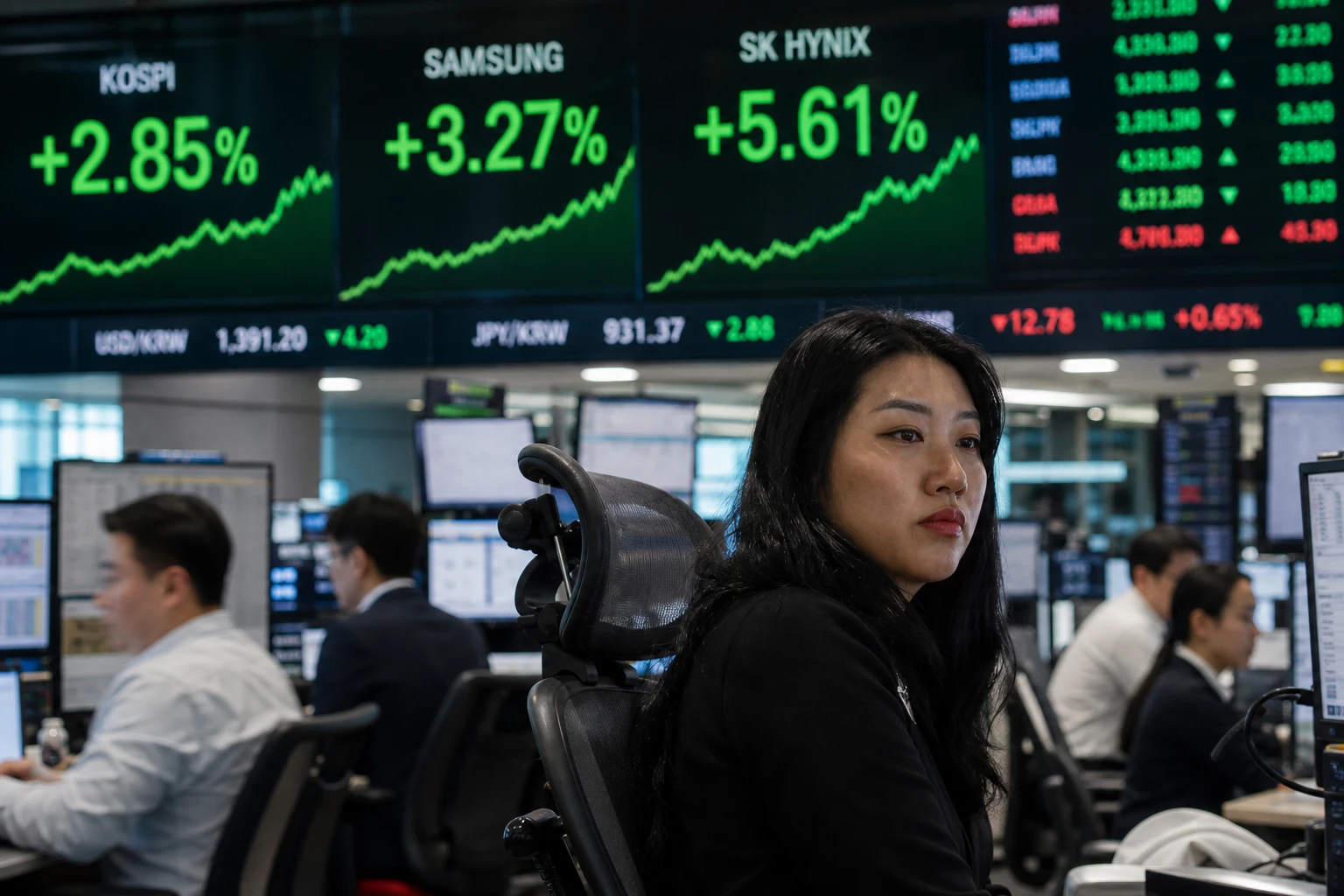
South Korea’s Kospi index jumped more than 16% on Friday as Samsung Electronics and SK Hynix led a furious rebound in chip stocks. The surge tracked a Wall Street bounce after Microsoft reported stronger-than-expected profits that investors read as proof AI spending is paying off.
Early trading saw the benchmark hit 16.5% higher at 6,515.40 before paring. The move came after the index sank more than 17% across the prior three sessions on AI bubble fears and China competition worries.
The Numbers Behind Friday’s Snapback
Samsung Electronics shares climbed 24.8%. Memory specialist SK Hynix jumped 27.8%. Those two names alone drive more than half the Kospi’s market value, so their moves set the entire index.
| Index or Stock | Friday Move | Context |
|---|---|---|
| Kospi | +16.5% early / still double-digit midday | Prior three days >17% drop |
| Samsung Electronics | +24.8% | Core AI memory and foundry exposure |
| SK Hynix | +27.8% | High-bandwidth memory leader |
| Nikkei 225 | +5.5% early | SoftBank +15%, Tokyo Electron ~+11% |
By some tallies the session ranked among the Kospi’s largest single-day gains on record. One widely shared market note put the value added near ₩585 trillion, or roughly $480 billion. Even so the index stayed well below its June peak above 9,000. Kospi historical closing levels show how far the multi-week slide had run before Friday’s reverse.
The arithmetic is simple. When more than half the index weight moves nearly 25% in a single session, the benchmark cannot stay flat. The early print at 6,515.40 already priced in that concentration. Midday paring did not erase the double-digit gain because the two chip leaders kept most of their advances.
The ₩585 trillion figure also underscores the scale of the prior damage. A rebound that large only appears after a wipeout of similar size. The three-day drop above 17% had cleared enough forced sellers for buyers to push prices through thin offers once the sentiment switch flipped.
Microsoft Earnings Flipped the Sentiment Switch
Microsoft shares soared 15.5% Thursday, its best day in nearly 18 years, after the company posted stronger profits and pointed to AI demand that is already converting into cash. Azure growth topped estimates. Management also signaled it could adjust capital spending if demand cooled, easing overcapacity fears.
Traders who had dumped Korean tech only days earlier flooded back. Stephen Innes of SPI Asset Management captured the whiplash: “The market went from throwing AI stocks overboard to fighting for the remaining seats before most traders had finished writing the obituary.”
The same profit signal lifted U.S. futures and other Asian tech names. Taiwan’s Taiex jumped more than 7%. The broader pattern was clear: one hyperscaler beat was enough to reverse a week of panic.
The mechanism was straightforward. Investors had been treating every soft data point as proof that AI spending would stall. Microsoft’s numbers showed cash arriving now, not only promises of future demand. The capital-spending flexibility removed the other fear: that big tech would keep building capacity into a slowdown. Korean memory names, priced as pure AI leverage, moved first and farthest.
Concentration Turns Every AI Swing Into a Market Event
Samsung and SK Hynix together made up more than half the Kospi’s weighting by June. In some periods their related leveraged products accounted for over 70% of local trading value. That structure lifts the whole market when AI optimism runs hot. It also drags everything down when sentiment cracks.
- Chipmakers drove the bulk of the 2026 rally that took the Kospi past 9,000.
- The same names led the roughly 40% value wipe from the June high in just weeks.
- Retail flows into single-stock leveraged ETFs amplified both legs.
- Foreign investors had already been net sellers for stretches before the latest crash.
Analysts called the earlier drop more positioning than fundamentals. Memory prices had still risen 50% to 80% sequentially in the second quarter. SK Hynix itself reported a six-fold profit jump, yet shares fell hard because results missed the loftiest expectations. The market was pricing the pace of growth, not the end of demand.
That gap between reported profits and share prices is the signature of a concentrated, leveraged market. When two stocks dominate weight and trading, the index stops behaving like a broad economy gauge. It becomes a high-beta proxy for whatever narrative is moving global AI names that day.
Leverage Left Retail Holding the Bag
The selloff that preceded Friday’s rebound was brutal for leveraged players. The Kospi had already tumbled nearly 11% one day and then another 6% the next, with an intra-day 12.6% plunge that triggered a trading halt. Volumes stayed light on the way down as forced unwinds hit.
Finance Minister Koo Yun-cheol apologized in parliament for the single-stock leveraged ETFs that had supercharged the boom. Officials moved to tighten rules further. A late-night meeting of the finance ministry, Bank of Korea and regulators produced promises of emergency stabilization powers.
- Individual investment caps around 20% of a portfolio
- Higher trading costs on leveraged products
- Simulated-trading requirements before full access
- Emergency stabilization powers for authorities
That backdrop explains why the rebound felt so sharp. Liquidations created air pockets. Once Microsoft removed the immediate fear, the same leverage that crushed prices on the way down helped rocket them higher. On X and trading desks the counter-view was blunt: treat the bounce as a sell-on-rise as long as the index stays under roughly 7,500, with a new low still possible.
The earlier phase of the rout, including the earlier Kospi plunge on the SK Hynix miss, already showed how quickly the structure can reverse.
China Competition Still Sits in the Background
Part of the three-day dump traced to fresh worries about Chinese memory rivals. Reports of domestic deep-ultraviolet lithography tools and the blockbuster listing of ChangXin Memory Technologies (CXMT) raised the risk of faster capacity growth and price pressure in commodity DRAM.
CXMT remains years behind the Korean leaders in high-bandwidth memory for AI accelerators. Yet its scale-up and the CXMT IPO that rattled global chip stocks were enough to feed the narrative that the AI memory supercycle might face new supply. Korean shares absorbed that hit first because of their outsized index weight.
Fundamentals for advanced memory still look supported by multi-year shortages and long-term hyperscaler contracts. The second-order question is whether every China headline will keep producing the same amplified Kospi moves.
The distinction matters for the next leg. Commodity DRAM faces a different supply curve than high-bandwidth memory. Korean leaders still hold the latter franchise. Headlines that blur the two products will keep hitting the Kospi harder than peers with less index concentration, even when the underlying technology gap has not closed.
What Else Moved Across Asia and Beyond
Tokyo’s Nikkei climbed 5.5% early to 65,282. SoftBank, an OpenAI backer, jumped 15%. Chip-equipment name Tokyo Electron rose nearly 11%. Hong Kong’s Hang Seng and the Shanghai Composite posted smaller gains. Australia’s ASX added 0.4%.
| Market or Name | Move | Note |
|---|---|---|
| Kospi | +16.5% early | Chip-led snapback |
| Taiwan Taiex | +7%+ | AI supply-chain bounce |
| Nikkei 225 | +5.5% early | SoftBank +15% |
| Tokyo Electron | ~+11% | Chip equipment |
| ASX | +0.4% | Smaller spillover |
| S&P 500 (Thu) | +1.7% | Nasdaq +2.8% |
The dollar fell sharply against the yen overnight on suspected intervention after the pair traded above 160, near multi-decade extremes. Japanese media pointed to a New York Fed rate check consistent with coordinated action. The dollar later bounced 0.6% to around 160.61 yen. The Bank of Japan held rates steady as expected. Analysts saw the currency move as timed to damp speculation around the decision.
Oil slipped. Brent fell 1.3% to $85.76 and U.S. crude 1.5% to $82.32 as ship-tracking data hinted at slightly better tanker flows through the Strait of Hormuz, still constrained by the longer U.S.-Iran conflict. On Thursday the S&P 500 had risen 1.7%, the Dow 1.2% and the Nasdaq 2.8%.
- June 19, 2026: Kospi hits record high above 9,000, briefly past 9,100.
- Early July: Index already ~20% off peak and enters technical bear territory.
- Late July (Tue-Wed): Back-to-back double-digit and high-single-digit drops, $2 trillion-plus market value erased, trading halt, leverage unwind.
- July 29: Microsoft reports strong quarter; shares surge next session.
- July 31: Kospi snaps back more than 16%, chips lead Asia higher.
The sequence shows how quickly the AI narrative can reverse when one large U.S. name clears a sentiment hurdle.
Memory Fundamentals Held Up Through the Slide
The three-day collapse looked like a demand scare. The underlying memory numbers told a quieter story. Prices had still risen 50% to 80% sequentially in the second quarter. That gain landed even as share prices were already rolling over from the June peak.
SK Hynix reported a six-fold profit jump in the same stretch. The stock still fell hard because the print missed the most aggressive forecasts. Positioning, not collapsing orders, drove the selling. Analysts who stayed focused on the contracts saw multi-year shortages and hyperscaler commitments still intact.
Friday’s rebound did not invent those fundamentals. It simply stopped ignoring them. Once Microsoft showed AI demand converting into cash, the same supply tightness that had been dismissed as old news returned to the front of the tape. The gap between operating reality and market price had grown wide enough for a single clean catalyst to close part of it in a day.
The Bounce Leaves Traders Split on What Follows
Even a 16% surge left the Kospi far below the June high above 9,000. The counter-view circulating on desks and social feeds treated the move as a chance to sell into strength while the index remained under roughly 7,500. That camp still sees room for a fresh low.
Year-to-date gains had once run above 40% in dollar terms, among the strongest starts of any major market. Those earlier profits explain both the size of the leveraged bets and the speed of the forced exits. Retail investors who rode single-stock products higher absorbed the bulk of the damage on the way down.
Global funds now watch Seoul as an almost round-the-clock read on AI risk appetite, trading in close step with U.S. chip names. That linkage cuts both ways. A clean hyperscaler beat can lift the Kospi before New York opens. A soft U.S. print can hit it just as fast. The Microsoft session proved the upside version of that transmission.
The Market Structure Still Dictates the Next Move
Even after Friday’s surge the Kospi sat far below the levels that produced Kospi crossing 9,000 earlier this year. Year-to-date gains remained strong in dollar terms, once above 40%, after one of the best starts among major markets. That does not erase the leverage residue or the concentration risk.
Policy makers are still tightening the rules around the products that turned ordinary profit-taking into a cascade. Retail investors who chased the upside with borrowed money already absorbed heavy losses. Global funds now treat the Kospi as an early read on AI risk appetite that trades almost around the clock with U.S. chip names.
The Microsoft beat bought a powerful rebound day. It did not rewrite the second-order reality: when two companies and a layer of leveraged ETFs dominate price discovery, every AI headline arrives in Seoul at full force.
The market went from throwing AI stocks overboard to fighting for the remaining seats before most traders had finished writing the obituary.
Stephen Innes of SPI Asset Management wrote that line as the bounce gathered pace. It still fits.


Halo Campaign Evolved Skulls Meet Death Barriers That Kill the Hunt

Spotify Running Mode Returns After the 2015 Experiment Failed

Amazon AWS Hits Fastest Growth in Years as AI Spend Pays Off

Amazon Bets Platform Beats Models in the AI Race

Apple C2 Modem Edges Into iPhone 18 Pro After Qualcomm Drop

Google Earth Adds Nano Banana 2 to Reimagine Real Places

Apple Upgrade Turns Phones Into Monthly Utility Bills

Asha Sharma Bets Xbox Growth on Console and Four C’s

MacBook Ultra Design Follows Apple’s Familiar Cascade Path

TAG Heuer Carrera x Team Ikuzawa Revives 1970s Roadmaster Stopwatch DNA

Pokémon GO Developer Niantic Rebrands as Scopely Explore

Persona 4 Revival Hands All Anime Cutscenes to Studio MAPPA

Jaylen Brown Traded to 76ers for Paul George and Four Draft Picks

Doom Studio id Software Cuts Half Its Staff in Xbox Layoffs

Nintendo Switch Online Adds Four Classics and One Japan-Only Title

Jordan Henderson Hospitalized After Wrist Injury at the Azteca

Mexico’s World Cup Run Ends at Azteca as England Hold On 3-2

Meta’s Muse Image Lets Anyone Use Your Instagram Photos in AI

Louis Vuitton Beats Molly Tea in China, Triggers Cultural Backlash

Pink Bearista Cup Returns July 13 as Starbucks Pink Vibes Drops
-

 TECHNOLOGY3 years ago
How to Adjust a Bulova Watch Band – An Easy Guide
-

 News3 years ago
Fred Pentland: Athletic Bilbao’s English mentor who changed the essence of Spanish football
-

 FINANCE3 years ago
Tax Planning for Every Season: Guide to Maximizing Your Tax Benefits
-

 Education3 years ago
African Ministers New Education Plan
-

 BUSINESS3 years ago
What is Entrepreneurial Operating System? A Comprehensive Guide to EOS
-

 Education3 years ago
Innovate Your Learning Journey with Technology and Enhance Education
-

 News3 years ago
Russians formally out of World Athletics Championships
-

 BUSINESS3 years ago
Top 9 Most Expensive American Cities to Rent an Apartment