
FINANCE
KOSPI Sidecar Halt Exposes AI Memory Concentration Risk
South Korea’s KOSPI triggered a program-selling sidecar as SK Hynix and Samsung fell hard, revealing how index weight and leverage amplify every AI trade reversal.

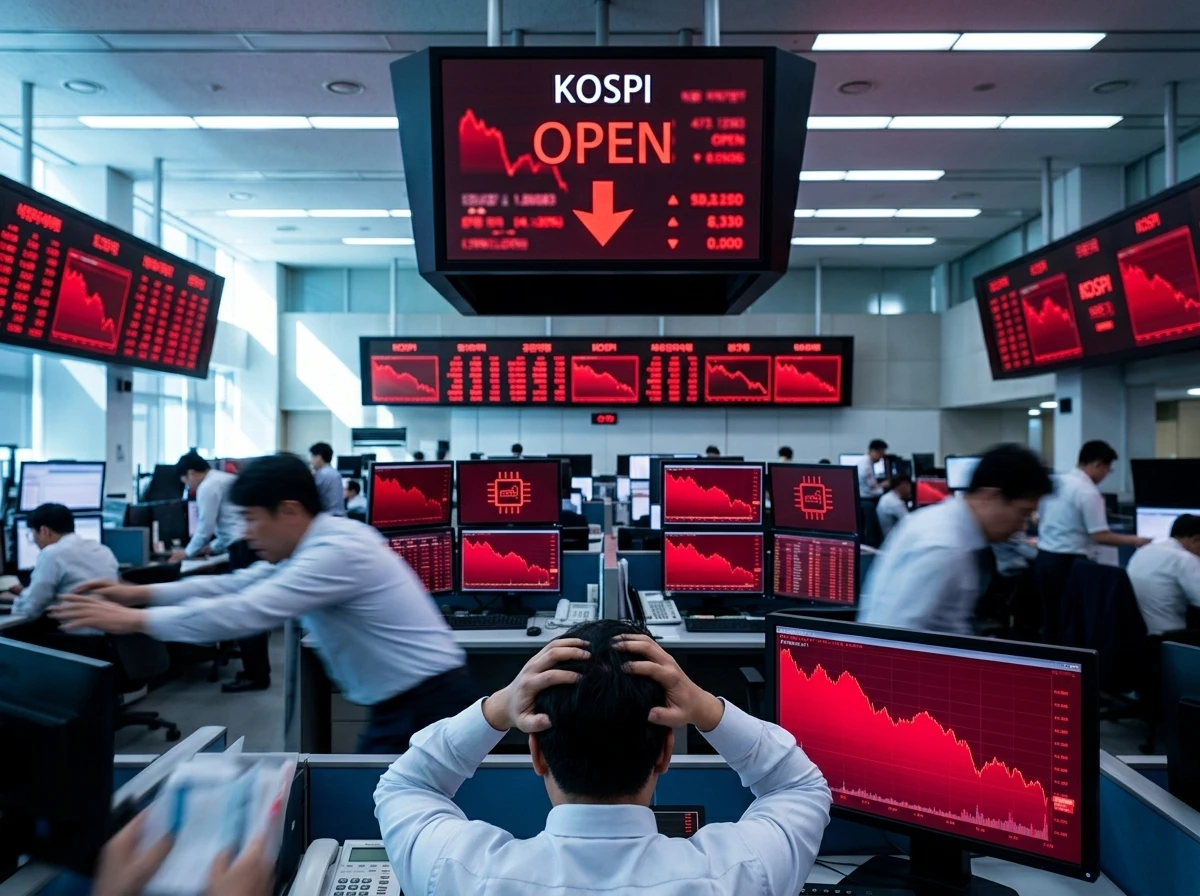
South Korea’s KOSPI slid as much as 6.4% on Wednesday and triggered a temporary program-selling halt after SK Hynix and Samsung Electronics led a fresh semiconductor rout. The index was last down 4.53% at 6,558.41.
The Korea Exchange activated its sell-side sidecar at 9:06 a.m. once KOSPI 200 futures had fallen 6.02% and stayed there for a minute. Early on, the benchmark itself stood 6.74% lower near 6,407.
The Numbers That Tripped the Sidecar
SK Hynix shares fell 6.56% on the day after sinking as much as 9.09% to 1.51 million won in the first half-hour. Samsung Electronics dropped 5.40%, having been off 7.45% at 248,500 won. The two names ranked among the heaviest drags on the index.
| Asset | Move | Level / Note |
|---|---|---|
| KOSPI | -4.53% (max -6.4%) | 6,558.41 last |
| SK Hynix | -6.56% (max ~-9%) | Early 1.51m won |
| Samsung Electronics | -5.40% (max -7.45%) | Early 248,500 won |
| SOX (Tue) | ~-5.6% | Worst since early July |
| Micron (Tue) | -7% | Memory hardest hit |
| U.S. 30-year yield | Touched 5.327% | Highest since 2007 |
Japan’s Kioxia fell 7.73% and TSMC slipped 1.47% as the selling spread across regional chip names. Hyundai Motor and Samsung Electro-Mechanics also joined the early drop.
Wall Street Overnight and the Yield Spike
The Philadelphia Semiconductor Index plunged 5.6% on Tuesday in its worst session since early July. Memory names led: Micron fell 7%, SK Hynix’s U.S.-listed shares dropped 9.2%, and Nvidia lost 2.3%. The Nasdaq closed 1.33% lower.
Rising bond yields added pressure. The U.S. 30-year Treasury yield climbed to its highest level since 2007 while the 10-year approached 4.72%. Higher long rates raise the discount applied to future earnings and make expensive growth stocks less attractive.
Investors pointed to heavy debt issuance by AI hyperscalers competing with Treasury supply, a widening federal deficit, oil prices above $90 on stalled U.S.-Iran talks, and sticky inflation fears. Vasu Menon of OCBC said competition for capital from those hyperscalers, the deficit, and opaque Fed signals all contributed. Anthony Saglimbene of Ameriprise noted that auctions had reminded markets the long era of stable-to-falling rates supporting stocks was shifting.
- 30-year yield touched 5.327%, multi-year high
- 10-year yield near 4.74%
- Hyperscaler bond supply already well above prior-year averages
- Oil and Iran risk kept inflation concerns alive
Readers can check the latest daily Treasury par yield curve rates directly from the U.S. Department of the Treasury.
Why Two Stocks Freeze the Whole Index
Samsung Electronics and SK Hynix together account for roughly half the KOSPI’s market weight, up sharply from about a quarter at the end of last year. Memory-chip companies have driven the bulk of 2026 gains. A reversal in the AI-memory trade therefore moves the entire benchmark.
Both companies are pure-play vehicles on high-bandwidth memory demand for AI data centers. That positioning leaves them exposed the moment investors question whether Big Tech’s capital spending will generate enough returns and cash flow. The KOSPI had risen more than 2% on Tuesday, extending a six-session winning streak, so profit-taking found ready sellers once sentiment flipped.
Counterpoint Research data show SK hynix still held a commanding SK hynix 58% HBM share in Q1 2026, with Samsung at 21% and Micron at 21%. The DRAM market itself expanded dramatically on AI demand. Concentration that powered the rally now magnifies every pullback.
- Samsung and SK Hynix near or above 50% combined KOSPI weight
- HBM leadership locked to AI accelerator demand
- Recent six-session rebound left gains to lock in
- Foreign selling often leads the tape on these days
The same dynamic has appeared in earlier 2026 sessions when the two names accounted for the large majority of index losses.
Leverage Turns a Dip into Household Damage
Retail investors poured tens of billions of dollars into leveraged single-stock and AI-chip ETFs after their launch. When the tape reverses, margin calls and forced liquidations accelerate the decline.
Earlier this summer more than 1.2 million leveraged retail accounts faced margin calls in one stretch; hundreds of thousands were fully liquidated. Brokerage deposits fell by tens of trillions of won. Margin loans dropped to multi-month lows as the squeeze bit. Regulators later expressed regret over the rushed approval of some leveraged products and warned about record margin debt.
The latest slide continues that pattern. Program selling collides with leveraged long positions, producing the sharp open drops that trip the sidecar. Local investors who chased the memory chip rally that lifted Hynix and Micron now sit on the wrong side of the same trade.
That is no longer merely an equity correction. It is a household balance-sheet event.
One market observer summed up the damage from the prior leveraged unwind in those terms. The same mechanics remain in place.
For more on how earlier AI plunges hit leveraged accounts, see coverage of leveraged Korean investors hit by prior AI plunges.
Sidecar Rules and 2026’s New Normal
A sell-side sidecar suspends program sell orders for five minutes once KOSPI 200 futures fall 5% or more from the prior close and hold that level for one minute. It does not halt ordinary cash trading. Full circuit breakers pause the entire market for longer once larger thresholds are hit.
The mechanism has fired repeatedly in 2026. Earlier counts reached the high 30s for the year, with clusters of daily triggers in volatile months. Traders on X described Wednesday’s open as another expected breaker rather than a shock, noting the algo-selling window that produced multi-percent drops in minutes and hundreds of trillions of won in temporary market-cap swings.
Details on the exact five-minute program trading halt rules confirm the futures threshold and short duration. The pause rarely reverses the day’s direction if the underlying foreign or futures flow continues.
- Trigger: KOSPI 200 futures -5% sustained one minute
- Duration: five minutes on program sells only
- 2026 pattern: dozens of activations, often clustered
- Difference from breaker: cash market stays open
Frequent use has prompted debate over whether the tool still cools volatility or simply marks the new rhythm of a concentrated, leveraged market.
What the Concentration Leaves Open
Crowded positioning in AI memory, a rapid rebound off recent lows, and the heavy Samsung-SK Hynix weighting mean any reversal in the semiconductor trade hits Korea harder and faster than most peers. Lingering doubts about the timeline for AI infrastructure returns keep the volatility premium elevated.
Foreign investors have led net selling on several of these sessions. Domestic retail, still nursing earlier margin damage, has less dry powder to buy the dips. The won traded near 1,410 per dollar and the Nikkei fell nearly 3% as the regional tape followed.
The sidecar itself is routine engineering. The second-order result is that Korea’s equity market now functions as a high-beta derivative on global AI-memory sentiment and long-end yields. Every Wall Street chip session and every Treasury auction therefore arrives in Seoul with an automatic amplification switch already flipped.
Wednesday’s recovery from the lows left the index still deeply red. The same two stocks that powered the multi-month advance remain the ones that can freeze it.


Spotify Running Mode hits Android and revives its old tempo experiment

Galaxy Tab S12 Ultra Renders Keep the Notch Fans Hate

Novato Spinning Round House Sells With Six Neighbors for $3.3 Million

Crop Tour Finds Indiana and Nebraska Corn Yields Lagging 2025

Best Buy 60th sale brings Android deals back to its roots

American Airlines reverses seatback screen bet years too late

Iran Hormuz Strikes Force Gulf Oil Onto Costlier Paths

Plague Tale Prequel Day One Joins Game Pass Wave 2 as Witcher Exits

NBA 2K27 opens The City to everyone and rewrites career eras

iOS 26.6.1 Patches 29 Flaws as AI Forces Faster Apple Updates

Caitlin Clark Skips the WNBA 3-Point Contest for a Third Straight Year

Rainout Gives Red Sox Two Shots at a Franchise-Record Win Streak

Double Fine Cuts 23 Jobs Weeks After Xbox Independence

Day-One Big Walk Lifts PS Plus August Beyond Recycled AAA

John Hight Exits Wizards After Digital Reckoning Hits

Curtis Mead’s Red Sox Debut Ends With Fractured Wrist

Moesch and Dressel Rewrite Night One at 2026 U.S. Nationals

Red Sox Squander Hot Streak Chance in 4-3 Loss to Athletics

Boutte’s Quiet Camp Takeover Forces Patriots Receiver Choices

Take-Two CEO Pushes Netflix Subs for GTA 6 Extended Look
-

 TECHNOLOGY3 years ago
How to Adjust a Bulova Watch Band – An Easy Guide
-

 News3 years ago
Fred Pentland: Athletic Bilbao’s English mentor who changed the essence of Spanish football
-

 FINANCE3 years ago
Tax Planning for Every Season: Guide to Maximizing Your Tax Benefits
-

 Education3 years ago
African Ministers New Education Plan
-

 BUSINESS3 years ago
What is Entrepreneurial Operating System? A Comprehensive Guide to EOS
-

 Education3 years ago
Innovate Your Learning Journey with Technology and Enhance Education
-

 News3 years ago
Russians formally out of World Athletics Championships
-

 BUSINESS3 years ago
Top 9 Most Expensive American Cities to Rent an Apartment