
BUSINESS
Iran Hormuz Strikes Force Gulf Oil Onto Costlier Paths
Unanswered Iranian missiles and tanker hits keep Strait of Hormuz traffic near zero, pushing Saudi pipelines and Chinese shippers to rewrite global oil routes.

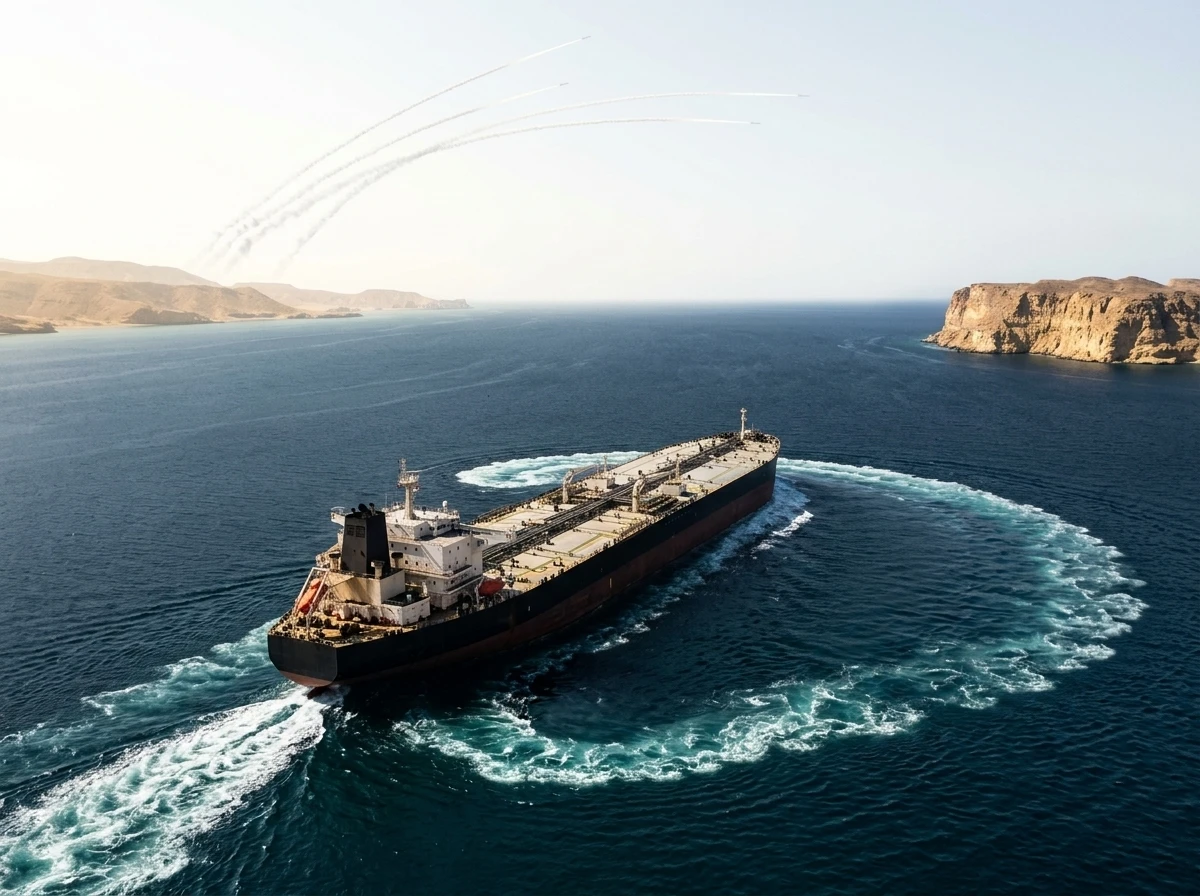
Two ballistic missiles launched from Iran toward the Strait of Hormuz on Tuesday triggered UAE air defenses and fell into the sea after assessments they were aimed at maritime traffic. The incident added to a string of tanker strikes that have reduced daily ship crossings to single digits against a pre-war average above 130.
The Trump administration has answered with economic pressure and a naval blockade of Iranian ports rather than fresh kinetic defense of the waterway, leaving commercial operators, Gulf producers and Chinese buyers to rewrite the routes that once carried a fifth of global oil and LNG.
Single-digit days replace the old 130-ship flow
Kpler ship-tracking data showed five commodity vessels crossing on one recent Saturday and none the following Sunday, compared with 31 the prior weekend. A later 24-hour window logged just 13 crossings, eight inbound and five outbound, against a baseline near 140. Some vessels run dark with AIS off, yet the visible total stays a fraction of normal.
UK Maritime Trade Operations reported a vessel struck by an unknown projectile while outbound in the strait on August 18, damaging the engine room and causing one crew casualty. Remaining crew received help from the Omani Coast Guard. Days earlier the UAE said three Abu Dhabi National Oil Company vessels came under attack while transiting.
| Period | Daily commodity crossings | Source note |
|---|---|---|
| Pre-war baseline | More than 130 | Kpler / industry average |
| Recent weekend | 5 then 0 | Kpler Aug 15-16 |
| Sample 24-hour window | 13 (8 in / 5 out) | Windward tracking |
| Brief MoU recovery | Temporary lift then collapse | CRS Commodity Context data |
Those tallies leave little room for a quiet rebound. A weekend that falls from five crossings to zero, then a full day that manages only thirteen, shows how thin the residual traffic has become. Dark-running ships may hide a few extra movements, but they do not restore the old density.
Iran has claimed management rights through a new Persian Gulf Strait Authority and says the waterway stays closed until the United States meets conditions from the collapsed June memorandum of understanding, including lifting its blockade of Iranian ports.
Each fresh strike reinforces that claim in practice even when governments dispute it on paper. Operators treat the strait as a high-risk lane first and a transit right second, which keeps the visible count depressed regardless of competing statements about who holds authority.
Washington chooses the squeeze over the escort
President Trump told Axios the United States is “low-keying it” with Iran, citing the country’s high inflation and inability to pay soldiers. He credited the naval blockade, in place since mid-April, with cutting Iranian crude exports that once ran near 1.5 million barrels per day. CENTCOM has redirected dozens of vessels, boarded some and disabled others.
We are just watching Iran with its huge inflation and the fact they have no money.
Trump said that in the Axios interview. Vice President JD Vance described a mix of diplomatic, economic and military tools still in play. Domestic polls show only about 35 percent of Americans approve of the war, a political constraint heading into midterms. Reports of stretched interceptor stocks have circulated, though a Pentagon official told Al Jazeera the force retains sufficient munitions for current tasks.
- Blockade impact: Iranian authorities report near-zero crude exports under the US “wall of steel.”
- Oil price path: Prices spiked above $100 earlier, later eased near $78-$89 as other supplies filled gaps.
- Talks status: Trump said Tuesday no negotiations are underway or planned; Iran denies direct talks.
- Chinese response: COSCO and CMES, controlling more than 100 VLCCs and once handling roughly half of China’s Middle East crude, halted Hormuz and Bab el-Mandeb tanker runs after contacts with central authorities.
The choice leaves commercial shippers as the real gatekeepers. Elevated dark-running and self-imposed halts by major fleets mean even claimed clearances produce little traffic.
By favoring the blockade over a standing escort regime, Washington shifts cost and risk onto owners, charterers and insurers. That approach matches the political limit suggested by the approval numbers, yet it also means the strait’s daily flow now depends less on naval presence than on private calculations of hull risk and war-risk premiums.
Gulf allies feel the gap first
Arab officials have told Western contacts that frustration with Washington is rising. Leaders worry the administration cannot manage the diplomacy needed to end the fighting. The UAE responded to the Tuesday missiles by suspending all trade, commercial exchange and financial transactions with Iran until further notice. Its defense ministry said the missiles targeted maritime traffic and that both fell into the sea, one inside and one outside territorial waters.
Saudi Arabia has already shifted large volumes off Hormuz. Its East-West pipeline to the Red Sea port of Yanbu lifted exports from about 2 million barrels per day before the war to more than 5 million barrels per day by early June, according to IEA analysis of Hormuz supply gap. That corridor now faces Houthi pressure in the Bab el-Mandeb, so the kingdom’s remaining outlets are fewer and longer. A related WSJ report noted Saudi oil supplies increasingly hang on a single exit once Hormuz and Red Sea routes both tighten.
| Outlet | Pre-war level | Wartime shift |
|---|---|---|
| Saudi East-West to Yanbu | About 2 million bpd | More than 5 million bpd by early June |
| Hormuz commodity crossings | More than 130 daily | Single digits on recent days |
| Iranian crude exports | Near 1.5 million bpd | Near-zero under the blockade |
Iran’s pattern of striking regional infrastructure and ships has aimed to make Gulf neighbors press Washington for a deal. The second-order result is that those same neighbors are building permanent work-arounds that reduce future reliance on either Iranian goodwill or American guarantees.
The UAE suspension and the Saudi pipeline surge point in the same direction. Regional governments are not waiting for a restored escort umbrella. They are cutting commercial ties where they can and moving barrels onto routes that bypass the chokepoint, even when those routes carry their own proxy threats farther west.
How the strait fight reached this stalemate
The sequence began with US-Israeli strikes on Iran on February 28, 2026. Iran answered by declaring the strait closed, boarding ships, laying mines and launching missiles and drones at Gulf states and bases. Traffic collapsed. A short April ceasefire and later June 17 memorandum of understanding briefly lifted volumes, then collapsed after fresh Iranian attacks on ships and US retaliatory strikes. Trump declared the MoU dead. By mid-July attack volume hit its highest point since April. Early August brought a quieter stretch of Iran-Oman talks, now again disrupted.
- February 28, 2026: US-Israel strikes open the war; Iran moves to close Hormuz.
- April 13: US naval blockade of Iranian ports begins; CENTCOM redirects and disables non-compliant ships.
- June 17: MoU signed for 60-day safe passage window and talks; temporary traffic rise follows.
- July 7-8: Fresh Iranian ship attacks collapse the MoU; US airstrikes resume.
- August 13-18: ADNOC tankers hit, additional vessel casualty, two ballistic missiles toward maritime traffic.
A CRS review of Hormuz scenarios lists possible next paths: expanded US military control of coastal areas, naval escorts, formal US administration with fees or investment demands, cooperative management modeled on Malacca, prolonged instability, or a US decision to deprioritize the waterway. Trump has floated both tolls and massive Gulf investments in the United States as compensation for past protection.
- Expanded US military control of coastal areas
- Naval escorts for commercial traffic
- Formal US administration with fees or investment demands
- Cooperative management modeled on Malacca
- Prolonged instability without a settlement
- A US choice to deprioritize the waterway
Each option carries a different burden for Gulf partners and shipowners. Escorts and coastal control imply sustained force commitment. Fees and investment demands shift the bargain toward compensation. Malacca-style cooperation would require Iranian buy-in that the collapsed MoU did not deliver. Deprioritization would lock in the single-digit traffic pattern already visible in the tracking data.
Alternative corridors harden into the new normal
The supply gap left by Hormuz has already been filled by a scramble of producers and routes. Saudi East-West flows, overseas stocks, and non-Gulf barrels closed much of the shortfall, though at higher cost and longer voyage times. CSIS charts on daily Hormuz crossings show traffic never recovered to pre-war levels even during brief openings. Insurers price the residual risk higher. Charterers prefer dark or southern Omani-adjacent tracks when they move at all.
Chinese majors’ halt removes a large share of the VLCC demand that once justified the risk. Smaller operators may still sneak through, yet the market signal is clear: Hormuz is no longer the default. Bab el-Mandeb disruptions compound the problem for Red Sea exits. Pipelines, floating storage and longer-haul Atlantic or Pacific barrels become structural rather than emergency options.
Iran continues to assert that management of the strait will never return to the pre-war pattern. Gulf states reject that claim. The practical outcome sits between them: traffic stays suppressed, alternative routes absorb volume, and the risk premium embeds in every barrel that once moved through the chokepoint.
Once major fleets cancel Hormuz and Bab el-Mandeb runs together, the remaining traffic is too thin to reset insurance and charter norms on its own. The brief MoU lift proved the point: volumes rose, then collapsed again when attacks resumed, and the tracking series never climbed back to the old baseline.
Buyers and fleets rewrite the demand map
Chinese state-linked majors once anchored a large share of the tanker demand that kept Hormuz busy. COSCO and CMES together control more than 100 VLCCs and had handled roughly half of China’s Middle East crude. Their halt after contacts with central authorities removes that anchor in a single stroke.
Without those cargoes, the commercial case for running the strait weakens for everyone else. Smaller operators can still attempt dark passages, but they do not replace the volume or the scheduling regularity that large fleets provided. The same caution now extends to Bab el-Mandeb, tightening the Red Sea exit that Saudi barrels use after the East-West pipeline hop.
Oil prices already traced the adjustment. The earlier spike above $100 gave way to a band near $78-$89 as other supplies filled gaps. That easing did not restore Hormuz traffic. It confirmed that buyers could meet needs elsewhere, which further reduces pressure to test the waterway under fire.
For Iran, the blockade’s reported cut of exports that once ran near 1.5 million barrels per day is the other half of the same map. Near-zero crude liftings under the “wall of steel” limit Tehran’s ability to monetize any residual control claim over the strait. The traffic fight and the export squeeze reinforce each other.
What shippers and producers now price in
Commercial decisions have outrun official claims of control. Trump has asserted the strait is open and cleared of mines; Iran says it remains shut pending US concessions. Operators vote with AIS off-switches and voyage cancellations. One high-engagement assessment on X noted that if a hostile force can repeatedly strike ally-flagged tankers inside the waterway while Washington claims total control, the deterrence problem is already visible.
The cumulative oil supply loss from Middle East producers has exceeded 1.3 billion barrels in some tallies. Global markets adapted, yet the adaptation itself creates new dependencies. Longer routes burn more fuel and add days. Pipeline capacity has limits. Houthi activity in the Red Sea shows that every alternative carries its own proxy risk.
For Gulf producers the lesson is practical. Diversify exits before the next spike. For China it is supply security through self-restraint on the most contested lanes. For the United States the second-order cost is a quieter erosion of the assumption that American power keeps the world’s energy arteries open at low premium. Economic pressure may eventually bend Iranian finances. In the meantime the waterway that once moved one-fifth of seaborne oil trade has become a high-cost, low-volume corridor by default, and the rerouting looks set to outlast any single ceasefire.
Shippers now treat single-digit crossing days as a planning baseline rather than a temporary shock. Producers lean on pipelines and longer-haul barrels even when that raises cost. Until both the blockade bargain and the strike pattern change together, those habits are likely to hold.


Spotify Running Mode hits Android and revives its old tempo experiment

Galaxy Tab S12 Ultra Renders Keep the Notch Fans Hate

Novato Spinning Round House Sells With Six Neighbors for $3.3 Million

Crop Tour Finds Indiana and Nebraska Corn Yields Lagging 2025

Best Buy 60th sale brings Android deals back to its roots

American Airlines reverses seatback screen bet years too late

Iran Hormuz Strikes Force Gulf Oil Onto Costlier Paths

Plague Tale Prequel Day One Joins Game Pass Wave 2 as Witcher Exits

NBA 2K27 opens The City to everyone and rewrites career eras

iOS 26.6.1 Patches 29 Flaws as AI Forces Faster Apple Updates

Caitlin Clark Skips the WNBA 3-Point Contest for a Third Straight Year

Rainout Gives Red Sox Two Shots at a Franchise-Record Win Streak

Double Fine Cuts 23 Jobs Weeks After Xbox Independence

Day-One Big Walk Lifts PS Plus August Beyond Recycled AAA

John Hight Exits Wizards After Digital Reckoning Hits

Curtis Mead’s Red Sox Debut Ends With Fractured Wrist

Moesch and Dressel Rewrite Night One at 2026 U.S. Nationals

Red Sox Squander Hot Streak Chance in 4-3 Loss to Athletics

Boutte’s Quiet Camp Takeover Forces Patriots Receiver Choices

Take-Two CEO Pushes Netflix Subs for GTA 6 Extended Look
-

 TECHNOLOGY3 years ago
How to Adjust a Bulova Watch Band – An Easy Guide
-

 News3 years ago
Fred Pentland: Athletic Bilbao’s English mentor who changed the essence of Spanish football
-

 FINANCE3 years ago
Tax Planning for Every Season: Guide to Maximizing Your Tax Benefits
-

 Education3 years ago
African Ministers New Education Plan
-

 BUSINESS3 years ago
What is Entrepreneurial Operating System? A Comprehensive Guide to EOS
-

 Education3 years ago
Innovate Your Learning Journey with Technology and Enhance Education
-

 BUSINESS3 years ago
Top 9 Most Expensive American Cities to Rent an Apartment
-

 News3 years ago
Russians formally out of World Athletics Championships