
News
American Airlines reverses seatback screen bet years too late
AA will install 4K seatback entertainment on 800-plus narrowbodies from 2028 and raise premium seats from 25% to 40%.

American Airlines will install next-generation 4K seatback entertainment systems on more than 800 narrowbody aircraft and raise premium seating from roughly 25% to about 40% of capacity, a multi-year reversal of the carrier’s long reliance on passengers’ own devices.
The Fort Worth-based airline announced the plans on August 18, 2026, with new jets arriving equipped in the second half of 2028 and retrofits starting later that year, stretching into the early 2030s. The move arrives as American trails Delta Air Lines and United Airlines on both cabin product and profitability.
The package ties hardware, cabin layout and connectivity into a single multi-year program. Screens alone will not reset the competitive picture. The denser premium cabins and the earlier Starlink rollout are meant to work with them.
A strategy from 2017 now looks expensive
Nearly a decade ago American chose not to put seatback screens on incoming Boeing 737 MAX jets and began stripping them from other narrowbodies. The airline reasoned that more than 90% of passengers already carried smartphones, tablets or laptops and that built-in monitors added weight, cost and eventual obsolescence.
It doubled down on streaming to personal devices and better Wi-Fi instead. Delta kept investing in seatback systems. United expanded them during cabin upgrades. American became the outlier among the big three U.S. carriers on short- and medium-haul flights.
That choice looked rational when personal devices were rising fast and fuel savings mattered. It looked thinner once cabin product became a clearer lever on both customer choice and unit revenue. The same narrowbody fleet that shed screens is now the fleet scheduled for the largest catch-up spend.
Customer habits shifted after the pandemic. Younger travelers now expect multiple devices plus larger shared screens. Technology also improved: newer systems are lighter and more capable. American told Fox News Digital that preferences evolved and the gap became hard to ignore.
We’re making one of the most significant investments in the onboard experience in our history. From next-generation seatback entertainment at every seat to substantially more premium seating options, these enhancements will give our customers more ways to relax, stay connected and enjoy their journey.
Chief Customer Officer Heather Garboden said that in the official announcement of fleetwide upgrades.
On X, one widely noted reply to the airline’s own post called the earlier removal “a dumb decision.” Crowds saw the pivot less as innovation than as overdue correction of a self-inflicted product shortfall.
- American removed screens and bet on personal devices and Wi-Fi
- Delta kept investing in seatback systems through the same period
- United expanded seatbacks during cabin upgrades
- American alone among the big three became the no-screen outlier on many narrowbody routes
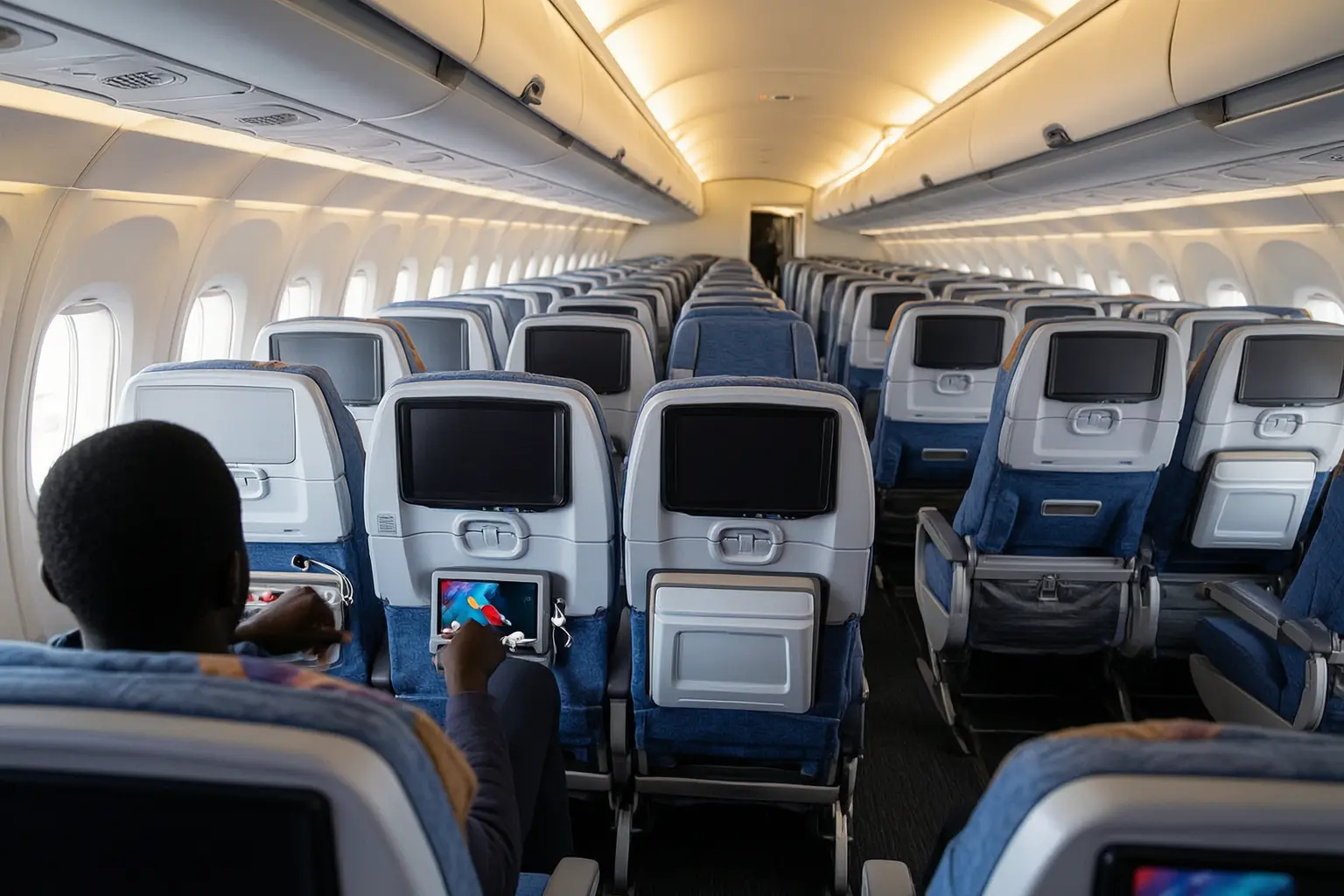
Premium seats move from one in four to two in five
Screens grab headlines. The denser premium cabin may move the revenue needle faster. Premium seating today makes up about 25% of seats on American’s narrowbody departures. The target is approximately 40% in coming years.
That expansion covers both First Class and Main Cabin Extra (extra-legroom economy with earlier boarding, dedicated bins and a free drink).
| Aircraft | First Class change | Notes |
|---|---|---|
| Airbus A319 / A320 | Add one row (about +4 seats) | Already underway |
| Boeing 737 MAX 10 | 24 First Class seats | New deliveries |
| Airbus A321neo | Additional First Class | Reconfiguration |
| Most narrowbodies | Expanded Main Cabin Extra | Majority of fleet |
American is already modifying A319s and A320s. Future MAX 10s arrive with the larger First cabin. A321neos get reworked for more premium rows. Refreshed interiors add storage, redesigned seats and better lighting.
| Premium share of narrowbody seats | Level |
|---|---|
| Today | About 25% |
| Target in coming years | About 40% |
Premium traffic already punches above its weight. In the second quarter of 2026, premium passenger unit revenue rose 13.4%. Industry reports put premium tickets at nearly half of American’s passenger revenue that quarter. Raising the share of higher-yielding seats is central to closing the margin gap with Delta and United.
Moving from one in four seats to two in five does not require every flyer to buy up. It requires enough of them to fill a larger pool of higher-yield inventory on the same departures. That is why the reconfigurations run across A319s, A320s, A321neos, MAX 10s and Main Cabin Extra on most of the narrowbody fleet rather than on a single aircraft type.
What the new entertainment hardware brings
The seatback platform is positioned as among the largest on North American narrowbodies. Premium seats get even bigger displays. Features include:
- 4K resolution with high contrast and color
- Bluetooth pairing for personal wireless headphones at every seat
- USB-C fast charging ports
- Personalized movie and TV recommendations
- Interactive flight maps with destination details and real-time insights
- Broader content library plus room for new partnerships
New Airbus A321 and Boeing 737 MAX 10 deliveries start with the systems in the second half of 2028. Existing narrowbodies get retrofitted beginning later in 2028. American’s current A320 family is the exception and will not receive the new seatback entertainment, the airline told Fox News Digital. Long-haul jets already have screens; this push covers the workhorse domestic and near-international fleet of roughly 800 to 876 mainline single-aisle aircraft.
The airline’s Big enhancements are taking flight post on X framed the package as making “every mile of the journey even better,” drawing more than 200,000 views and heavy engagement within a day.
Hardware alone does not finish the product story. The same seats gain fast charging and Bluetooth audio so passengers are not juggling adapters or wired headsets. Personalized recommendations and interactive maps are meant to keep the larger library useful on short hops as well as longer domestic legs. The A320-family carve-out still leaves a slice of the fleet on the older model until those jets age out or face a later decision.
Rivals stayed ahead while American cut costs
Delta’s seatbacks top out around 11 inches; United’s around 10 inches. American is promising larger formats. That technical edge arrives late. For years the absence of screens was a frequent complaint among flyers comparing the three carriers on similar routes.
Financial pressure sharpens the timing. American delivered record Q2 2026 revenue of $16.7 billion but cut its full-year outlook under a fuel-cost surge. Adjusted results for 2026 are now guided from a 65-cent loss to a 65-cent profit per share, with break-even at the midpoint. CEO Robert Isom has publicly acknowledged the wider margin gap with the other two legacy carriers and made closing it a long-range priority.
Fuel and thin margins leave less room for product experiments that fail. The original screen removal saved installation cost, weight and fuel burn. Those savings now look modest next to the revenue premium that better cabins generate and the competitive traffic American has risked losing.
Record top-line results did not erase the margin problem. Guidance that stretches from a 65-cent loss to a 65-cent profit underscores how little cushion remains when fuel spikes. In that setting, a cabin that sells more premium seats and draws fewer product complaints is less a luxury project than a tool for defending yield.
Passengers will wait years for the full picture
The first new aircraft with the screens land in late 2028. Retrofits run in parallel and finish in the early 2030s. Most travelers will see the change gradually, route by route and aircraft by aircraft, rather than overnight.
- 2027, High-speed Starlink Wi-Fi installation begins on narrowbodies
- Second half 2028, New Airbus and Boeing narrowbodies arrive with 4K systems; retrofits start
- Late 2020s into early 2030s, Fleetwide screen installation and premium reconfigurations complete
Starlink arrives first and pairs with the later screens. Passengers can stream on their own devices at high speed or use the built-in hardware. The combination, American says, opens personalized experiences and new revenue from engagement. The carrier already announced a large Starlink deal covering hundreds of jets ahead of broader rollout.
Until the hardware arrives, flyers remain on the current mix of streaming and limited seatbacks. American’s own site still describes current inflight entertainment options that lean heavily on personal devices for many domestic flights.
The staggered path matters for expectations. A passenger on a freshly delivered MAX 10 in 2028 will see a different cabin from one on an older narrowbody still waiting its turn. Full fleet consistency is an early-2030s outcome, not a 2028 switch-flip.
How Starlink Bridges the Years Before Screens
Connectivity lands ahead of the seatback wave. Starlink installation on narrowbodies begins in 2027, roughly a year before the first factory-fitted 4K jets and the start of retrofits. That order is deliberate. High-speed Wi-Fi can improve the existing bring-your-own-device model while the heavier cabin work is still queued.
Once screens arrive, the same pipe supports both paths. Travelers who prefer a phone or tablet keep a fast stream. Travelers who want the bigger seatback display get content, maps and recommendations without draining a personal battery as quickly. USB-C charging at the seat reduces the usual power scramble on longer domestic legs.
American already framed the pairing as a way to open personalized experiences and new engagement revenue. The earlier Starlink deal covering hundreds of jets gives the airline a connectivity layer at scale before the entertainment hardware is fleetwide. In practical terms, the Wi-Fi step is the bridge across the long retrofit window.
Why the 2017 Bet Now Forces Multi-Year Catch-Up
The original removal program was a cost and weight decision sold on passenger device habits. More than 90% of travelers already carried phones, tablets or laptops, so built-in monitors looked easy to cut. Delta and United took the opposite path and kept seatbacks in the competitive set for short- and medium-haul flying.
Habits moved after the pandemic. Younger travelers began to treat a large shared screen as normal even when they also carried multiple devices. Newer seatback systems grew lighter and more capable, undercutting part of the weight-and-obsolescence case. The product gap stopped being theoretical; it showed up in routine comparisons on similar routes.
Catch-up on roughly 800 to 876 mainline single-aisle aircraft cannot be a single overnight campaign. New deliveries in the second half of 2028 absorb the system at the factory. Retrofits begin later that year and stretch into the early 2030s. Premium reconfigurations run on a parallel track so the revenue mix can improve while the entertainment install is still incomplete.
The public reaction on X, including the widely noted “dumb decision” reply, treated the announcement as a correction rather than a leap ahead. That reading fits the timeline. American is spending to restore parity on a feature set its closest rivals never abandoned, while also lifting premium density from about 25% toward 40%.
Screens, faster Wi-Fi and more paid space land together
The entertainment systems, Starlink and denser premium cabins form one package rather than three separate projects. More First and Main Cabin Extra seats raise average fares. Better screens and connectivity reduce the friction that once made American’s narrowbodies feel basic next to rivals. Lounge upgrades, better dining brands and mobile tools round out the ground-to-air story the airline is selling.
Whether the investment closes the profit gap depends on execution speed, fuel prices and how quickly competitors respond with their own next upgrades. For now American is spending to erase a product deficit it created. Passengers who fly the carrier regularly will eventually get larger screens, Bluetooth audio, faster charging and a higher chance of an extra-legroom or First seat. They will just wait until the end of the decade for the full fleet to match the press release.
The reckoning for the 2017 bet is measured in years of catch-up spending and a still-open margin race with Delta and United.


Spotify Running Mode hits Android and revives its old tempo experiment

Galaxy Tab S12 Ultra Renders Keep the Notch Fans Hate

Novato Spinning Round House Sells With Six Neighbors for $3.3 Million

Crop Tour Finds Indiana and Nebraska Corn Yields Lagging 2025

Best Buy 60th sale brings Android deals back to its roots

American Airlines reverses seatback screen bet years too late

Iran Hormuz Strikes Force Gulf Oil Onto Costlier Paths

Plague Tale Prequel Day One Joins Game Pass Wave 2 as Witcher Exits

NBA 2K27 opens The City to everyone and rewrites career eras

iOS 26.6.1 Patches 29 Flaws as AI Forces Faster Apple Updates

Guardians Rout Twins With Seven Homers, Leave Joe Ryan One Shy of Record

Caitlin Clark Skips the WNBA 3-Point Contest for a Third Straight Year

Rainout Gives Red Sox Two Shots at a Franchise-Record Win Streak

Double Fine Cuts 23 Jobs Weeks After Xbox Independence

John Hight Exits Wizards After Digital Reckoning Hits

Day-One Big Walk Lifts PS Plus August Beyond Recycled AAA

Curtis Mead’s Red Sox Debut Ends With Fractured Wrist

Moesch and Dressel Rewrite Night One at 2026 U.S. Nationals

Red Sox Squander Hot Streak Chance in 4-3 Loss to Athletics

Boutte’s Quiet Camp Takeover Forces Patriots Receiver Choices
-

 TECHNOLOGY3 years ago
How to Adjust a Bulova Watch Band – An Easy Guide
-

 News3 years ago
Fred Pentland: Athletic Bilbao’s English mentor who changed the essence of Spanish football
-

 FINANCE3 years ago
Tax Planning for Every Season: Guide to Maximizing Your Tax Benefits
-

 Education3 years ago
African Ministers New Education Plan
-

 BUSINESS3 years ago
What is Entrepreneurial Operating System? A Comprehensive Guide to EOS
-

 Education3 years ago
Innovate Your Learning Journey with Technology and Enhance Education
-

 BUSINESS3 years ago
Top 9 Most Expensive American Cities to Rent an Apartment
-

 News3 years ago
Russians formally out of World Athletics Championships