
News
Galaxy Tab S12 Ultra Renders Keep the Notch Fans Hate
Official Galaxy Tab S12 Ultra image confirms thin bezels, dual cameras and S Pen with the same notch, as Dimensity 9500 and IFA timing set the real upgrade path.

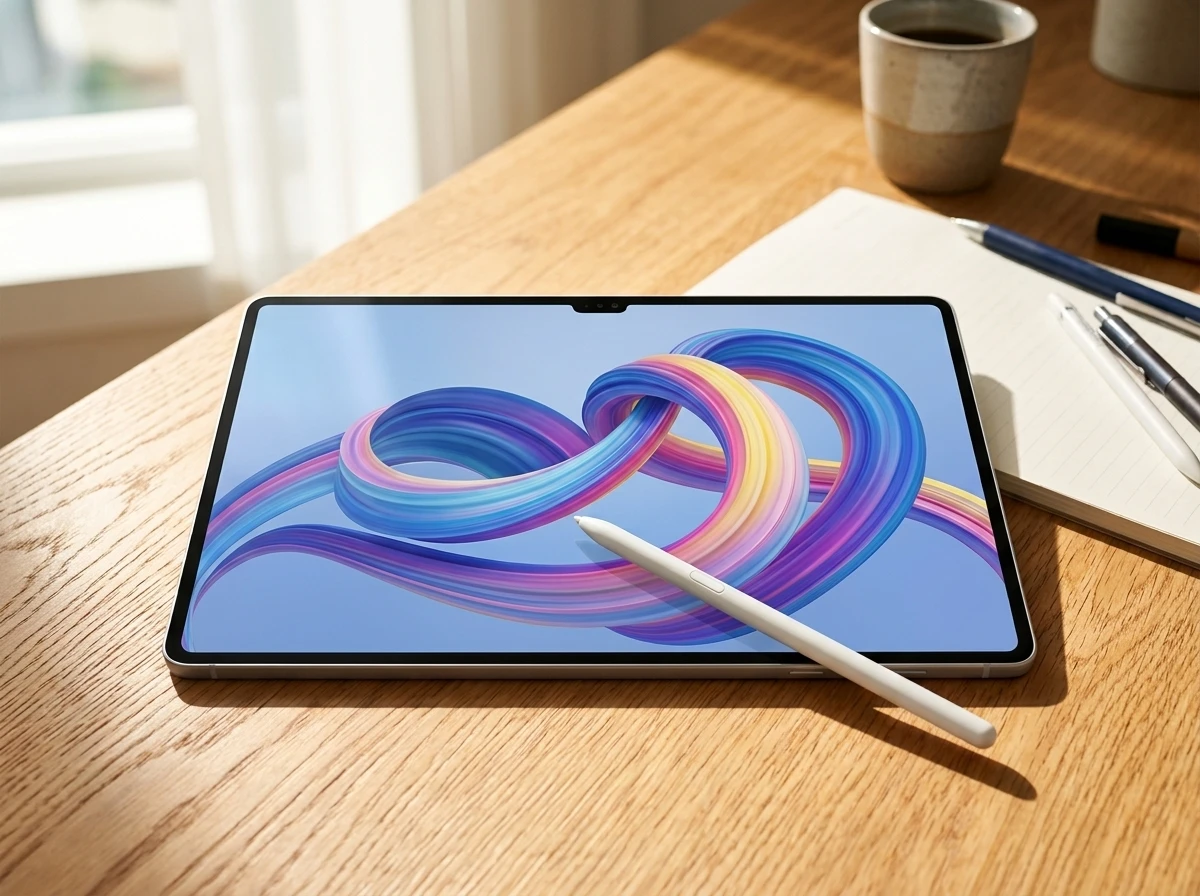
Android Headlines published an exclusive official-looking render of the Samsung Galaxy Tab S12 Ultra on August 18, 2026, showing the front, back and bundled S Pen in one frame. The image locks the final design weeks before the expected IFA debut and confirms almost no exterior change from last year’s model.
Thin uniform bezels, a small centered notch for dual front cameras, dual rear cameras that each protrude separately, and an S Pen with a visible side button define the look. Everything orients around landscape use, right down to the rear logo.
That continuity is the story. Samsung is not teasing a redesign cycle. It is refining a chassis buyers already know and shifting the upgrade case onto silicon, software life and day-to-day efficiency instead of a new silhouette.
What the new official render actually shows
The low-resolution but clear image matches earlier July CAD leaks and leaves little room for surprise. Samsung is shipping the same basic chassis that defined the Tab S11 Ultra.
- Very thin, even bezels on all four sides of the large display
- Small notch centered at the top edge when held horizontally for dual selfie cameras
- Two separate rear camera bumps plus an LED flash positioned for landscape grip
- S Pen included, complete with a physical button that the render makes visible
- Rear logo and overall layout built for horizontal productivity work
A recent Google Play Console listing already confirmed both Wi-Fi and cellular versions of the Ultra and the companion S12+. Market availability will differ by region as usual.
The render’s value is confirmation, not revelation. CAD files and certification photos had already sketched the outline. An official-style frame with the S Pen and rear layout in one shot simply closes the loop. Design speculation can stop. Attention moves to price, silicon and the software window.
Landscape priority still governs every exterior choice. The centered notch, split rear camera bumps, flash placement and logo orientation all assume the tablet sits wider than it is tall. That is consistent with DeX use, split-screen work and long video calls on a 14.6-inch panel.
Expected specs put beside the Tab S11 Ultra
Leaks converge on a near-identical body and battery with a clear silicon step. The table below draws from the multi-source consensus reported across Android Headlines, SammyGuru and others.
| Feature | Galaxy Tab S11 Ultra (2025) | Galaxy Tab S12 Ultra (expected) |
|---|---|---|
| Display | 14.6-inch Dynamic AMOLED 2X, 120Hz | 14.6-inch Dynamic AMOLED 2X, 120Hz |
| Chipset | MediaTek Dimensity 9400+ | MediaTek Dimensity 9500 |
| Battery / charging | 11,600 mAh, 45W | 11,600 mAh, 45W |
| Memory start | 12 GB RAM, 256 GB | 12 GB RAM, 256 GB (up to higher tiers) |
| S Pen / durability | Bundled, IP68 | Bundled with button, IP68 expected |
| Software | Android 16 / One UI 8.x | Android 17 / One UI 9, seven years of updates |
The S12+ is expected to run a matching Dimensity 9500 behind a cleaner 12.4-inch panel without the notch. Both should keep microSD expansion and the same thin aluminum build that dropped the Ultra to roughly 5.1 mm last year.
Read side by side, the table shows where Samsung is spending its engineering budget. Display size, refresh rate, battery capacity, charging speed and base memory do not move. The generational markers are the Dimensity 9500, the Android 17 and One UI 9 start point, and the seven-year update promise. Everything else is carryover by design.
Shared traits across the two sizes remain straightforward:
- Dimensity 9500 in both the Ultra and the S12+
- microSD expansion retained on the premium pair
- Thin aluminum construction carried over from the prior generation
- Bundled S Pen as a standard part of the box contents
The S12+ trades the Ultra’s notch and larger canvas for a cleaner 12.4-inch front. That gives Samsung a clear good-better split inside one announce cycle rather than staggered launches.
Why the notch that nobody wants is staying
Fans have asked for a punch-hole or under-display camera for years. Samsung already uses under-display cameras on its own Galaxy Z Fold 8. Yet the Ultra keeps the U-shaped notch that first appeared on earlier models.
The practical reason is dual front cameras. Video calls, remote work and content capture remain core jobs for a 14.6-inch premium tablet. A single punch-hole or early under-display sensor would trade image quality that buyers actually notice. Multiple reports frame the choice as deliberate rather than lazy: camera performance for meetings outweighs a seamless panel for the people writing the checks.
On X, earlier summer posts that briefly floated a hole-punch design drew heavy engagement, only for live certification images and the new official render to shut that hope down. The crowd reaction is mostly resignation mixed with jokes about Samsung mocking its own old anti-notch ads. Productivity users who already own the form factor appear less bothered than the comment sections.
The tension is easy to map. Foldables can hide a single under-display camera because their front-facing needs differ. A 14.6-inch productivity tablet is often a conference camera first and a media slab second. Dual sensors still win when the buyer’s main job is looking sharp on a long call while notes and reference docs fill the rest of the panel.
Resignation in the comments does not equal rejection at retail. Owners who already live in this form factor tend to judge the notch by whether meetings look clean, not by whether the top edge matches a concept sketch. That gap between enthusiast threads and purchase behavior is why the U-shape survives another cycle.
Dimensity 9500 becomes the actual generational step
Samsung already moved its flagship tablets to MediaTek with the S10 and S11 lines. The S12 Ultra continues that path with the newer Dimensity 9500 built on TSMC’s 3 nm process.
MediaTek’s own materials list a 1+3+4 core layout (one C1-Ultra at up to 4.21 GHz, three C1-Premium at 3.5 GHz, four C1-Pro at 2.7 GHz), larger caches, and an Arm Mali-G1 Ultra MC12 GPU. The company posts 32% faster single-core performance claims and 17% multi-core gains versus the prior Dimensity flagship, plus up to 33% GPU and 119% ray-tracing improvements, doubled NPU throughput for on-device AI, and efficiency gains that keep the chip cooler under load.
- CPU: up to 32% single-core, 17% multi-core vs previous Dimensity flagship
- GPU / RT: 33% peak graphics, 119% ray tracing, first 120 fps ray-traced mobile claim
- AI: NPU 990 with over 2x token generation and lower peak power
- Storage / connect: first 4-lane UFS 4.1, Wi-Fi 7, advanced 5G modem
For a tablet that spends hours on multitasking, DeX, large-language-model features and long video calls, those efficiency numbers matter more than a thinner bezel. One UI 9 on Android 17 plus the seven-year OS and security promise extends the usable life well into the early 2030s.
The MediaTek path is no longer an experiment. Two prior tablet generations set the baseline. The 9500 has to deliver snappier app switching, cooler sustained loads and stronger on-device AI without forcing Samsung to revisit battery capacity or the 5.1 mm-class shell. On paper the mix of CPU, GPU, NPU and UFS 4.1 gains is aimed exactly at that brief.
Ray-tracing headlines will draw gaming attention, yet the steadier win for this product is thermal headroom during long DeX sessions and multitasking. A chip that stays cooler under load protects both fanless comfort and battery life inside an unchanged 11,600 mAh envelope and 45W charge ceiling.
Prices climb while the chassis stays put
Samsung indicated during its Q2 2026 earnings that the next Tab S series will cost more. Leak consensus puts the S12+ near $1,100 and the Ultra near $1,400 for base storage, a noticeable step above the current Tab S11 Ultra starting configurations that opened around $1,200-$1,300 depending on storage and region.
Same battery capacity, same charging speed, same basic cameras and the same exterior make the price rise a harder sell unless the Dimensity 9500 and software package deliver clear day-to-day gains. The move mirrors other recent Samsung decisions. The company has already tested aggressive pricing splits on foldables with its Galaxy Z Fold 8 price split strategy, and early demand for that line showed Fold 8 preorder demand outpacing supply. Continuity on the tablet side lets Samsung protect margins while it absorbs higher component costs elsewhere.
Against the iPad Pro the Ultra still offers a larger canvas, expandable storage, a bundled stylus and the longer software window. Whether those advantages outweigh Apple’s ecosystem lock-in will decide how many buyers accept the higher sticker.
The pricing bet is blunt. Samsung is asking more for a body shoppers can already recognize from across a store aisle. The justification has to come from sustained performance, AI features that feel useful on a large panel, and a support calendar that reaches further than rivals. If those pieces land, the higher open looks like a longer ownership cycle rather than a simple inflation pass-through.
If they do not, the unchanged cameras, battery and chassis give critics an easy checklist. The Fold 8 split showed Samsung will test steeper tiers when demand holds. Tablets now get the same margin logic, with less visual novelty to soften the ask.
How the Two Sizes Split the Premium Line
Samsung’s two-tier plan keeps the silicon story simple while the fronts diverge. Both the Ultra and the S12+ are expected to use the Dimensity 9500, keep microSD expansion and ship with the S Pen in the box. The split is almost entirely about canvas size and the presence of the notch.
| Point of split | Galaxy Tab S12 Ultra | Galaxy Tab S12+ |
|---|---|---|
| Panel size | 14.6-inch Dynamic AMOLED 2X | 12.4-inch panel, cleaner front |
| Front camera layout | Centered notch, dual cameras | No notch on the expected design |
| Base price (leak consensus) | Near $1,400 | Near $1,100 |
| Shared ground | Dimensity 9500, bundled S Pen, microSD, thin aluminum build | |
That structure lets Samsung announce one chipset story and two clear buyer paths on the same day. Shoppers who want maximum screen and dual front cameras pay up for the Ultra. Shoppers who want a lower entry and a cleaner bezel line can stop at the S12+ without giving up the generational silicon jump.
Regional Wi-Fi and cellular mixes will still vary, as the Google Play Console listings already signaled. The constant is the paired launch itself. A single IFA window with both sizes ready keeps the premium tablet message tidy and avoids a drawn-out drip of closely related models.
Why Seven Years of Updates Change the Math
One UI 9 on Android 17 arrives with a seven-year OS and security promise that stretches usable life into the early 2030s. On a tablet that already starts near the top of the market, that calendar is part of the product, not a footnote.
Carryover hardware makes the software window do more work. The display, battery capacity, charging rate and basic camera layout are familiar. Buyers who skip a purely cosmetic refresh need another reason to move. A support runway that long reframes the higher sticker as a cost spread across more seasons of DeX, multitasking and on-device AI rather than a one-year bounce.
It also sharpens the iPad Pro comparison already in view. The Ultra still answers with a larger canvas, expandable storage, a bundled stylus and that longer software window. Ecosystem lock-in remains Apple’s counterweight. The seven-year clock gives Samsung a concrete timeline to point at when the exterior looks the same and the open price sits higher than the S11 Ultra’s $1,200-$1,300 start.
For IT buyers and long-hold consumers, update duration often matters more than a notch debate. The same chassis can stay in rotation longer when security patches and OS upgrades keep pace. That is the quiet half of the generational step beside the Dimensity 9500’s raw gains.
IFA timing and the S12+ twin
Samsung has used IFA Berlin for its flagship tablets several years running. The S11 Ultra landed there on September 4, 2025. Everything points to the same window this year.
- July 2026, CAD renders and early certifications surface; Dimensity 9500 software references appear
- Early August 2026, additional front renders and wallpapers leak; Google Play Console listings confirm Wi-Fi and 5G model numbers
- August 18, 2026, Android Headlines exclusive official-style full render with S Pen and rear details
- September 4-8, 2026, IFA Berlin window; announcement and possible hands-on expected
The official IFA site lists the Berlin event running 4 to 8 September 2026, and Samsung is already an active presence and sponsor. The S12+ is expected to launch on the same day, giving Samsung a clean two-tier premium tablet story.
Until the event, the only open questions left are final pricing tiers, exact camera sensor naming, and whether any last-minute AI features get demoed on stage. The design itself is settled.
The cadence from July CAD files to the mid-August render leaves little suspense about shape. What remains is stage craft: how Samsung frames the Dimensity 9500 gains, whether AI demos lean on the doubled NPU throughput, and how openly it defends the notch as a dual-camera tool. A joint Ultra and S12+ reveal would echo the tidy two-tier story the specs already imply.
Sponsors and active presence on the IFA calendar reduce the odds of a last-minute venue shift. The September 4-8 window is the working assumption until Samsung says otherwise. Hands-on time, if granted, will matter more for thermals and software polish than for design discovery.
Buyers who liked the Tab S11 Ultra will find almost nothing to relearn. Buyers who wanted a visual leap will have to decide whether the Dimensity 9500, longer software life and dual-camera practicality justify another generation of the same silhouette at a higher price.
The render ends the exterior debate. From here the argument is simpler: pay more for faster silicon, cooler sustained work, stronger on-device AI and updates into the early 2030s, or hold the S11 Ultra and wait for a future chassis change that this cycle refuses to deliver.


Spotify Running Mode hits Android and revives its old tempo experiment

Galaxy Tab S12 Ultra Renders Keep the Notch Fans Hate

Novato Spinning Round House Sells With Six Neighbors for $3.3 Million

Crop Tour Finds Indiana and Nebraska Corn Yields Lagging 2025

Best Buy 60th sale brings Android deals back to its roots

American Airlines reverses seatback screen bet years too late

Iran Hormuz Strikes Force Gulf Oil Onto Costlier Paths

Plague Tale Prequel Day One Joins Game Pass Wave 2 as Witcher Exits

NBA 2K27 opens The City to everyone and rewrites career eras

iOS 26.6.1 Patches 29 Flaws as AI Forces Faster Apple Updates

Caitlin Clark Skips the WNBA 3-Point Contest for a Third Straight Year

Rainout Gives Red Sox Two Shots at a Franchise-Record Win Streak

Double Fine Cuts 23 Jobs Weeks After Xbox Independence

Day-One Big Walk Lifts PS Plus August Beyond Recycled AAA

John Hight Exits Wizards After Digital Reckoning Hits

Curtis Mead’s Red Sox Debut Ends With Fractured Wrist

Moesch and Dressel Rewrite Night One at 2026 U.S. Nationals

Red Sox Squander Hot Streak Chance in 4-3 Loss to Athletics

Boutte’s Quiet Camp Takeover Forces Patriots Receiver Choices

Take-Two CEO Pushes Netflix Subs for GTA 6 Extended Look
-

 TECHNOLOGY3 years ago
How to Adjust a Bulova Watch Band – An Easy Guide
-

 News3 years ago
Fred Pentland: Athletic Bilbao’s English mentor who changed the essence of Spanish football
-

 FINANCE3 years ago
Tax Planning for Every Season: Guide to Maximizing Your Tax Benefits
-

 Education3 years ago
African Ministers New Education Plan
-
 BUSINESS3 years ago
What is Entrepreneurial Operating System? A Comprehensive Guide to EOS
-

 Education3 years ago
Innovate Your Learning Journey with Technology and Enhance Education
-

 News3 years ago
Russians formally out of World Athletics Championships
-

 BUSINESS3 years ago
Top 9 Most Expensive American Cities to Rent an Apartment