
News
Google Hands Day-to-Day AI Control to Brin Circle as Hassabis Steps Up
Demis Hassabis becomes DeepMind chair and Alphabet chief scientist while Koray Kavukcuoglu runs ops and Sergey Brin pushes product urgency over research culture.

Demis Hassabis stepped aside as Google DeepMind CEO on August 5, becoming chair of the lab and Alphabet’s chief scientist while Koray Kavukcuoglu takes day-to-day charge as SVP. The move lands as co-founder Sergey Brin intensifies hands-on pressure for faster product shipping and Jeff Dean leaves with three other veterans to found a new public-benefit company.
Alphabet shares fell roughly 4 percent on the news. Gemini already reaches more than 950 million monthly users, yet flagship model delays and talent exits have kept investors watching the competitive gap with OpenAI and Anthropic.
Who Now Runs What at Google DeepMind
Sundar Pichai and Hassabis laid out the new structure in internal notes published on the company blog. Hassabis keeps a strategic seat on AGI questions, advises the remaining GDM leads, and continues running Isomorphic Labs. Kavukcuoglu, previously CTO of DeepMind and Google’s chief AI architect, oversees Gemini model development, frontier research, the Gemini app, and developer teams while reporting directly to Pichai.
Hassabis described the change as freeing him for the “big picture.” In his note he wrote that AGI feels “close at hand” and that the next steps must go well for humanity. Pichai called the AGI-and-science work “vitally important to Alphabet and humanity.”
| Role | Before | After |
|---|---|---|
| Demis Hassabis | CEO, Google DeepMind | Chair, GDM; Chief Scientist, Alphabet |
| Koray Kavukcuoglu | CTO, GDM; Chief AI Architect | SVP, Google DeepMind |
| Jeff Dean | Chief Scientist / senior AI leader | Co-founder, Discovery Loop |
| Reporting line for GDM ops | Through Hassabis | Direct to Sundar Pichai |
The titles look clean on paper. The operational reality is a sharper split between long-horizon science and the daily race to ship models and features.
Brin Pulls Product Levers Harder
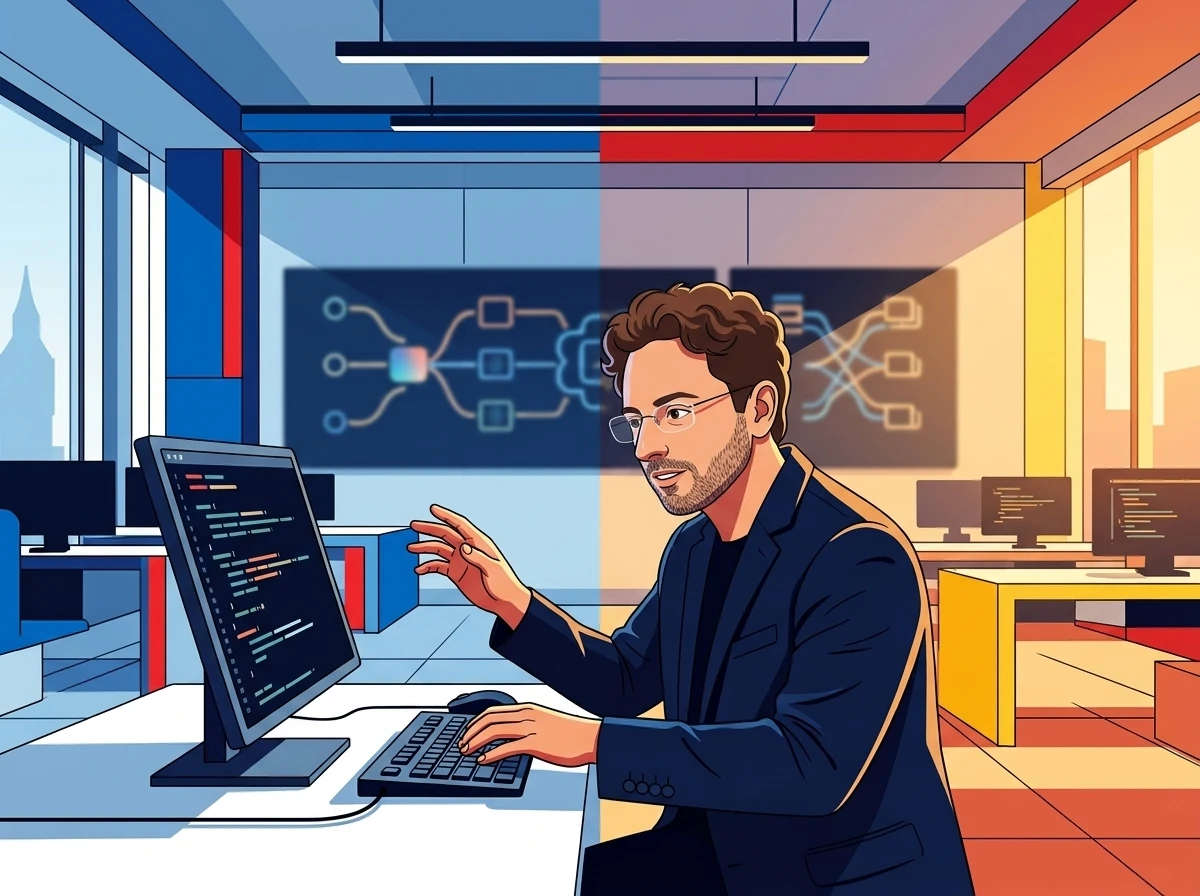
Sergey Brin has spent recent years back in the code and the meetings. Reports describe him programming on Gemini projects and personally pushing a “strike team” aimed at closing the coding-agent gap with Anthropic’s Claude. Internal researchers had rated Claude’s code higher; Brin’s response was urgency, not patience.
- Brin rejoined day-to-day AI work after describing retirement as unsatisfying.
- He and Kavukcuoglu have been directly involved with the coding strike team.
- An internal memo framed better agentic coding as the shortest path to models that improve themselves.
- Fortune and other outlets earlier quoted Gemini leaders saying Brin and Larry Page were active contributors, not distant advisors.
That hands-on style sits behind the FT framing of power shifting back toward the Silicon Valley founders. London’s research culture, long protective of longer scientific cycles, now faces explicit product velocity demands from the top.
Hassabis Chooses the AGI Horizon
I’ve been working towards AGI my whole life and now, like many of you, I feel it is close at hand. It’s critical that we collectively get the next steps right to ensure this all goes well for humanity and we usher in an incredible new age of discovery and wonder.
Hassabis wrote those lines in the staff note that accompanied the role change. He will advise Kavukcuoglu and the GDM leads from the new London offices, stay close to Pichai on strategic AGI matters, and lean harder into Isomorphic Labs drug discovery work. He has long argued that improving human health should be AI’s highest-value application; AlphaFold already earned him and John Jumper a Nobel Prize.
The chair-and-chief-scientist package keeps him inside Alphabet with real influence on the longest-term questions. It also removes him from the daily trade-offs between research purity and product deadlines that now sit with Kavukcuoglu and the founders.
Jeff Dean Walks Out With an Elite Cohort
Minutes before the Hassabis announcement, Jeff Dean confirmed he was leaving after 27 years. He is founding Discovery Loop with Sanjay Ghemawat, Quoc Le and Oriol Vinyals. Google is a founding investor and cloud partner. The new public-benefit corporation aims to automate experimental loops in science and engineering, starting with machine-learning research itself and later targeting National Academy of Engineering grand challenges.
Dean told the New York Times that leaving a public company gives the group more leeway to make decisions that are not purely financial. The four founders collectively built foundational pieces of Google Search infrastructure, TensorFlow, TPUs, Pathways, and major Gemini and Alpha-series systems. Their exit is the largest single research-brain drain in this cycle.
- August 5, 2026, Dean and co-founders announce Discovery Loop; Google confirms investor role.
- Same day, Pichai and Hassabis publish the GDM leadership memos.
- Following session, Alphabet shares drop about 4 percent as investors digest both moves.
Some current and former employees read Dean’s departure as the end of a more idealistic Google AI era. Dean had signed public pledges against lethal autonomous weapons and an amicus brief supporting Anthropic’s red lines on mass surveillance and fully autonomous lethal systems. Google later accepted broader Pentagon terms after Anthropic’s standoff.
Culture Clash Between Science and Shipping
DeepMind was acquired with cultural guardrails that limited certain military and intelligence uses. Those boundaries have eroded as the competitive and political environment hardened. Anonymous Google staff quoted by The Verge described Dean’s exit as part of “the vestiges of Google’s idealism” dying out and warned of resulting mediocrity.
Industry observers saw Hassabis’s move as a loss of operational influence for the research-first camp. One former employee cited far more internal competition around AI products than in the previous decade and pressure to hire people who can accelerate launches. Kavukcuoglu’s public profile is heavy on product and model announcements; Zvi Mowshowitz and others on X framed him as a capabilities operator rather than a safety-first counterweight.
The second-order effect is straightforward. Alphabet keeps the scientific brand and the AGI rhetoric. Day-to-day model and app decisions now sit closer to the founders’ product urgency and to Pichai’s direct line. That may close feature gaps faster. It also removes two high-profile figures who had publicly drawn ethical lines.
Commercial Momentum Still Looks Strong on Paper
Google is not starting from weakness. The same memos that announced the leadership change listed concrete traction:
- 950 million-plus monthly users on the Gemini app
- 900 million-plus downloads of Gemma open models
- Flash models in high demand and a live Cyber model
- AI features already woven through Search, YouTube and Cloud
Pichai pointed to Q2 earnings momentum across those businesses and to world-class compute. Alphabet’s capital spending remains aggressive; rivals face the same infrastructure race. Parallel pressure shows up at other hyperscalers, including Amazon AWS AI infrastructure spend that has returned strong growth. Google’s own consumer AI experiments, from search overhauls to tools like Google Earth AI image tools, keep expanding the surface area that must ship reliably.
Yet the flagship Gemini update that many expected in June stayed delayed. Several senior researchers left for OpenAI or Anthropic earlier in the summer. Morale questions and the perception of slower iteration have lingered even as user numbers climbed.
What the New Structure Buys
The Pichai and Hassabis staff memos present a clean division of labor: Hassabis shapes AGI strategy and science, Kavukcuoglu drives models and products at speed, Brin and the founders stay in the weeds, and Google retains a research relationship with the Dean group. On the surface that looks like specialization.
In practice it recenters decision rights. Product cadence and competitive response now have a shorter path to the top of Alphabet. The London scientific culture that once negotiated hard for independence and external oversight has less day-to-day leverage. Safety and governance voices that signed public pledges have either stepped up into strategic roles or walked out the door.
Whether the trade works will show in the next Gemini releases, coding-agent benchmarks, and whether more research talent follows Dean. For now Google has chosen velocity and founder involvement over the older DeepMind operating model. The scientific brand remains. The control structure has shifted.


NFL Three-Strike Safety Fouls Now Pull Coaches and Clubs In

Browns Fans Tape Protest Signs to Jim Brown Statue Over Watson

Amazon Pixel 11 Deal Erases the $100 Hike for One More Day

Elden Ring on Switch 2 Turns Its Own Worst Label Into a Portable Win

Ternus Takes the Stage With Apple’s Foldable Debut

Ikea Xbox Yxstaby Turns Controller Thumbstick Into Home Furniture

Pokémon Center Turns Past Worlds Wins Into Bundles and a Pikachu Coin

NFL Scraps Pro Bowl Game to Restore Pure Player Honor

New Twitter.now Bets the Brand Musk Left Behind

Bella Mir’s Famous First Loss Meets the Accountant Who Won

Double Fine Cuts 23 Jobs Weeks After Xbox Independence

Day-One Big Walk Lifts PS Plus August Beyond Recycled AAA

John Hight Exits Wizards After Digital Reckoning Hits

Curtis Mead’s Red Sox Debut Ends With Fractured Wrist

Moesch and Dressel Rewrite Night One at 2026 U.S. Nationals

Red Sox Squander Hot Streak Chance in 4-3 Loss to Athletics

Boutte’s Quiet Camp Takeover Forces Patriots Receiver Choices

Take-Two CEO Pushes Netflix Subs for GTA 6 Extended Look

Halo Campaign Evolved Skulls Meet Death Barriers That Kill the Hunt

Wildlands Free Update Hands Players the Tools They Already Invented
-

 TECHNOLOGY3 years ago
How to Adjust a Bulova Watch Band – An Easy Guide
-

 News3 years ago
Fred Pentland: Athletic Bilbao’s English mentor who changed the essence of Spanish football
-

 FINANCE3 years ago
Tax Planning for Every Season: Guide to Maximizing Your Tax Benefits
-

 Education3 years ago
African Ministers New Education Plan
-

 BUSINESS3 years ago
What is Entrepreneurial Operating System? A Comprehensive Guide to EOS
-

 Education3 years ago
Innovate Your Learning Journey with Technology and Enhance Education
-

 News3 years ago
Russians formally out of World Athletics Championships
-

 BUSINESS3 years ago
Top 9 Most Expensive American Cities to Rent an Apartment