
News
Witch Bottle Containing Human Teeth and Fish Hooks Found in English Chimney — Tied to Accused Witch’s Childhood Home

It began with routine roof work. It ended with a chilling glimpse into England’s enduring obsession with witches.
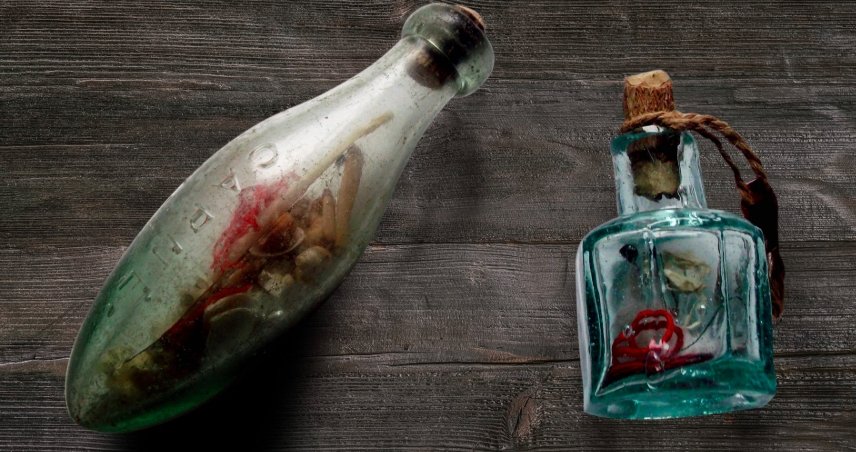
During the recent demolition of a chimney at a former public house in Watford Village, workers uncovered a torpedo-shaped glass bottle containing a concoction of human teeth, fish hooks, shards of glass, and a murky unidentified liquid — a so-called “witch bottle,” crafted to ward off evil spirits and hexes.
What makes the find particularly striking is its location: the childhood home of Angeline Tubbs, a woman accused of witchcraft in the 18th century who would later become a ghostly legend in upstate New York.
A Bottle From the Shadows of Victorian England
The object — unearthed from the rafters of the former Star and Garter Inn — dates to the 1830s or later, a time when England’s belief in witchcraft was still simmering, even after centuries of trials and executions.
While anti-witchcraft laws were repealed in 1736, belief in malefic forces persisted well into the 19th century. Witch bottles, often made of glass or ceramic, were secreted into the walls, floors, and hearths of homes. The logic? Trap malevolent spells or confuse the witches casting them.
-
Common ingredients: nails, pins, hair, fingernail clippings, sometimes even urine.
-
Uncommon in this case: fish hooks and human teeth, suggesting a personalized ritual.
-
Typical placement: hidden under thresholds or chimneys — points of spiritual vulnerability.
This bottle, containing materials rarely found together, is now part of a growing database of more than 100 recorded examples of witch bottles across England. Most hail from the 17th century — but few are discovered in such pointedly symbolic locations.
The Witch of Saratoga — Born in This House?
Local lore holds that Angeline Tubbs was born on the same Northamptonshire property in 1761, decades before the bottle’s creation. Though she emigrated to the newly independent United States as a teenager, her presence remains very much alive in regional folklore.
After being abandoned by her fiancé, a British soldier, she settled in the woods near Saratoga Springs, New York, surviving by reading fortunes and living alone with a notorious clowder of cats. By the mid-1800s, Tubbs had become something of a living legend — “a mysterious and uncertain character,” according to 19th-century memoirs.
“From her appearance and occupation, it was fortunate she lived more than a century after the Salem tragedies,” noted historian William Stone in Reminiscences of Saratoga and Ballston.
Reportedly living to 104 years old, Tubbs escaped the violent fates that befell hundreds of women in earlier witch hunts. Yet the fear of witchcraft — and the protective measures it inspired — clearly lingered long after she crossed the Atlantic.
Historic Paranoia, Encased in Glass
The building’s anonymous current owner told BBC News he found the bottle lodged tightly into brickwork during routine repairs and had no idea of its connection to folklore until locals began pointing out the property’s ties to Tubbs.
“I might just tuck it away again — let someone else find it in another 100 years,” he mused.
Archaeologists, however, aren’t quite ready to let the relic vanish.
Dr. Ceri Houlbrook, a folklore and history expert at the University of Hertfordshire, confirmed the object’s identity and placed its manufacture firmly after 1830, when torpedo bottles became common.
“It’s certainly later than most witch bottles,” she explained. “So sadly not contemporary with Angeline Tubbs — but still a fascinating find.”
The timing of the bottle raises questions. Was it left by a later resident who feared the property was haunted by Tubbs’ lingering presence? Or was it simply another reflection of enduring rural superstitions?
The Legacy of Witch Trials — and Their Cultural Hangover
From Salem to Scotland, accusations of witchcraft have claimed thousands of lives — particularly women — often based on little more than suspicion, poverty, or perceived eccentricity.
-
In England, up to 300 people were executed in East Anglia alone between 1644 and 1646 during a peak of witch-hunting hysteria led by Matthew Hopkins, the self-styled “Witchfinder General.”
-
Laws criminalizing witchcraft remained in effect until 1736.
-
Even after decriminalization, the cultural imagination kept witches alive in folk practices, rituals, and superstitions — like the use of witch bottles.
According to researchers at the Museum of London Archaeology, such vessels were placed in:
-
Churchyards
-
Riverbanks
-
Under floors and chimneys
-
Buried near thresholds
The aim was always the same: to repel, trap, or neutralize perceived magical threats.
From Folklore to Forensics
While most witch bottles are left undisturbed, this one now joins a growing collection of folk-magic artifacts that scholars say deserve serious study — not just as curiosities, but as cultural documents.
“Each bottle tells a story,” Dr. Houlbrook said. “They reflect the fears, the customs, and the unspoken anxieties of people who felt vulnerable in a world they couldn’t fully explain.”
And as modern England grapples with its supernatural past — from pardons for accused witches in Scotland to growing interest in folk traditions — it’s clear these objects still hold a certain kind of power.













Walmart’s $50 Million Opioid Settlement Closes Case Without Admission

California Sues Over $120 Million Morro Bay Wind Lease Buyout

Gilead Bixlenvo FDA Nod Opens Single Pill Path for Complex HIV Cases

Meta’s $18B Kids Deal Forever Shields Data Used to Spot Under-13s

Lettuce Outbreak Drove Record Cyclospora Spike Across 20 States

Amazon Shaves $20 Off M6 Mac Mini Before It Even Ships

SpaceX Louisiana Port Tests Debt Markets on Orbital AI Scale

Microsoft High Lifts Indexes as Small Caps Crack Support

Apple Replays 2015 Saturday Midnight Preorder for iPhone 18 Pro

Updated COVID Shots Clear FDA but Access Friction Hits High-Risk Groups

Take-Two CEO Pushes Netflix Subs for GTA 6 Extended Look

Halo Campaign Evolved Skulls Meet Death Barriers That Kill the Hunt

Wildlands Free Update Hands Players the Tools They Already Invented

Destiny 2 Fans Unlock Vaulted Maps After Live Service Ends

Quake Gets 19 Free Maps From MachineGames Quake Club

Quordle Monday Delivers Gavel Crush Speed Ethos Cleanly

Stripe Bid Shows PayPal Moat Cracked After Years of Slide

Tyson’s Five-Year Utah Plant Falls to Cattle Shortage Reckoning

Silver Lake Workday Talks Signal Private Floor for Software

Kennedy Lewis Takes Majority Control of The Greenbrier in $500M Deal
-

 TECHNOLOGY3 years ago
How to Adjust a Bulova Watch Band – An Easy Guide
-

 News3 years ago
Fred Pentland: Athletic Bilbao’s English mentor who changed the essence of Spanish football
-

 FINANCE3 years ago
Tax Planning for Every Season: Guide to Maximizing Your Tax Benefits
-

 Education3 years ago
African Ministers New Education Plan
-

 BUSINESS3 years ago
What is Entrepreneurial Operating System? A Comprehensive Guide to EOS
-

 Education3 years ago
Innovate Your Learning Journey with Technology and Enhance Education
-

 News3 years ago
Russians formally out of World Athletics Championships
-

 BUSINESS3 years ago
Top 9 Most Expensive American Cities to Rent an Apartment