
News
Paddle, Purpose, and Progress: “Neuro-Pong” Keeps Minds Sharp in Grand Junction

Twice a week in Grand Junction, ping pong becomes more than a game — it becomes therapy.
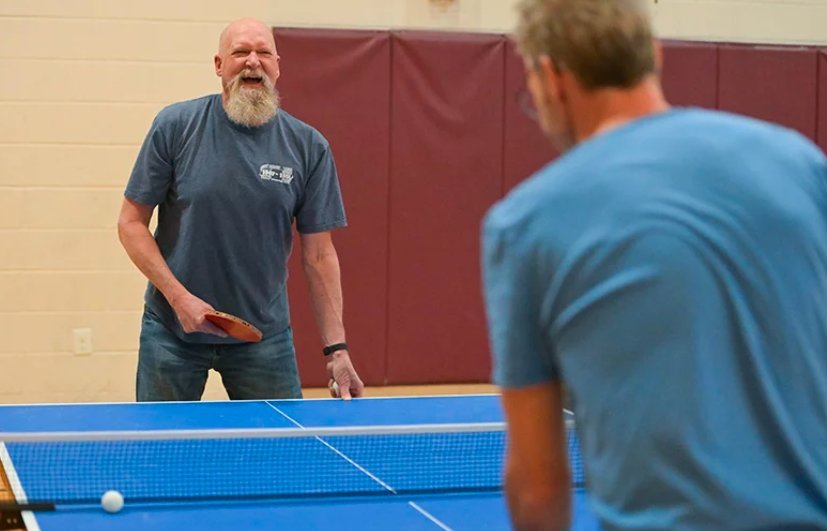
Inside First Christian Church, under soft lights and the gentle hum of casual conversation, paddles clap against plastic balls. But this is no ordinary rec league. It’s “Neuro-Pong,” a program built for people battling neurological conditions — and it’s changing lives, one serve at a time.
Whether it’s Parkinson’s, Alzheimer’s, Multiple Sclerosis, or a traumatic brain injury, participants walk in with a diagnosis. But by the time they leave, many say they’ve found something else: hope, movement, and belonging.
“It’s Not Just Ping Pong”
The idea is simple. But its effects are anything but.
“The whole premise of Neuro-Pong is for those who have neurodegenerative diseases,” explained Jacob Trowbridge, the program’s upbeat, paddle-wielding coach. “And our goal is to help them. This is a great avenue for exercise in a low-risk way.”
Twice a week — Wednesdays from 2 to 4 p.m., and Saturdays from 10 to noon — the fellowship hall transforms into a therapeutic training ground.
There’s no scoreboard. No intense competition. Just a handful of tables, laughter, focused faces, and the rhythmic back-and-forth of paddles and ping pong balls.
“You’re actually using your brain,” said Trowbridge. “You’re challenging it. You’re building in ways that you haven’t before in your life. So I think people really like that.”
Brain, Body, and Ball: The Neuroscience of Table Tennis
It might look like casual fun. But the science behind Neuro-Pong is real.
Studies from institutions like the Mayo Clinic and the Cleveland Clinic have shown that coordinated movement activities — especially those that combine mental strategy and physical motion — can slow cognitive decline and improve motor function.
Here’s why ping pong works so well:
| Benefit | Why It Helps Neurological Patients |
|---|---|
| Hand-eye coordination | Strengthens neural pathways and reflexes |
| Balance and footwork | Enhances mobility and muscle memory |
| Mental engagement | Stimulates problem-solving and focus |
| Social interaction | Combats isolation and depression |
“It’s not necessarily about becoming a better ping pong player,” Trowbridge said. “It’s about doing things you never thought you’d be able to do. That’s what’s powerful.”
“We Show Up for Each Other”
But beyond the brain health and improved dexterity, participants say it’s the community that keeps them coming back.
“I’m all about the personal connection,” Trowbridge said with a smile. “That’s why it’s so nice to hear about how everyone’s week was going. I love that part of this.”
He recalled a moment last week when a participant who had trouble standing a year ago rallied three balls in a row — something unthinkable just months earlier. Everyone clapped. Someone teared up. No one cared about the score.
“This place becomes a lifeline,” said Mary, a 68-year-old with early-stage Parkinson’s who’s been coming since February. “It reminds you you’re still capable.”
Diagnoses Don’t Define Them
For many, Neuro-Pong offers a much-needed break from the emotional toll of illness.
“People start to view themselves only through their diagnosis,” said Trowbridge. “This flips the script. You’re not just someone with Parkinson’s. You’re someone who got up, came here, picked up a paddle, and tried something new. That’s huge.”
Others echoed the sentiment.
“I was scared to come at first,” said James, 72, who was diagnosed with early-onset Alzheimer’s last fall. “But now? I laugh more here than I do the rest of the week.”
Even those with more advanced symptoms participate, with support from volunteers or loved ones. There’s no age cap, no prior experience required. And absolutely no judgment.
“It’s about challenging yourself,” Trowbridge said. “And if you miss the ball 20 times in a row? That’s okay. You still showed up. You still moved. That matters.”
Grand Junction Leads by Example
In a region where access to neurological therapy can be limited, programs like Neuro-Pong fill a critical gap — not just in care, but in joy.
Local hospitals have taken notice. Some doctors now recommend it to patients directly. Therapists say the mix of movement, laughter, and purpose could be the missing link for many managing long-term conditions.
“This could be a model for other towns,” said a Mesa County health coordinator visiting the Saturday session. “It’s scalable, it’s community-driven, and the outcomes speak for themselves.”
Trowbridge hopes to expand the program to more locations across western Colorado — maybe even the state.
“All it takes is a table, a few paddles, and a heart for the people,” he said.
Come One, Come All
Neuro-Pong welcomes everyone — whether you’re living with a diagnosis or just want to support a loved one.
“If you’ve never played, we’ll teach you,” Trowbridge said. “If you’re nervous, come watch first. No pressure. Just progress.”
Sessions are held every Wednesday from 2:00 to 4:00 p.m. and every Saturday from 10:00 a.m. to noon at First Christian Church, Grand Junction.
And yes, anyone can join.
Because in a world that often focuses on limitations, “Neuro-Pong” is a rare place where the only rule is to keep swinging.








Iowa Farmer Built Resilience for 16 Years Then Tariffs Hit Hard

HHS Adds FDA Tech and Drugs Deputies to Lock In AI and Review Power

Nvidia Earnings Carry a Built-In Sell-the-News Trap

HP Licenses Huawei Wi-Fi Patents Despite the Entity List

Poland Named in $131B F-15 Deal Echoes Apache Path

Sewer Scavengers Near Penn Station Repeat a Decades-Old NYC Pattern

Second Muni Fatigue Crash Exposes Surface Line Gaps

Chick-fil-A Chicken and Waffles Closes Its 80-Year Loop

Musk Data Centers Leave a Mississippi Family’s Historic Land Empty

OpenAI Data Center Chief Exits as Stargate Strategy Shifts

Double Fine Cuts 23 Jobs Weeks After Xbox Independence

Day-One Big Walk Lifts PS Plus August Beyond Recycled AAA

Curtis Mead’s Red Sox Debut Ends With Fractured Wrist

John Hight Exits Wizards After Digital Reckoning Hits

Red Sox Squander Hot Streak Chance in 4-3 Loss to Athletics

Moesch and Dressel Rewrite Night One at 2026 U.S. Nationals

Boutte’s Quiet Camp Takeover Forces Patriots Receiver Choices

Take-Two CEO Pushes Netflix Subs for GTA 6 Extended Look

Halo Campaign Evolved Skulls Meet Death Barriers That Kill the Hunt

Wildlands Free Update Hands Players the Tools They Already Invented
-

 TECHNOLOGY3 years ago
How to Adjust a Bulova Watch Band – An Easy Guide
-

 News3 years ago
Fred Pentland: Athletic Bilbao’s English mentor who changed the essence of Spanish football
-

 FINANCE3 years ago
Tax Planning for Every Season: Guide to Maximizing Your Tax Benefits
-

 Education3 years ago
African Ministers New Education Plan
-

 BUSINESS3 years ago
What is Entrepreneurial Operating System? A Comprehensive Guide to EOS
-

 Education3 years ago
Innovate Your Learning Journey with Technology and Enhance Education
-

 News3 years ago
Russians formally out of World Athletics Championships
-

 BUSINESS3 years ago
Top 9 Most Expensive American Cities to Rent an Apartment