
News
French Open Line Call Furor Overshadows Fonseca Upset of Ruud

Casper Ruud led the second-set tiebreak 8-7 on Sunday, two points from leveling his fourth-round match against Joao Fonseca, when a forehand down the line decided far more than a single point. A line judge called it in. A shout from the crowd said out. The chair umpire came down, studied the clay, and confirmed the call. The television replay, drawn from electronic line calling, showed the opposite. The French Open is the only Grand Slam still using human line judges, and on Day 8 that choice turned a thrilling match into the latest argument about whether anyone can trust what they just watched.
This was not a one-off. The disputed point capped a week in which players and officials at Roland Garros kept stopping matches to argue over marks in the dirt, and a decision the tournament made months ago to keep its officiating human is now bleeding into its biggest results.
The Tiebreak That Two Systems Saw Differently
Ruud, a two-time French Open finalist, was already a set down when the second-set breaker reached 8-7 in his favor. Then came the sequence everyone replayed.
- Fonseca laced a forehand down the line, and the baseline judge signaled the ball in.
- A shout from the crowd called it out, and chair umpire Louise Engzell climbed down to inspect the mark.
- She ruled the trace had caught the line. Ruud did not challenge it but asked who had made the original call.
- Broadcast electronic line calling showed the reverse, that the ball had missed.
- On a later swing a Ruud shot was called out, the umpire overruled it as in, and this time the electronic read-out agreed with her.
Had the verdict gone the other way, Ruud levels the match at a set apiece. Instead Fonseca took the breaker and a two-set cushion he never surrendered, closing out a 7-5, 7-6(8), 5-7, 6-2 win to reach his first Grand Slam quarterfinal at 19.
Why a Clay Mark and a Camera Trace Disagree
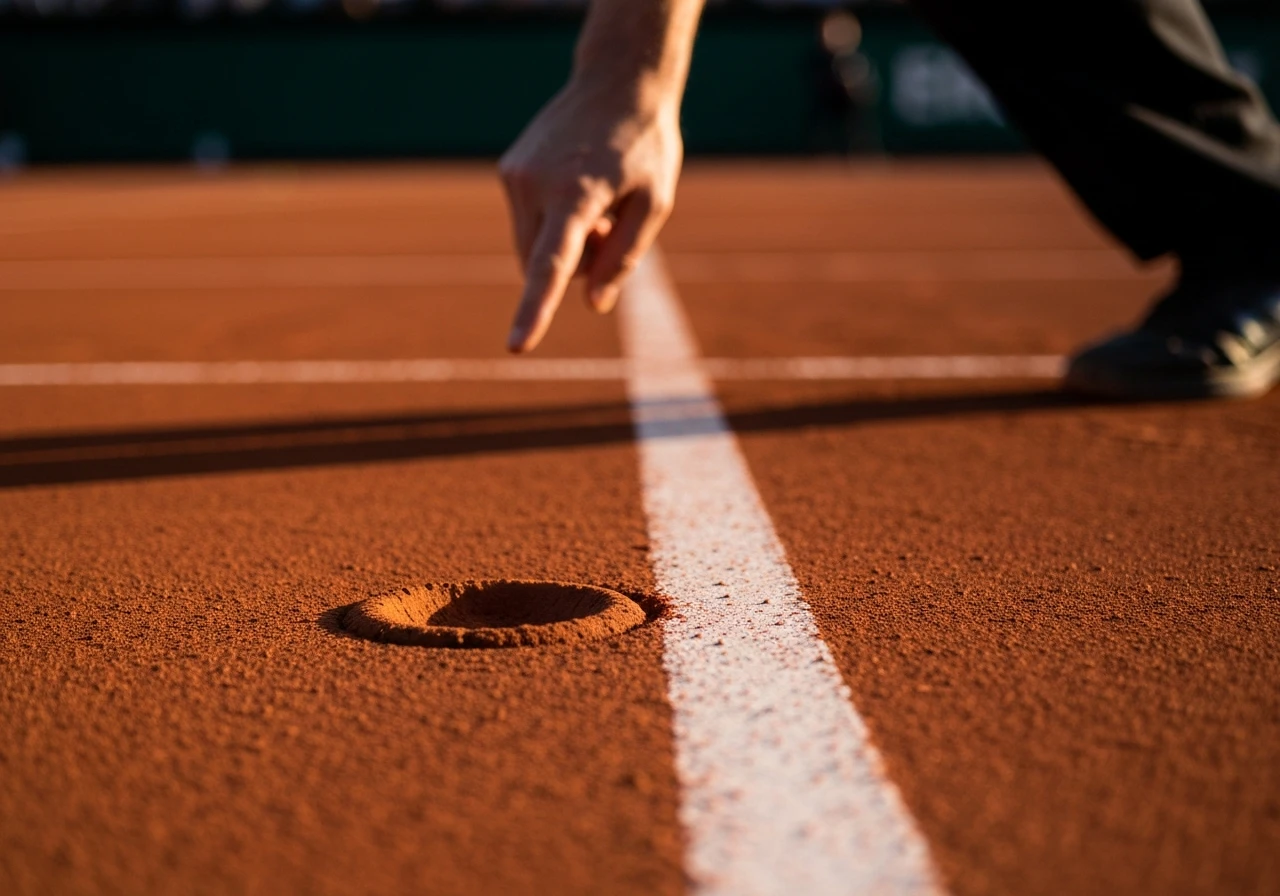
Here is the part that makes clay different from hard court, and the reason the tournament has an argument for doing things its own way. The dent a ball leaves in red brick dust is not a perfect record of where the ball actually landed.
- Clay is a living surface. Wind and uneven amounts of brick dust shift across a court during a match, so a similar shot can leave a slightly different imprint depending on where it bites.
- A ball that lands in can skid and leave a mark that looks out, and a ball that lands out can leave a mark that reads in.
- Electronic line calling (ELC, the camera system that tracks a ball’s trajectory and contact point) folds those variables in and carries a published 3mm margin for error.
- A chair umpire reading a mark by eye can only judge whether the trace touches or overlaps the line. The umpire cannot see flight path or contact point.
That gap is why Sunday felt so unjust to people watching at home. The umpire and the replay were answering two different questions, yet television rendered both in the same picture, inviting a comparison that never quite lines up. For most of tennis history the mark was the law. Asking players and fans to accept that their own eyes have misled them, in the middle of a tiebreak, is a very hard sell.
A Week of Standoffs With the Officials
Ruud and Fonseca were not the first to stop the clock this fortnight. Disputes over calls have become a running theme of the tournament.
One player showed an umpire two different ball marks during a match, arguing the wrong one had been read. Another threatened never to speak to an umpire again. Andrey Rublev, the Russian seeded 11th, had his own tense exchange before losing a five-setter to Jakub Mensik of the Czech Republic, who reached his maiden Grand Slam quarterfinal. The grievances differ in detail; the source is the same.
Jim Courier, the former world No. 1 and four-time Grand Slam champion, did not hide his view from the commentary booth.
Matches should be decided by the players not by people
Courier called the episode a massive controversy, “as it should be,” speaking during television coverage of the Ruud match. It is the kind of line that travels far beyond a single result, and it lands on a tournament that has invited the scrutiny.
Ukraine’s Guaranteed Semifinalist and Zverev’s Open Door
Away from the officiating noise, Day 8 set up two of the richer story lines of the second week.
- 1-1: the head-to-head record between Elina Svitolina and Marta Kostyuk before Tuesday’s quarterfinal.
- 16-match win streak: what Kostyuk carries into Paris after titles this year.
- Three lost Grand Slam finals: the record Alexander Zverev is trying to shed.
An All-Ukrainian Quarterfinal
Svitolina, the No. 7 seed, rallied past Belinda Bencic of Switzerland 4-6, 6-4, 6-0. She joins Kostyuk, the No. 15 seed, who had opened Sunday by upsetting four-time champion Iga Swiatek 7-5, 6-1. Their meeting guarantees a Ukrainian woman in a French Open semifinal for the first time in the Open era, a milestone you can trace through Kostyuk’s fourth-round upset of Swiatek.
Kostyuk, 23, arrives off a run that includes the Rouen Open and the Madrid title. “I’m the most consistent I have ever been in my career,” she said in her news conference. Svitolina has long had a fond relationship with clay, with three titles in Rome, yet the French Open is the only major where she has never reached the last four. The depth of the Ukrainian presence is plain across the rest of the women’s draw upsets at Roland Garros.
Zverev’s First Time as the Favorite
Zverev, the world No. 3, eased past lucky loser Jesper de Jong 7-6(3), 6-4, 6-1 in just over two hours. For the first time at a major he is the tournament favorite, a status handed to him by the absence of Carlos Alcaraz and the early exits of Jannik Sinner and Novak Djokovic.
Opportunity arrives with pressure. The 29-year-old German has reached three finals at the majors and lost all three. “I’m here, I’m feeling confident with my game,” he said after beating de Jong. His quarterfinal pits him against Rafael Jodar, the 19-year-old Spaniard who came from two sets down for the first time in his career to beat Pablo Carreno Busta.
The Last Grand Slam Holdout
All of it returns to one institutional choice, made well before a ball was struck this fortnight.
Three Slams Switched, One Held Out
Electronic line calling is now the norm in tennis. Three of the four majors and most of the tour above the entry level rely on it. Roland Garros stands alone.
| Grand Slam | Line calling | Electronic system since |
|---|---|---|
| Australian Open | Electronic | 2021 |
| US Open | Electronic | 2022 |
| Wimbledon | Electronic | 2025 |
| French Open | Human line judges | Not adopted |
The contrast is sharpest for players who spend the rest of the calendar trusting a camera and then arrive in Paris to argue over dirt. It was hard enough adjusting to electronic calls when clay events first added them. Switching the rule back, for a few weeks, asks the same nervous systems to flip again.
The Federation’s Defense
The French Tennis Federation has defended the tradition without apology. Gilles Moretton, the federation president, has said the body wants to keep line judges as long as possible and that, for now, “the players are driving the train.” Lionel Ollinger, the federation vice president, said the tournament “will continue to show off the excellence of French umpiring, which is recognised across the world.”
There is institutional weight behind the stance. The 2025 edition fielded 404 match officials, including 284 French representatives, a pipeline the federation views as a national asset rather than a cost to be automated away. The quarterfinals begin Tuesday with the draw wide open and the line judges still in their chairs. If the calls hold clean through the closing rounds, the case for tradition survives another year. If another disputed mark lands in a semifinal or the final, the pressure players are already applying gets a far bigger stage.






Spotify Running Mode hits Android and revives its old tempo experiment

Galaxy Tab S12 Ultra Renders Keep the Notch Fans Hate

Novato Spinning Round House Sells With Six Neighbors for $3.3 Million

Crop Tour Finds Indiana and Nebraska Corn Yields Lagging 2025

Best Buy 60th sale brings Android deals back to its roots

American Airlines reverses seatback screen bet years too late

Iran Hormuz Strikes Force Gulf Oil Onto Costlier Paths

Plague Tale Prequel Day One Joins Game Pass Wave 2 as Witcher Exits

NBA 2K27 opens The City to everyone and rewrites career eras

iOS 26.6.1 Patches 29 Flaws as AI Forces Faster Apple Updates

Double Fine Cuts 23 Jobs Weeks After Xbox Independence

Day-One Big Walk Lifts PS Plus August Beyond Recycled AAA

John Hight Exits Wizards After Digital Reckoning Hits

Curtis Mead’s Red Sox Debut Ends With Fractured Wrist

Red Sox Squander Hot Streak Chance in 4-3 Loss to Athletics

Moesch and Dressel Rewrite Night One at 2026 U.S. Nationals

Boutte’s Quiet Camp Takeover Forces Patriots Receiver Choices

Take-Two CEO Pushes Netflix Subs for GTA 6 Extended Look

Halo Campaign Evolved Skulls Meet Death Barriers That Kill the Hunt

Wildlands Free Update Hands Players the Tools They Already Invented
-

 TECHNOLOGY3 years ago
How to Adjust a Bulova Watch Band – An Easy Guide
-

 News3 years ago
Fred Pentland: Athletic Bilbao’s English mentor who changed the essence of Spanish football
-

 FINANCE3 years ago
Tax Planning for Every Season: Guide to Maximizing Your Tax Benefits
-

 Education3 years ago
African Ministers New Education Plan
-

 BUSINESS3 years ago
What is Entrepreneurial Operating System? A Comprehensive Guide to EOS
-

 Education3 years ago
Innovate Your Learning Journey with Technology and Enhance Education
-

 BUSINESS3 years ago
Top 9 Most Expensive American Cities to Rent an Apartment
-

 News3 years ago
Russians formally out of World Athletics Championships