
News
Tesla Model 3 Autopilot Crash Kills 76-Year-Old Texas Woman
NHTSA opened a Special Crash Investigation after a Tesla Model 3 on Autopilot crashed into a Katy, Texas home and killed 76-year-old Martha Avila.

The National Highway Traffic Safety Administration opened a Special Crash Investigation on Monday into a Tesla Model 3 crash that killed a 76-year-old Texas woman on Friday night. The driver told Harris County deputies the vehicle was operating with an automated driving assistance system engaged when it left the road in the 21300 block of Rose Hollow Lane in Katy and plowed into the front room. Tesla CEO Elon Musk and the company’s AI chief publicly disputed the driver’s account within hours.
NHTSA’s spokesperson said the agency is “launching a special crash investigation into this crash.” Musk, in a post on X, wrote that the crash “makes no sense” because “FSD drives slowly through neighborhood streets and this was a high speed crash!” Tesla Vice President of AI Ashok Elluswamy followed with his own post, asserting the driver “manually overrode self-driving by pressing the accelerator all the way to 100%.” The driver’s Autopilot claim and the Tesla executives’ denials are still under investigation and have not been independently confirmed.
A Tesla Came Through the Wall on Rose Hollow Lane
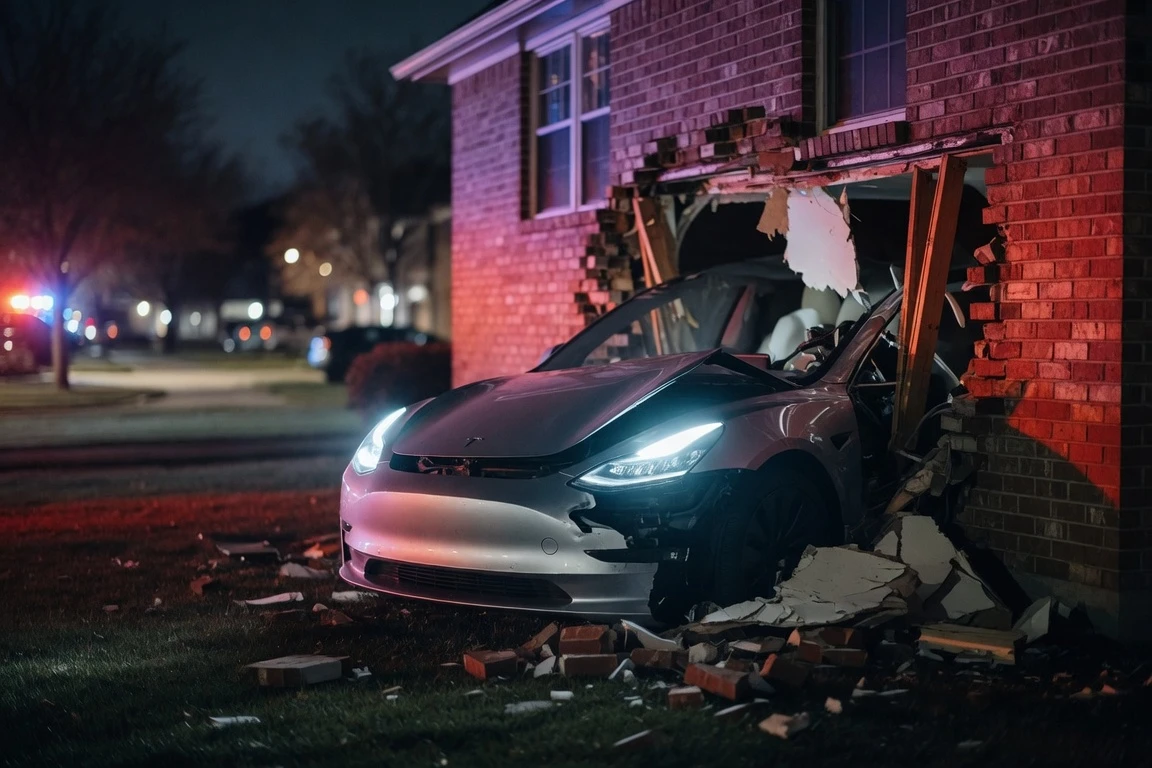
On Friday, June 19, 2026, at around 8 p.m. local time, a Tesla Model 3 left a residential street in Katy, Texas, at high speed and crashed through the front of a two-story brick home. The driver, identified by Harris County authorities as 44-year-old Michael Butler, told deputies he had been using Tesla’s automated driving assistance when the car failed to stay in its lane. Martha Avila, 76, was inside the home with her daughter’s family when the vehicle tore into the front room; she was transported by air to a hospital and pronounced dead. No charges had been filed as of Monday.
In surveillance footage shared by Avila’s daughter, Jennifer Barbour, the Model 3 is seen accelerating down Rose Hollow Lane before striking a curb and plowing through the brick facade. A witness put the speed at 60 to 70 mph. Sergeant Alex Turman of the Harris County Sheriff’s Office said the vehicle “failed to turn right at an intersection and, at a high rate of speed, crashed directly into a house”. Butler was hospitalized with no signs of intoxication and is cooperating with investigators. The home was rendered uninhabitable, and the family is now in temporary housing.
| Attribute | Detail |
|---|---|
| Date | Friday, June 19, 2026, around 8 p.m. local time |
| Location | 21300 block of Rose Hollow Lane, Katy, Texas |
| Vehicle | Tesla Model 3 |
| Driver | Michael Butler, 44 |
| Driver claim | Automated driving system engaged |
| Victim | Martha Avila, 76 |
| Witness speed estimate | 60 to 70 mph |
| Tesla AI chief’s claim | 73 mph; accelerator pressed to 100% |
| Driver status | Hospitalized; no charges filed as of Monday |
| NHTSA action | Special Crash Investigation opened Monday |
Driver Says Autopilot. Musk Says It Was Human.
Three accounts now exist, and they do not agree. Butler told deputies his automated driving system was engaged; Musk said on X that the crash “makes no sense” given how the system behaves. Elluswamy, Tesla’s Vice President of AI, said the data shows the driver floored it himself.
In this case, the driver manually overrode self-driving by pressing the accelerator all the way to 100% of the accel pedal in this residential area. They reached a speed of 73 mph during the crash, and had the accelerator pressed even after the crash.
On X on June 22, 2026, Tesla Vice President of AI Ashok Elluswamy posted what is now the company’s most detailed public statement on the crash.
Musk’s post, replying to coverage of the crash, read in full: “FSD drives slowly through neighborhood streets and this was a high speed crash!” Elluswamy responded on X with the Tesla AI chief’s full account of the crash, blaming manual driver input for the high speed. He said the driver had floored the accelerator in a residential area, with the pedal staying pressed even after impact. Elluswamy did not provide a source for the telemetry he cited.
Read together, the three statements lay out the central dispute of the federal probe. Butler blames the software. Musk’s defense rests on the speed: the system, he says, would never drive that fast on a residential street. Elluswamy blames a foot on the accelerator, which pushed the car to 73 mph during the crash on a residential street.
| Account | Source and venue | Key claim | Number cited |
|---|---|---|---|
| Michael Butler | Statement to Harris County deputies | Operating with an automated driving assistance system engaged | None given |
| Elon Musk | Post on X, June 22, 2026 | FSD drives slowly through neighborhood streets and this was a high speed crash | None |
| Ashok Elluswamy | Post on X, June 22, 2026 | Driver manually overrode self-driving by pressing the accelerator all the way to 100% | 73 mph; 100% accelerator |
What “Full Self-Driving” Is Allowed to Do
Sitting at the center of the dispute is a software brand called Full Self-Driving (Supervised), with the qualifier in parentheses. The company’s own Model 3 owners’ manual tells drivers the system requires constant attention and that they must be ready to take over at any moment. Tesla’s website adds that Autopilot and Full Self-Driving Capability are intended for a fully attentive driver with hands on the wheel. The website also states that the currently enabled features do not make the vehicle autonomous. The hardware is sold as autonomy-in-progress.
On the regulatory side, even the words self-driving sit at the center of a separate legal fight. The California Department of Motor Vehicles found Tesla had engaged in false advertising around its use of Autopilot and Full Self-Driving in December 2025. Under pressure of a 30-day dealership sales suspension, Tesla changed the marketing language for new vehicles in January 2026, according to the state’s California’s Autopilot marketing ruling against Tesla. Both are Level 2.
Three Federal Probes Already on Tesla’s Desk
The new Special Crash Investigation opens with two other NHTSA matters already on Tesla’s file. In October 2025, NHTSA opened Preliminary Evaluation PE25012, examining Full Self-Driving in roughly 2.88 million Teslas after reports of vehicles running red lights and crossing into oncoming lanes, detailed in NHTSA’s October 2025 FSD investigation filing. In March 2026, the agency upgraded a separate FSD investigation to an engineering analysis covering roughly 3.2 million vehicles, the last procedural step before NHTSA can demand a recall.
That probe covers 2017-through-2026 Model 3 sedans, the same model involved in the Katy crash. The October probe has logged 58 reports, including 14 crashes and 23 injuries. Senators Edward Markey and Richard Blumenthal last week sent NHTSA a letter demanding the agency investigate FSD safety risks, writing that Tesla’s “claims are based on misleading data analysis, such as comparing unlike crash outcomes, comparing new vehicles to the entire US vehicle fleet, and relying on incomplete crash data.” NHTSA confirmed it received the letter.
The new probe falls into a category NHTSA calls the Special Crash Investigation program, described in its how NHTSA’s crash investigation program works materials as the most in-depth inquiry the agency runs. The agency’s own records show it has opened 46 such investigations into Teslas using self-driving or driver-assistance technology over the past decade. In more than a dozen of those crashes, at least one person, a driver, passenger, or pedestrian, was killed. The Monday announcement adds another line to that tally. Whether the March probe graduates to a recall may now hinge on what the Katy data recorder shows.
Meanwhile, last year NHTSA opened a separate investigation into why Tesla was not reporting crashes promptly as required by federal rules. Tesla has also faced questions over its own data handling.
| Probe | Vehicles covered | Scope | Status | Key date |
|---|---|---|---|---|
| Special Crash Investigation program | 46 SCIs over the past decade | Crashes involving self-driving or driver-assistance systems | Ongoing, with new SCI added June 22 | June 22, 2026 (new SCI) |
| Preliminary Evaluation PE25012 | About 2.88 million | FSD running red lights, crossing into oncoming lanes | Open | October 2025 |
| Engineering Analysis (FSD) | About 3.2 million | FSD performance; covers 2017-through-2026 Model 3 sedans | One step from recall | Upgraded March 2026 |
The Name Itself Is the Concession
The marketing story around Tesla’s driver-assist software has been rewritten three times in the last eight months. California came first, in court. Tesla dropped the Autopilot name for new California vehicles in January 2026 after a state court and the California DMV found the company had engaged in false advertising. The October 2025 NHTSA probe had already pushed the company to defend its safety record publicly, with roughly 2.88 million Teslas caught up in the red-light investigation. In 2023, Tesla recalled more than two million vehicles following a two-year NHTSA investigation into Autopilot crashes.
Musk has spent the last year trying to shift the Tesla story from car sales to AI and robotaxis. The company is rolling out robotaxis using automated software in several U.S. cities and plans to invite Tesla owners to put their cars into the fleet. That effort now competes with a federal engineering analysis one step from a recall, a fresh Special Crash Investigation, and a California regulatory record that has already forced a name change, even as Tesla shares closed up by a point on Monday at $405.05.
Each piece of evidence so far points in the same direction. The car carried a software brand called Full Self-Driving, and the driver reportedly believed that brand enough to let the car drive itself on a residential street. The owner’s manual told him he had to be ready to take over at all times. NHTSA was already running a federal probe that could end with a recall. Elluswamy, in defending FSD on X, called coverage of the crash “blatantly irresponsible reporting” and reaffirmed that the system is “safer than manual driving.”
- 46 special crash investigations opened by NHTSA into Tesla over the past decade
- 58 reports in the October 2025 red-light probe, including 14 crashes and 23 injuries
- About 3.2 million Teslas covered by the March 2026 engineering analysis
- More than 2 million vehicles in Tesla’s 2023 recall
- About 2.88 million Teslas caught up in the October 2025 red-light probe
A Grandmother, an Uninhabitable Home, and a Lawsuit Coming
Avila lived with her daughter, son-in-law, and their three children, all of whom were in the home at the time of the crash. Her daughter, Jennifer Barbour, shared the doorbell video of the crash and posted: “This is the car flying into my home. My mom didn’t deserve this.” A GoFundMe page set up for the family had raised more than $27,000 as of Monday. Houston-based Zehl & Associates told reporters the family has hired the firm. Attorneys were attempting to have a lawsuit against Tesla and the driver filed by Tuesday, with earlier reporting on the Texas crash and the family’s response tracking the first 48 hours. The home is now uninhabitable.
As of Monday, no charges had been filed against Butler, according to online court and jail records reviewed by Houston Public Media. The Harris County Sheriff’s Office said evidence gathered during the ongoing investigation “will be presented to the Harris County District Attorney’s Office to determine whether charges are appropriate.” Musk’s broader bet on autonomy rests on the same software now sitting in a federal file: how Rivian and Uber are staking the robotaxi market captures the parallel pressure Tesla faces from autonomous rivals while its name is back in the regulator’s inbox.




Spotify Running Mode hits Android and revives its old tempo experiment

Galaxy Tab S12 Ultra Renders Keep the Notch Fans Hate

Novato Spinning Round House Sells With Six Neighbors for $3.3 Million

Crop Tour Finds Indiana and Nebraska Corn Yields Lagging 2025

Best Buy 60th sale brings Android deals back to its roots

American Airlines reverses seatback screen bet years too late

Iran Hormuz Strikes Force Gulf Oil Onto Costlier Paths

Plague Tale Prequel Day One Joins Game Pass Wave 2 as Witcher Exits

NBA 2K27 opens The City to everyone and rewrites career eras

iOS 26.6.1 Patches 29 Flaws as AI Forces Faster Apple Updates

Double Fine Cuts 23 Jobs Weeks After Xbox Independence

Day-One Big Walk Lifts PS Plus August Beyond Recycled AAA

John Hight Exits Wizards After Digital Reckoning Hits

Curtis Mead’s Red Sox Debut Ends With Fractured Wrist

Red Sox Squander Hot Streak Chance in 4-3 Loss to Athletics

Moesch and Dressel Rewrite Night One at 2026 U.S. Nationals

Boutte’s Quiet Camp Takeover Forces Patriots Receiver Choices

Take-Two CEO Pushes Netflix Subs for GTA 6 Extended Look

Halo Campaign Evolved Skulls Meet Death Barriers That Kill the Hunt

Wildlands Free Update Hands Players the Tools They Already Invented
-

 TECHNOLOGY3 years ago
How to Adjust a Bulova Watch Band – An Easy Guide
-

 News3 years ago
Fred Pentland: Athletic Bilbao’s English mentor who changed the essence of Spanish football
-

 FINANCE3 years ago
Tax Planning for Every Season: Guide to Maximizing Your Tax Benefits
-

 Education3 years ago
African Ministers New Education Plan
-

 BUSINESS3 years ago
What is Entrepreneurial Operating System? A Comprehensive Guide to EOS
-

 Education3 years ago
Innovate Your Learning Journey with Technology and Enhance Education
-

 News3 years ago
Russians formally out of World Athletics Championships
-

 BUSINESS3 years ago
Top 9 Most Expensive American Cities to Rent an Apartment