
News
FAA Grounds SpaceX Starship Just Days Before $1.75T IPO

The fourth Starship mishap investigation in 16 months landed on Wednesday, roughly fifteen days before SpaceX is scheduled to ring the Nasdaq opening bell. The Federal Aviation Administration said it cleared SpaceX to lead the inquiry, will be involved at every step, and will sign off on the final report and any corrective actions before the company’s next Starship attempt can fly.
SpaceX’s S-1 (Securities and Exchange Commission registration) prospectus, filed weeks earlier, names Starship as the spine of three growth bets: Starlink Version 3 deployment in the back half of this year, mobile satellite service, and orbital AI compute infrastructure. Booster 19’s hard splashdown in the Gulf of America on May 22 is the first public test of that dependency since the filing went out.
Why Booster 19 Triggered the Fourth Mishap Inquiry in 16 Months
The FAA said its post-flight assessment found that “off-nominal performance” of the Super Heavy booster “resulted in a mishap” requiring formal review. No injuries or damage to public property were reported, and the agency did not identify which clause of SpaceX’s 14 CFR Part 450 launch license framework was tripped.
A mishap inquiry is triggered when an FAA-licensed operation meets one of nine conditions in the rule. Three of them sit close to Flight 12’s facts:
- Impact of hazardous debris outside defined areas
- Failure to complete a launch or reentry as planned
- Malfunction of a safety-critical system
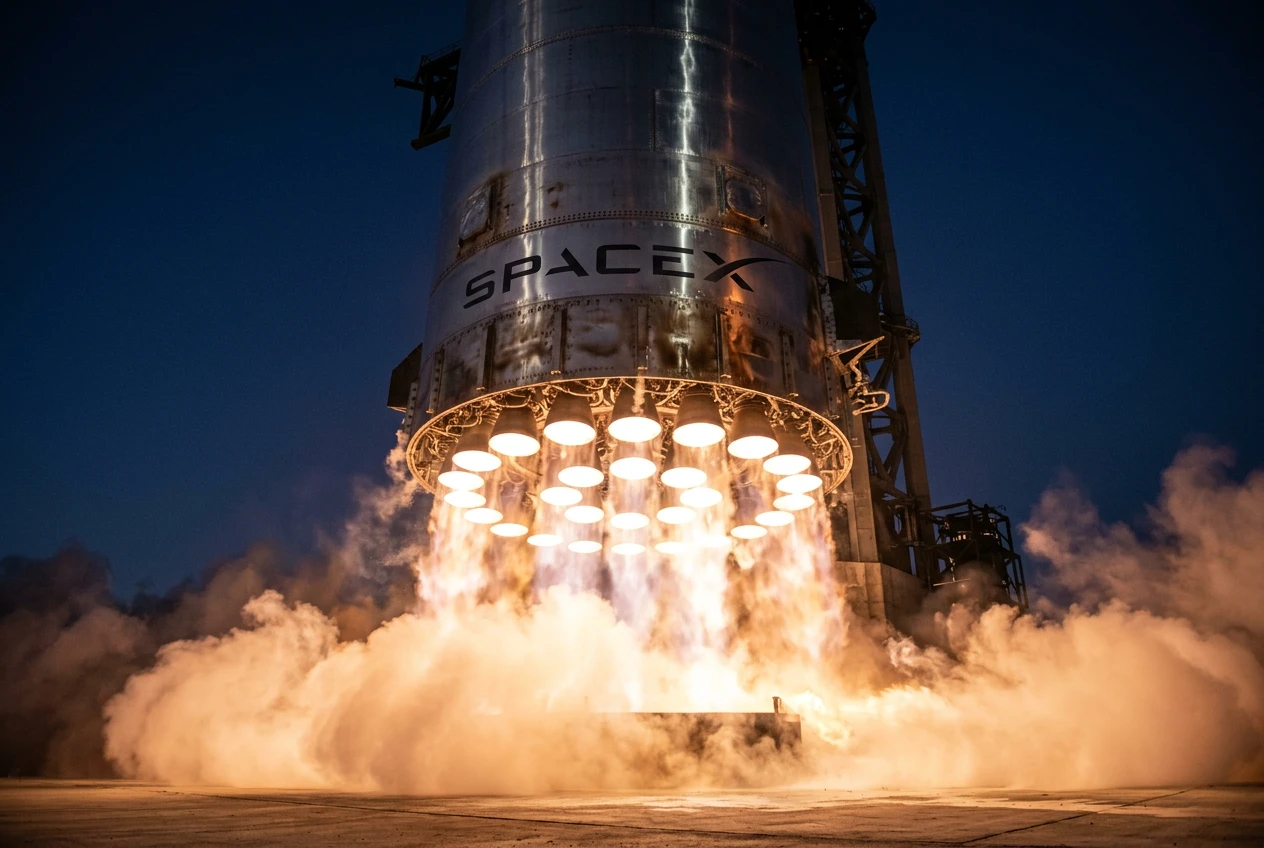
The proximate event was a botched boostback burn. About 1 minute and 42 seconds into ascent, one of the 33 Raptor V3 engines on the booster shut down. Stage separation followed cleanly. When the booster flipped and tried to relight its center engines for the return burn, several engines that were supposed to ignite did not.
We are not seeing as many booster engines ignited as we expected for boostback, but we are seeing six good engines on ship.
That was Dan Huot, a member of the SpaceX communications team, narrating the live broadcast in the seconds before the booster’s directional flip turned into a partial burn and, ultimately, a hard splashdown in the Gulf. The vehicle was over open water by then, well outside the populated debris hazard area.
Raptor 3’s Debut Looked Clean Until Boostback
Flight 12 was the first time SpaceX flew Raptor 3, the third-generation methalox engine the company is counting on to lift the heavier V3 stack. All 33 engines lit at the pad. By the company’s own metric, ascent performance “remained comparable to previous Raptor 2 flights,” with one shutdown two-thirds of the way up.
Boostback is where the picture changed. SpaceX’s on-screen engine status at the 2 minute, 32 second mark showed 12 of 13 center engines lit. As the booster reached for the outer ring of relights to slow itself for the splashdown, several of those outer engines went dark on the graphic. The company’s own post-flight write-up confirmed the booster “was unable to light all planned engines and performed a partial boostback burn that ended early.”
SpaceX moved at least 10 Raptor engines from Booster 20 to Booster 19 after a 10-engine static fire test in March ended abruptly because of a ground-side issue. That hardware shuffle, highlighted in the first episode of SpaceX’s in-house Starship docu-series, means the engines that flew on this mission had a more involved provenance than a standard build. Investigators will want to know whether re-fit history correlates with the relight failures.
One of the three Raptor Vacuum engines on the upper stage (tail number S39) also flagged an issue, prompting controllers to skip a planned in-coast reignition. The FAA did not flag that anomaly as a driver of the formal inquiry, which keeps the spotlight squarely on the booster.
The Mishap-Investigation Track Record Since Flight 7
SpaceX has been through this drill enough times to know the rhythm. The prior three mishap investigations resolved in windows that stretched from about 10 weeks to several months when both stages failed in the same flight. The pattern of fail, investigate, return is now the default operating tempo for Starship development.
| Flight | Event date | What failed | FAA closure | Pause length |
|---|---|---|---|---|
| 7 | Jan 16, 2025 | Upper stage broke up over Turks and Caicos | Mar 28, 2025 | ~10 weeks |
| 8 | Mar 6, 2025 | Ship lost attitude control, four engines shut down | Jun 12, 2025 | ~14 weeks |
| 9 | 2025 | Booster exploded; ship broke up over Indian Ocean | 2025 | Multi-month |
| 12 | May 22, 2026 | Booster partial boostback; hard Gulf splashdown | Open as of May 28 | TBD |
The corrective-action counts tell their own story: 11 fixes after Flight 7, 8 after Flight 8. None of those fixes touched Raptor 3, because Raptor 3 had not yet flown. The Flight 12 inquiry will be the first to confront the new engine in flight conditions, which is exactly why the investigation matters more than the splashdown itself.
The FAA process is laid out in advisory circular AC 450.173-1 and the underlying Part 450 rule. SpaceX must produce a root-cause analysis and a list of corrective actions, the FAA verifies implementation, then the agency clears flight. Nothing in the framework is fast.
The Investigation Lands Fifteen Days Before the IPO
SpaceX’s S-1 framed Starship as the rate-limiting step for almost everything else the company sells. Growth strategy, the filing says, “depends on our ability to increase our launch cadence and payload capacity, which is dependent on the successful development of Starship at scale.” Unexpected anomalies, supply-chain disruptions, and technical challenges “could result in delays or failures to deploy Starship on our anticipated schedule.”
The IPO calendar is tighter than the investigation calendar. SpaceX’s listing on Nasdaq is set for June 12 under the ticker SPCX, with shares pricing the prior evening at a $1.75 trillion to $2 trillion valuation. That is roughly 11 trading days after the mishap inquiry opened. If history holds, the FAA review will still be running when bankers ring the bell.
Pricing committees care, in order, about launch cadence, Starlink revenue trajectory, and the Department of Defense backlog. The inquiry touches the first two directly. Bankers can model around a 10-week grounding because they have done it before. They will struggle to model around a Raptor 3 design issue that would force a redesign cycle, because that pause is a different shape.
Starlink V3 Has No Plan B for Starship
The S-1 calls out a specific timeline: Starlink V3 satellites in the back half of 2026. Those satellites cannot fly on anything else SpaceX operates. At roughly 1,760 kilograms and seven meters long, each V3 unit is too big for the Falcon 9 payload fairing. The company tells investors directly that “our current operational rockets, including Falcon 9 and Falcon Heavy, are not capable of deploying V3 satellites and V2 Mobile satellites.”
The throughput math is what the prospectus leans on. A single Starship can carry up to 60 V3 satellites per launch. Each unit is rated at 1 terabit per second of downlink, roughly 10 times what current V1 hardware delivers. Without Starship at cadence, the V3 constellation does not get built on schedule.
That bottleneck has commercial weight. American Airlines committed to outfit more than 500 narrow-body Airbus aircraft with Starlink starting in Q1 2027, a launch customer scale that assumes the constellation’s capacity grows as promised. A mishap loop that stretches into Q4 puts the V3 ramp behind the customer contracts rather than ahead.
The further-out items in the prospectus read the same way. Orbital AI compute infrastructure, in-orbit data centers, and the EchoStar deal closing in fall 2027 all assume Starship moves from prototype to production launches. Each one degrades quietly if the engine investigation stretches beyond the typical 10-week window.
What Flight 13 Likely Loses
SpaceX has hardware in flow. Ship 40 and Booster 20 are the next pairing. Whether the company elects to attempt an orbital trajectory or repeat the planned, missed Gulf splashdown is the immediate operational question.
The likely answer, given an open Raptor 3 inquiry, is a more conservative profile. A tower catch of either stage with the chopstick arms looks off the table until the investigation closes. Public timing of a return-to-flight depends on whether the corrective actions involve software, hardware, or design changes; the first finishes in weeks, the third in quarters.
If the FAA closes the Flight 12 inquiry in line with the Flight 7 and Flight 8 pace, SpaceX returns to the pad by early August with a chastened flight plan, the IPO behind it, and the V3 deployment window still partially intact. If Raptor 3 turns out to need a redesigned ignition sequence or refurbished hardware, the back half of 2026 stops being a Starlink V3 deployment window and starts being a Raptor 3 qualification window. That second branch is the one Nasdaq pricing committees do not yet have a number for.






Stock Futures Wobble as Trump’s Hormuz Blockade Meets Earnings Season

Chipotle Enters Mexico, the Market That Sank Taco Bell Twice

Samsung’s Galaxy Watch 9 and Watch Ultra 2 Bet on a Borrowed Chip

Pentagon Suspends CMMC Phase 2, Relieving Small Firms, Straining Assessors

PS5 Adds a Weekly Wrap-Up Widget While Recently Played Stays Broken

A Brazilian Gamer Sued Microsoft Over a Hacked Xbox Account, and Won

Volkswagen’s CEO Confirms 100,000 Jobs Are on the Table

Assassin’s Creed Black Flag Resynced Splits Handhelds by Price

Lorde Calls Smart Glasses ‘Not Sexy’ Right on Ray-Ban’s Own Stage

Nintendo Eyes a Switch 2 OLED Model as the Memory Crisis Bites

Halo Studios Reverses PS Plus for Halo: Campaign Evolved on PS5

Black Ops 1 and 2 PS5 Ports: $40 Price Tag Has Fans Uneasy

Matt Brown Dismisses Rousey and Paul’s MVP MMA Ratings Win Over UFC

Star Wars: Galactic Racer Is a Roguelite Racer With a Podracing Skin

Julius Randle Traded to Nets as Wolves Reclaim Cap Space for Dosunmu

Sega’s $49.99 Sonic Classic and Modern Bundles Hit Switch in October

Colombia Edge DR Congo as Muñoz Books World Cup Knockout Place

Douze Dixièmes Closes Five Months After MIO: Memories in Orbit

Warriors Take Yaxel Lendeborg, the Oldest Pick in the 2026 NBA Draft

Meta’s Muse Image Lets Anyone Use Your Instagram Photos in AI
-

 TECHNOLOGY3 years ago
How to Adjust a Bulova Watch Band – An Easy Guide
-

 News3 years ago
Fred Pentland: Athletic Bilbao’s English mentor who changed the essence of Spanish football
-

 FINANCE3 years ago
Tax Planning for Every Season: Guide to Maximizing Your Tax Benefits
-

 Education3 years ago
African Ministers New Education Plan
-

 BUSINESS3 years ago
What is Entrepreneurial Operating System? A Comprehensive Guide to EOS
-

 Education3 years ago
Innovate Your Learning Journey with Technology and Enhance Education
-

 News3 years ago
Russians formally out of World Athletics Championships
-

 BUSINESS3 years ago
Top 9 Most Expensive American Cities to Rent an Apartment