
News
A Simple Thermodynamic Rule May Predict Black Hole Mergers
Penn State researchers find that black hole mergers may be governed by a simple entropy rule, predicting the final remnant to within a few percent.

Black hole mergers may be governed by a simple thermodynamics rule usually applied to gases. A team at Penn State shows that the final black hole produced when two black holes collide lands at the state that maximizes entropy, the same kind of rule that describes two hot gases mixing in a box.
Predictions of that final state have, until now, required feeding Einstein’s equations of general relativity into supercomputers. The new approach, laid out in a paper published in the journal Physical Review Letters in 2026, lines up with those simulations to within a few percent. The authors say the result hints that thermodynamics may be a more fundamental organizer of black hole interactions than physicists had assumed.
A Simpler Rule for the Universe’s Most Violent Events
Two black holes spiraling into each other emit gravitational waves strong enough to be picked up by instruments on Earth from billions of light-years away. The merged black hole left behind rings like a struck bell before settling into a stable state described by just two numbers, its final mass and spin.
The new work, published in the journal Physical Review Letters, comes from a team led by Penn State physicists and includes collaborators at the University of Mississippi and UC Berkeley. The first author is Monica Rincon-Ramirez, a postdoctoral scholar in physics in the Penn State Eberly College of Science. The team’s leader is B.S. Sathyaprakash, Elsbach Professor of Physics and professor of astronomy and astrophysics at Penn State, with professor of physics Eugenio Bianchi, postdoctoral researchers Vaishak Prasad (Penn State), Nathan K. Johnson-McDaniel (University of Mississippi), and Ish Gupta (UC Berkeley) also on the paper.
Until now, predicting the final mass and spin required feeding Einstein’s equations of general relativity into supercomputers. The Penn State approach replaces that brute-force calculation with a single, familiar idea from thermodynamics: the final state is the one that maximizes entropy. That simple substitution, the team reports, lands within a few percent of the supercomputer result.
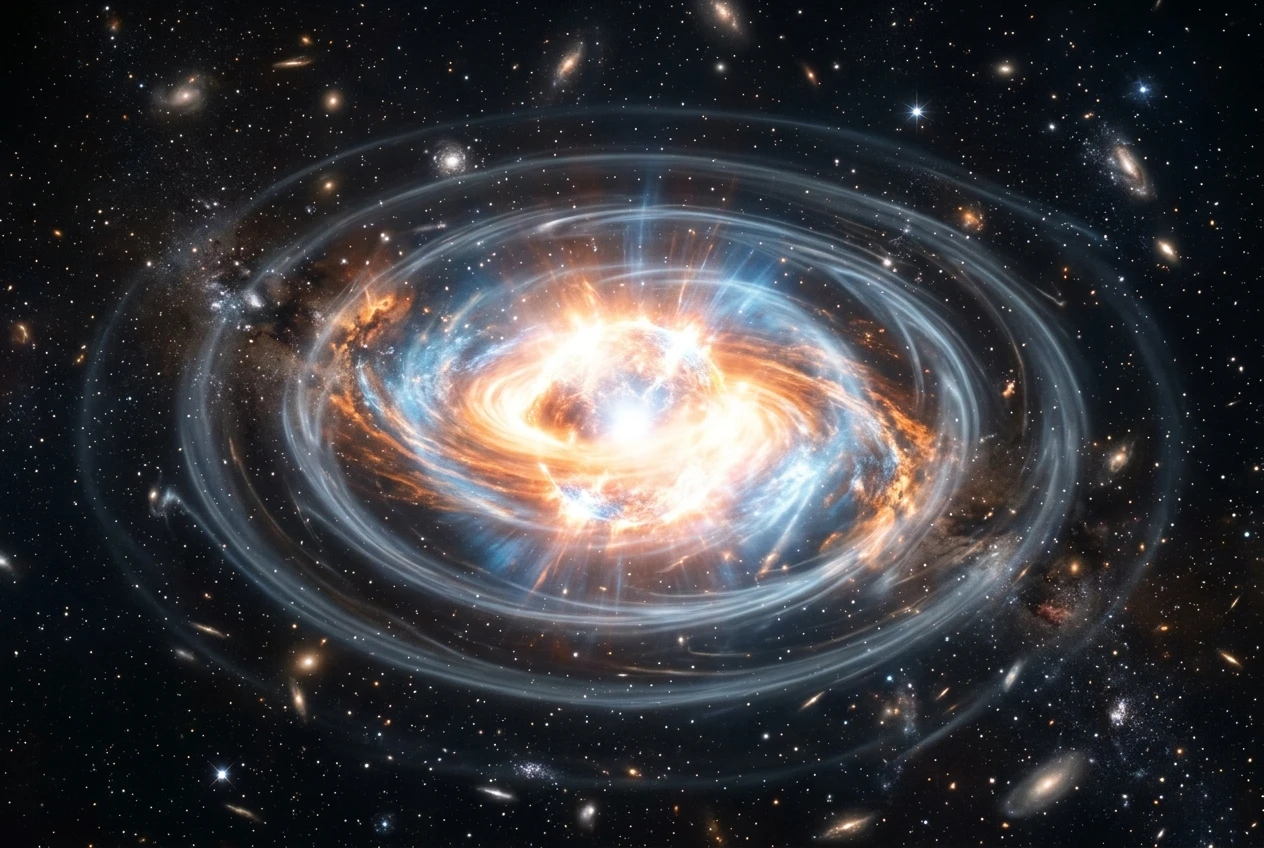
The Conjecture in Plain Terms
The team calls their new idea the maximum entropy conjecture for black hole mergers, and the full case is laid out in the preprint laying out the maximum entropy conjecture. It says that once the energy and angular momentum carried away by gravitational waves during the collision are properly accounted for, the final black hole is the state that maximizes entropy, the measure of disorder, or more precisely, of how many ways something can be arranged. Vaishak Prasad, the Penn State postdoctoral researcher, used a familiar image: a messy room has high entropy because there are countless ways things can be strewn about, while a perfectly tidy room has low entropy because there are only a few arrangements that count as tidy.
Thermodynamics predicts that nature drifts toward high-entropy states simply because there are more of them. The team’s conjecture proposes that black hole mergers obey the same drift. As professor of physics Eugenio Bianchi of Penn State, one of the paper’s authors, put it in the Penn State press release on the new finding:
When two hot gases are brought into contact, one does not need to track every microscopic interaction of the molecules in the gases to determine the final state of the combined gas. Maximizing entropy, while accounting for other physical laws, predicts the outcome.
How the Math Lines Up
The team tested the conjecture by tracking the binary’s evolving mass and angular momentum through the inspiral, then mapping those values onto a sequence of hypothetical rotating remnant black holes. At each step, they computed the entropy of the corresponding Kerr black hole, a stationary, rotating solution to Einstein’s equations. The entropy of the sequence climbed to a maximum at a particular mass and spin. That maximum sat at values strikingly close to the mass and angular momentum of the actual final remnant, as predicted independently by numerical relativity simulations.
The agreement held whether the binary’s mass and angular momentum were drawn from a post-Newtonian approximation or from full numerical relativity evolution. In both cases, the maximum-entropy point matched the supercomputer result within a few percent. That is not a proof, and the team is careful to call the result a conjecture rather than a theorem, but the consistency across two independent ways of describing the binary is what makes the result suggestive.
The procedure is, in the team’s own description, “somewhat ad hoc.” It does not derive the result from first principles. It picks the answer and asks whether nature agrees, then finds that across the cases tested, nature does.
What the Merger Seems to Remember
When two black holes collide and merge, the resulting remnant black hole seems to “forget” almost everything about the collision except its mass and spin. The team describes that selective memory in a thermodynamic frame, where the only variables that survive the merger are the ones the final state can use to maximize entropy. The central finding, in Rincon-Ramirez’s words, emerged from studying how the merging black holes’ evolving mass and angular momentum map onto those of a sequence of hypothetical rotating black hole remnants, and from finding that the entropy of that sequence reaches a maximum at values close to the actual final remnant.
The conceptual shift is small but consequential. The paper’s authors do not change the long-standing picture of what a stationary black hole looks like, fully described by just its mass and spin. They reframe which combinations of mass and angular momentum are reachable after a merger, and answer that question with the same tool used to predict how two gases mix.
- The final mass and spin, the two numbers a stationary black hole is generally thought to retain.
- The energy radiated away as gravitational waves during the inspiral and ringdown.
- The angular momentum radiated away as gravitational waves, which lowers the final spin.
A Second Penn State Push in the Same Direction
The Penn State work is not the only recent push in this direction. A separate team at the same university, led by Abhay Ashtekar, the Atherton University Professor and Evan Pugh Professor of Physics Emeritus, published findings that extend Hawking’s laws of black hole mechanics to dynamic, out-of-equilibrium black holes.
That study tackles a related but distinct problem. Hawking’s formulation of black hole mechanics was built for black holes at equilibrium, unchanging over time, while real black holes form, merge, and evaporate. The Ashtekar team’s solution was to replace the familiar event horizon with a dynamical horizon defined by the black hole’s local properties at a given instant, not by what may happen in the future. The change removes the teleological problem that has blocked extending thermodynamic laws to dynamic black holes for half a century.
Read together, the two papers sketch a research program. Ashtekar’s work extends the laws of black hole mechanics to dynamic, out-of-equilibrium black holes. Sathyaprakash’s team proposes a thermodynamic principle that may govern the selection of the final state when two dynamic black holes meet. The maximum entropy work was funded by the U.S. National Science Foundation, and the broader question of how black holes form and behave across cosmic time is the subject of other recent work, including Webb’s find of a black hole that predated its galaxy.
| Study | Lead | Key idea | Journal |
|---|---|---|---|
| Maximum Entropy Conjecture for Black Hole Mergers | Sathyaprakash (first author: Rincon-Ramirez) | The merger remnant is the state that maximizes entropy over mass and angular momentum | Physical Review Letters (2026) |
| Dynamic Black Holes Explained by Simple Thermodynamics | Abhay Ashtekar | Replace event horizons with dynamical horizons to extend thermodynamic laws to out-of-equilibrium black holes | Physical Review Letters (2026) |
The Question the Paper Leaves Open
B.S. Sathyaprakash, who leads the research team, frames the result in deliberately open terms. The team, he says, has found that the most natural way to describe what the remnant remembers can be explained using thermodynamic concepts. The work, he adds, explores a surprising possibility at the intersection of gravity, black hole physics, and thermodynamics that goes beyond the established laws of black hole mechanics. The piece he closes on is a question:
Could entropy maximization be a fundamental organizing principle governing black hole interactions more generally?
That question is not rhetorical. If entropy maximization does for black hole mergers what it does for mixed gases, the same principle might apply to other black hole processes, including the evaporation predicted by Hawking, the capture of matter by a black hole, or the long settling phase after a near-miss. The Penn State work does not test those cases. It makes them testable, for the first time, with a tool that does not require a supercomputer.
Frequently Asked Questions
What is the maximum entropy conjecture for black hole mergers?
It is the proposal, from the Penn State team, that the final black hole produced by a merger is the one that maximizes entropy, the measure of disorder in a system, once the energy and angular momentum radiated away as gravitational waves are subtracted. The team maps the binary’s evolving mass and angular momentum to a sequence of hypothetical rotating remnant black holes, then picks the one whose entropy is highest. The procedure is described as “somewhat ad hoc” in the preprint, but it lands within a few percent of full numerical relativity simulations in the cases tested.
Why does this matter if Einstein’s equations already work?
Einstein’s equations give exact answers only when run on a supercomputer, which limits the number of merger scenarios physicists can explore. A thermodynamic shortcut, if it holds, would let researchers scan many more possibilities cheaply and might surface patterns the full equations obscure. It also reframes the question: instead of computing the merger, one predicts it from a principle that already governs gases, magnets, and engines.
Has this been proven, or is it still a conjecture?
It is still a conjecture. The team has shown the entropy-maximization procedure reproduces the supercomputer result to within a few percent across the cases tested, but they have not proved it must always hold. The paper is titled “Maximum Entropy Conjecture for Black Hole Mergers,” and the authors are explicit that the agreement, while suggestive, is not yet a theorem.
What does this mean for how physicists study black hole mergers?
The paper points toward testing the principle on other black hole processes, including the evaporation predicted by Hawking and the capture of matter by a black hole. Whether entropy maximization is a fundamental organizer of black hole interactions more generally is the test the team has left for future work, and a question the paper deliberately leaves open.
Where can I read the paper?
The paper, by Monica Rincon-Ramirez and colleagues, is published in Physical Review Letters in 2026, with the DOI 10.1103/hvp6-ydbq. A preprint of the paper, including the full case for the conjecture, is available on the arXiv repository. Penn State has also published a press release on the finding, and the University of Mississippi and UC Berkeley are listed as author affiliations on the published version.







Spotify Running Mode hits Android and revives its old tempo experiment

Galaxy Tab S12 Ultra Renders Keep the Notch Fans Hate

Novato Spinning Round House Sells With Six Neighbors for $3.3 Million

Crop Tour Finds Indiana and Nebraska Corn Yields Lagging 2025

Best Buy 60th sale brings Android deals back to its roots

American Airlines reverses seatback screen bet years too late

Iran Hormuz Strikes Force Gulf Oil Onto Costlier Paths

Plague Tale Prequel Day One Joins Game Pass Wave 2 as Witcher Exits

NBA 2K27 opens The City to everyone and rewrites career eras

iOS 26.6.1 Patches 29 Flaws as AI Forces Faster Apple Updates

Guardians Rout Twins With Seven Homers, Leave Joe Ryan One Shy of Record

Caitlin Clark Skips the WNBA 3-Point Contest for a Third Straight Year

Rainout Gives Red Sox Two Shots at a Franchise-Record Win Streak

Double Fine Cuts 23 Jobs Weeks After Xbox Independence

John Hight Exits Wizards After Digital Reckoning Hits

Day-One Big Walk Lifts PS Plus August Beyond Recycled AAA

Curtis Mead’s Red Sox Debut Ends With Fractured Wrist

Moesch and Dressel Rewrite Night One at 2026 U.S. Nationals

Red Sox Squander Hot Streak Chance in 4-3 Loss to Athletics

Boutte’s Quiet Camp Takeover Forces Patriots Receiver Choices
-

 TECHNOLOGY3 years ago
How to Adjust a Bulova Watch Band – An Easy Guide
-

 News3 years ago
Fred Pentland: Athletic Bilbao’s English mentor who changed the essence of Spanish football
-

 FINANCE3 years ago
Tax Planning for Every Season: Guide to Maximizing Your Tax Benefits
-

 Education3 years ago
African Ministers New Education Plan
-

 BUSINESS3 years ago
What is Entrepreneurial Operating System? A Comprehensive Guide to EOS
-

 Education3 years ago
Innovate Your Learning Journey with Technology and Enhance Education
-

 BUSINESS3 years ago
Top 9 Most Expensive American Cities to Rent an Apartment
-

 News3 years ago
Russians formally out of World Athletics Championships