
AUTOMOBILE
Tesla Defends FSD After Texas Crash Kills 76-Year-Old at 73 mph
Tesla says the driver manually overrode Full Self-Driving by flooring the accelerator in a fatal Texas crash. NHTSA has opened a new federal probe.

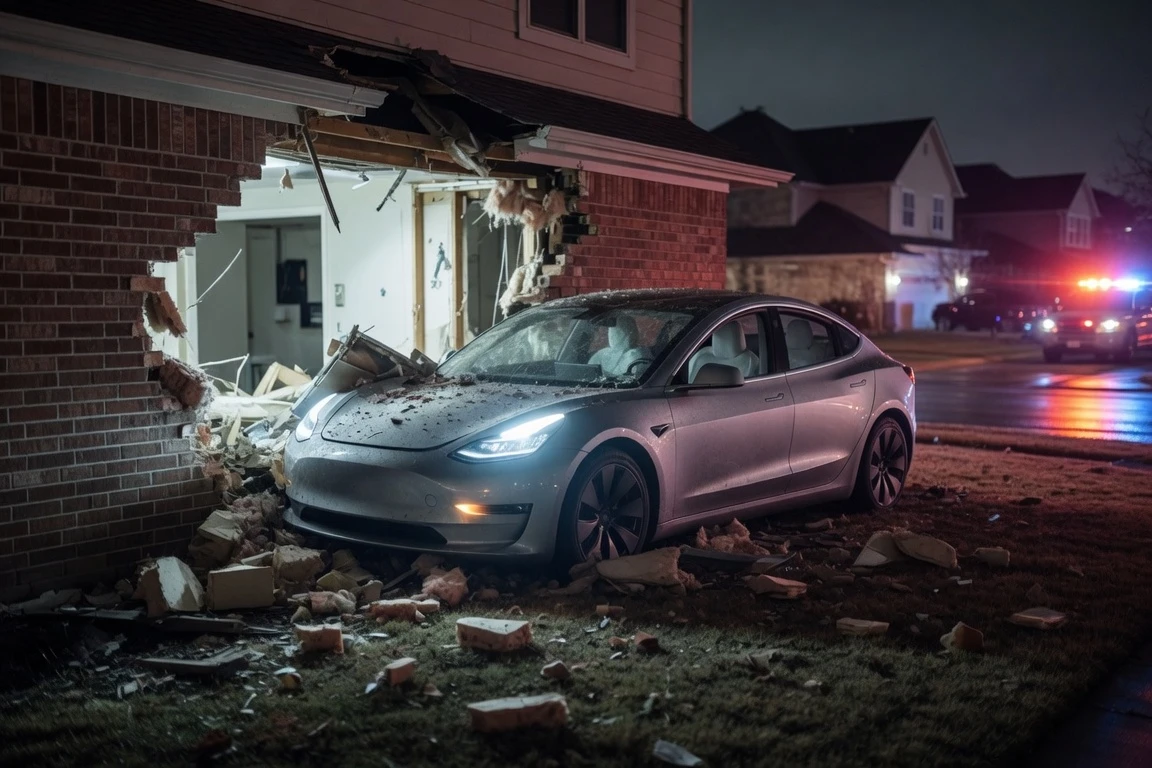
A Tesla Model 3 slammed into a brick home in Katy, Texas, on Friday night, killing 76-year-old Martha Avila, who was standing in the front room. Tesla pushed back within hours: its vice president of AI software, Ashok Elluswamy, posted on X that the vehicle’s Full Self-Driving system was overridden by the driver, Michael Butler, who he said floored the accelerator to 73 mph with the pedal still pressed after the impact.
The National Highway Traffic Safety Administration opened a Special Crash Investigation the same day, the most in-depth federal review of a Tesla incident and the latest in a series of more than 40 such probes since 2016, per TechCrunch. The crash has triggered a planned wrongful-death lawsuit against Tesla by the Avila family, according to Houston Public Media. A Miami federal jury in August 2025 found Tesla 33% responsible for a 2019 Key Largo Autopilot crash and imposed a $243 million judgment, upheld in February, a precedent the new case will be measured against.
What Happened on Rose Hollow Lane
Around 8 p.m. on Friday, June 19, a Model 3 driven by 44-year-old Michael Butler left the 21300 block of Rose Hollow Lane, a residential street in the Houston suburb, and crossed a curb before plowing into the front of a two-story brick home, the Harris County Sheriff’s Office said. The car entered the front room at a “high rate of speed” and struck Avila, who was inside with her daughter’s family, per the sheriff’s office. Surveillance footage shared by Avila’s daughter, Jennifer Barbour, shows the Model 3 accelerating down the street, striking the curb, and tearing through the brick facade. A witness at a nearby party estimated the car was traveling 60 to 70 mph, per Electrek.
Avila, 76, was airlifted to a hospital, where she was pronounced dead, the sheriff’s office said. The home was rendered uninhabitable by the breach, and the family is now in temporary housing, according to a GoFundMe account that had raised more than $27,000 as of Monday. Her daughter told KHOU she was struggling to place blame: “I don’t know if it’s his fault or the car’s fault or what really happened. I’ve never seen a car go that fast.”
Butler was hospitalized with no signs of intoxication and was cooperating with investigators, per the Harris County Precinct 5 Constable’s Office. He told deputies he was operating the vehicle “with an automated driving assistance system engaged at the time of the crash,” the sheriff’s office said. No charges had been filed as of Monday, and the sheriff’s office said evidence would be presented to the Harris County District Attorney’s Office to determine whether charges are appropriate. Butler’s Autopilot claim has not been independently confirmed, and Tesla did not respond to a request for comment from CNBC.
The Harris County Sheriff’s Office Vehicular Crimes Division is leading the local investigation, and Zehl & Associates, a Houston law firm, said Monday it plans to file a civil wrongful-death lawsuit on the Avila family’s behalf. Sergeant Alex Turman of the sheriff’s office said the vehicle “failed to turn right at an intersection and, at a high rate of speed, crashed directly into a house.”
Tesla Pushes Back on the Autopilot Claim
Tesla, a company that famously dismantled its press team years ago, broke its silence on Monday afternoon through two of its highest-ranking executives. Ashok Elluswamy, vice president of AI software at Tesla and the first engineer hired onto the Autopilot team in 2014, took to X to dispute Butler’s account. CEO Elon Musk replied in kind on the same platform, writing that the incident “makes no sense.” The pair’s posts, on the day NHTSA opened a federal probe, amount to Tesla’s most detailed public statement on the crash. Elluswamy did not cite a source for the telemetry he referenced, and Tesla did not respond to a separate request for comment from CNBC.
In this case, the driver manually overrode self-driving by pressing the accelerator all the way to 100% of the accel pedal in this residential area. They reached a speed of 73 mph during the crash, and had the accelerator pressed even after the crash.
The post was made by Ashok Elluswamy, Tesla’s vice president of AI software, on June 22, 2026, in reply to coverage of the crash on X. Musk, in a separate post the same afternoon, added that “FSD drives slowly through neighborhood streets and this was a high speed crash.” Elluswamy also accused the press of planting “FUD [fear, uncertainty, and doubt] in the minds of the general public,” per The Verge.
Tesla’s account places its own driver-assistance software in the loop at the moment of impact, with the driver’s pedal input as the override. The company has not publicly released the underlying telemetry, the event data recorder readout, or any third-party validation of its numbers. The Washington Post has reported that Tesla has a history of losing, withholding, or making it difficult for attorneys and other interested parties to obtain the comprehensive electronic data its cars generate in severe collisions. The federal probe will pull that data independently, per the agency’s standard procedure for Special Crash Investigations.
Three Conflicting Stories From One Crash
Three accounts of what happened on Rose Hollow Lane now exist, and they do not agree. Butler told deputies his automated driving system was engaged. Musk said on X that the crash “makes no sense” given how the system behaves, without elaborating on what he believed did happen. Elluswamy said the data shows the driver floored the accelerator to 100% of pedal travel and never let up. Each account was reported by a different outlet, and none has been independently verified by investigators.
The Harris County Sheriff’s Office released a statement on Saturday describing the vehicle as “operating with an automated driving assistance system engaged at the time of the crash,” a characterization that did not name the system or specify its status. Musk’s post on June 22, 2026, was a single sentence that questioned how a system which “drives slowly through neighborhood streets” could have produced a high-speed crash, without disputing that FSD was on. Elluswamy’s post the same day was Tesla’s first public confirmation that Full Self-Driving was active, and his explanation pointed to driver input rather than software behavior. The conflict will now be settled by NHTSA’s Special Crash Investigation, which will pull the vehicle’s event data recorder and onboard logs to determine whether a driver-assistance system was engaged, at what speed, and what inputs the driver made. As of Monday, the sheriff’s office had not laid charges, and Butler remained hospitalized.
| Account | Source and venue | Key claim | Number cited |
|---|---|---|---|
| Michael Butler | Statement to Harris County deputies | Operating with an automated driving assistance system engaged | None given |
| Elon Musk | Post on X, June 22, 2026 | FSD drives slowly through neighborhood streets and this was a high speed crash | None |
| Ashok Elluswamy | Post on X, June 22, 2026 | Driver manually overrode self-driving by pressing the accelerator all the way to 100% | 100% accelerator pedal |
The Federal Probe’s Long Memory
NHTSA’s Special Crash Investigation, opened Monday, is the agency’s most in-depth category of inquiry, intended for accidents that occur under unusual circumstances. Investigators will pull the event data recorder and onboard logs to determine whether a driver-assistance system was engaged, the speed at which the car was moving, and the driver inputs in the seconds before impact. The probe is reportedly the latest in more than 40 such investigations the agency has opened into Tesla crashes since 2016, per TechCrunch.
The new SCI lands on a federal docket that is already crowded with Tesla matters. In March 2026, NHTSA upgraded its Full Self-Driving probe to an Engineering Analysis covering roughly 3.2 million vehicles, the last procedural step before the agency can demand a recall, per Electrek. That probe covers 2017-through-2026 Model 3 sedans, the same model involved in the Katy crash. A separate, still-open preliminary evaluation covers about 2.88 million Teslas for FSD committing traffic violations like running red lights and crossing into oncoming lanes. Tesla is also under separate NHTSA scrutiny for failing to properly report crashes involving Autopilot and FSD.
- 46 Special Crash Investigations NHTSA has opened into Teslas using self-driving or driver-assistance technology over the past decade, per agency records cited by Houston Public Media
- 3.2 million Teslas covered by the current NHTSA Engineering Analysis, the last step before the agency can demand a recall
- 65 fatalities in Tesla Autopilot or FSD crashes from 2013 to 2025, per a tally by TeslaDeaths.com cited by CNBC
Tesla is also under a separate NHTSA investigation into whether it has been reporting crashes involving Autopilot and FSD in a timely manner, as required by federal rules. The Washington Post has reported that Tesla has a history of losing, withholding, or making it difficult for attorneys and other interested parties to obtain the comprehensive electronic data its cars generate in severe collisions. In the Key Largo litigation, Tesla told plaintiffs the crash data did not exist until an independent researcher recovered the “collision snapshot” the car had automatically uploaded to Tesla’s servers, which showed the system had detected the pedestrian. That history is why the agency’s own data pull matters more than Tesla’s X post. The data picture, including the prior Engineering Analysis and the 2025 PE, is laid out in the prior report on the Texas crash.
How a Florida Verdict Reset the Debate
In August 2025, a Miami federal jury found Tesla 33% responsible for a 2019 Key Largo crash in which driver George McGee, using Autopilot, blew through a T-intersection and killed Naibel Benavides Leon. The jury put 67% of the fault on McGee, who had admitted he dropped his phone and took his eyes off the road. The $243 million judgment, which a federal judge upheld in February, was the first major jury verdict to hold Tesla partly liable for a fatal crash involving its driver-assistance software. The case is the precedent that now sits behind every federal investigation into a Tesla fatality.
The Key Largo jury’s reasoning is what makes the precedent portable. Even though the driver was plainly misusing the system, the jury concluded Tesla shared responsibility because its marketing and weak, steering-torque-based driver monitoring fostered a false sense of what the car could do. The same complacency dynamic, misuse combined with system design, is now the legal frame the Katy crash is being measured against. Houston Public Media quoted Nikolas Guggenberger, a professor at the University of Houston Law Center, who said liability “gradually shifts from the driver to the company as the car behaves more autonomously.” Guggenberger added that the driver can still be liable for product or manufacturing defects.
Tesla’s framing in the Key Largo case, that the data showed the driver did it, was the same framing Elluswamy deployed on X on Monday. The Key Largo jury’s response was to read Tesla’s own data and find the company partly at fault. NHTSA’s Special Crash Investigation, the most in-depth federal review the agency runs, will now do the same for the Rose Hollow Lane data. The next move belongs to the agency.
The Branding Wrinkle That Won’t Go Away
The system at the center of the dispute is sold under two names, neither of which describes what it does. Tesla discontinued “Autopilot” as the standard driver-assistance name for new California vehicles in January 2026, after a state court and the California DMV found the company had engaged in false advertising around the term. The California DMV had moved to suspend Tesla’s dealer licenses, and Tesla changed the marketing language for new vehicles in California to avoid a 30-day sales suspension. Full Self-Driving (Supervised), the current $99 monthly subscription product, “requires you to pay attention to the road and be ready to take over at all times,” per the Model 3 owners’ manual quoted by CNBC.
The parentheses around “Supervised” are doing work. Both Autopilot and Full Self-Driving (Supervised) are classified as Level 2 systems by SAE International, a designation that requires a fully attentive driver at all times, per NHTSA’s own description. The system is sold as autonomy-in-progress, hardware-ready for a future of unsupervised driving, while drivers are told the software cannot drive itself. The May 2026 Clairemont, California, crash, in which six people were injured when a Tesla struck another vehicle and plowed into a home, came with witness reports that the driver said they were using Autopilot at the time, per NBC 7 San Diego. The new Rose Hollow Lane data, when it lands, will test how long the gap between the marketing and the manual can hold.
Frequently Asked Questions
What happened in the Texas Tesla crash?
On Friday, June 19, 2026, around 8 p.m. local time, a Tesla Model 3 driven by Michael Butler, 44, left Rose Hollow Lane in Katy, Texas, and crashed into a two-story brick home, killing 76-year-old Martha Avila, who was standing in the front room.
Why is Tesla saying the driver overrode Full Self-Driving?
Tesla’s vice president of AI software, Ashok Elluswamy, posted on X that vehicle data shows the driver manually overrode the system by pressing the accelerator to 100% of pedal travel, reaching the speed Tesla cited, with the pedal still pressed after the impact. The full post is at Elluswamy’s full post on the data.
What has Elon Musk said about the crash?
Musk posted on X that the crash “makes no sense” and pointed to how Full Self-Driving normally behaves in residential streets, calling the high-speed impact inconsistent with how the system drives. His full post is at Musk’s post calling the crash nonsense.
What is NHTSA investigating?
NHTSA opened a Special Crash Investigation on Monday, June 22, 2026, the most in-depth federal probe category. The agency will pull the vehicle’s event data recorder and onboard logs to determine whether a driver-assistance system was engaged, at what speed, and what inputs the driver made in the seconds before impact.
Could Tesla still be held liable if the driver floored the accelerator?
Yes. In August 2025, a Miami federal jury found Tesla 33% responsible for a 2019 Key Largo Autopilot crash in which driver George McGee dropped his phone and ran a stop sign, killing Naibel Benavides Leon. The jury’s $243 million judgment, upheld in February 2026, found Tesla’s marketing and weak driver monitoring created the conditions for misuse, even when the driver was clearly at fault.





Iowa Farmer Built Resilience for 16 Years Then Tariffs Hit Hard

HHS Adds FDA Tech and Drugs Deputies to Lock In AI and Review Power

Nvidia Earnings Carry a Built-In Sell-the-News Trap

HP Licenses Huawei Wi-Fi Patents Despite the Entity List

Poland Named in $131B F-15 Deal Echoes Apache Path

Sewer Scavengers Near Penn Station Repeat a Decades-Old NYC Pattern

Second Muni Fatigue Crash Exposes Surface Line Gaps

Chick-fil-A Chicken and Waffles Closes Its 80-Year Loop

Musk Data Centers Leave a Mississippi Family’s Historic Land Empty

OpenAI Data Center Chief Exits as Stargate Strategy Shifts

Double Fine Cuts 23 Jobs Weeks After Xbox Independence

Day-One Big Walk Lifts PS Plus August Beyond Recycled AAA

Curtis Mead’s Red Sox Debut Ends With Fractured Wrist

John Hight Exits Wizards After Digital Reckoning Hits

Red Sox Squander Hot Streak Chance in 4-3 Loss to Athletics

Moesch and Dressel Rewrite Night One at 2026 U.S. Nationals

Boutte’s Quiet Camp Takeover Forces Patriots Receiver Choices

Take-Two CEO Pushes Netflix Subs for GTA 6 Extended Look

Halo Campaign Evolved Skulls Meet Death Barriers That Kill the Hunt

Wildlands Free Update Hands Players the Tools They Already Invented
-

 TECHNOLOGY3 years ago
How to Adjust a Bulova Watch Band – An Easy Guide
-

 News3 years ago
Fred Pentland: Athletic Bilbao’s English mentor who changed the essence of Spanish football
-

 FINANCE3 years ago
Tax Planning for Every Season: Guide to Maximizing Your Tax Benefits
-

 Education3 years ago
African Ministers New Education Plan
-

 BUSINESS3 years ago
What is Entrepreneurial Operating System? A Comprehensive Guide to EOS
-

 Education3 years ago
Innovate Your Learning Journey with Technology and Enhance Education
-

 News3 years ago
Russians formally out of World Athletics Championships
-

 BUSINESS3 years ago
Top 9 Most Expensive American Cities to Rent an Apartment