
News
China’s LineShine Tops El Capitan as World’s Fastest Supercomputer
China’s LineShine took the TOP500 number one spot at 2.198 exaflops, the first machine to cross that mark without GPUs and the first Chinese win since 2017.

China’s LineShine supercomputer took the top spot on the TOP500 ranking of the world’s most powerful machines on Tuesday, ending El Capitan’s 19-month reign as the planet’s fastest computer. The system at the National Supercomputing Centre in Shenzhen measured 2.198 exaflops on the standard High Performance Linpack benchmark, roughly 20% ahead of the US-built El Capitan at Lawrence Livermore National Laboratory.
The more consequential detail is how LineShine got there. It is the first machine in the ranking’s history to sustain more than two exaflops using only conventional central processing units, with no graphics processors at all, a design choice the TOP500 organisers say shows there is no single dominant path to leading-class supercomputing. The win is also the first time a Chinese system has topped the list since Sunway TaihuLight in 2017.
A Crown Returns to Shenzhen After Nine Years
The 67th edition of the TOP500 was unveiled at the International Supercomputing Conference in Hamburg, Germany, and is posted on the official TOP500 site. LineShine, never previously listed, debuted at number one. El Capitan, which had held the top position since November 2024, dropped to second. The US Frontier machine at Oak Ridge National Laboratory in Tennessee stayed third and Argonne Leadership Computing Facility’s Aurora in Illinois stayed fourth, with the new Shenzhen system giving the world five publicly verified exascale machines.
- 2.198 exaflops on HPL, LineShine’s debut score.
- 1.809 exaflops on HPL, El Capitan’s score in second place.
- 13.79 million CPU cores inside LineShine.
- 42.2 MW of power consumed by LineShine at full load.
- Five publicly verified exascale machines on the June 2026 list.
The Shenzhen system was built by the Shenzhen Cloud Computing Center and runs on China’s domestically developed LingKun platform, a hardware stack anchored by LX2 processors based on the Armv9 instruction set, the proprietary LingQi interconnect and the Kylin operating system. National Supercomputing Centre deputy director Huang Xiaohui said in April that the system had reached full-stack independence from underlying hardware to core software.
For nine years after 2017, no Chinese system led the list. According to The New York Times, LineShine was developed without public funding, which the centre says is what allowed the submission this year. The previous Chinese number one, Sunway TaihuLight, debuted at the top in 2016 and held the position in 2017 before being overtaken by the US-built Summit system in 2018. In the years that followed, China’s presence on the list became increasingly opaque as US export restrictions tightened, even as the country’s installed supercomputing base kept growing.
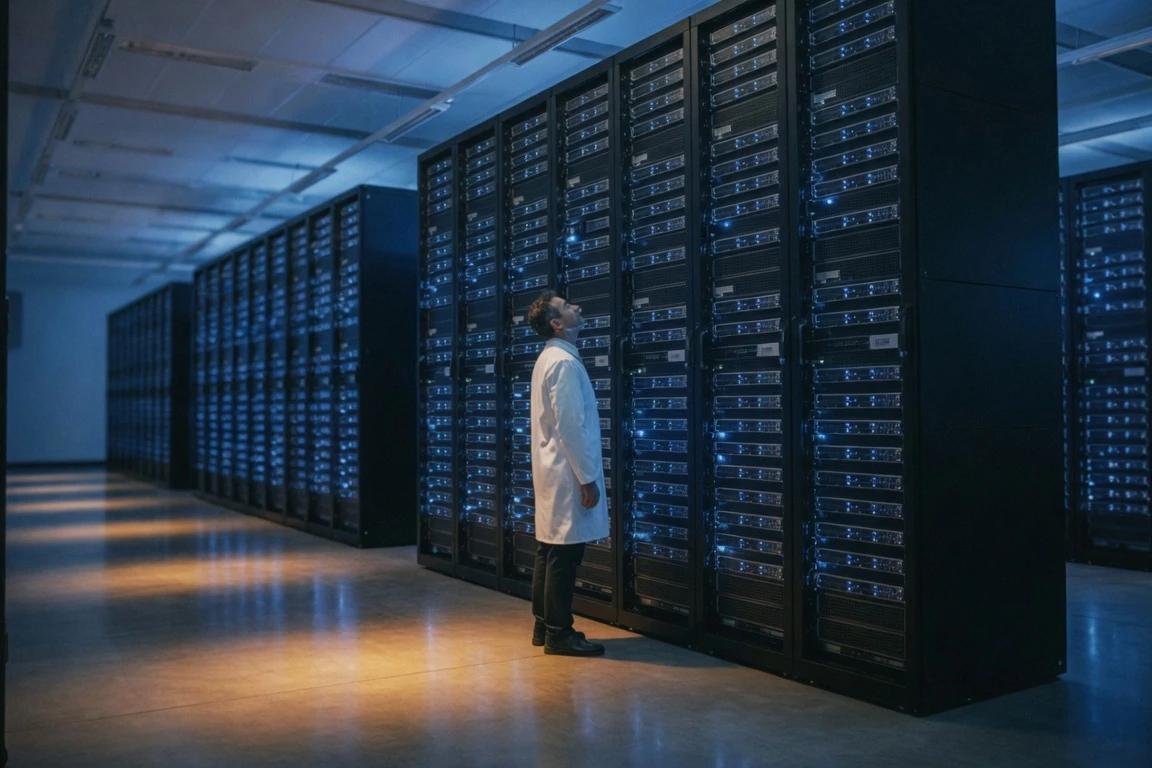
The CPU-Only Bet That Just Hit Exascale
Every other publicly verified exascale machine relies on accelerators. El Capitan pairs AMD EPYC host CPUs with AMD Instinct MI300A accelerators, Frontier and Aurora run on AMD or Intel CPUs coupled with AMD Instinct or Intel data-centre GPUs, and JUPITER Booster runs on a GH200 Superchip with integrated accelerators. LineShine does none of this, a point the full architecture breakdown of LineShine makes clear from the chip on up.
The system abandoned the conventional CPU-GPU architecture. Instead, it relies on domestically developed processors with built-in AI acceleration, high-speed memory, a proprietary interconnect network, and liquid-cooling technology.
That was chief designer Lu Yutong, speaking at the conference in Hamburg. The Shenzhen Cloud Computing Center has not disclosed who designed the LX2 chip itself, but Jon Peddie of Jon Peddie Research has identified it publicly as a Huawei part, a label neither Huawei nor the centre has confirmed. The system runs on 40,960 LX2 processors packing 13.79 million cores in total, each integrating two chiplets with 304 cores apiece at 1.55 GHz, on-package high-bandwidth memory, and Scalable Vector and Matrix Extension units to accelerate AI matrix operations. Tom’s Hardware, reporting on the architecture earlier, said each node carries two LX2 processors connected by the LingQi network at 1.6 Tb/s per node.
The architecture doubles as an answer to US export controls. Tom’s Hardware noted in April that CPU-only supercomputers offer several advantages for China, including reduced dependence on Nvidia GPUs and the CUDA software ecosystem. LineShine also avoids the bandwidth-hungry data shuttles between separate CPU and accelerator memories, exposing a larger coherent memory pool useful for the irregular control flow, heavy I/O and long-context patterns of scientific AI. The bet is to build a CPU dense enough with vector and matrix engines to compete with GPU-augmented systems, and let the export controls do the rest.
LineShine also took the top of the HPCG benchmark, an alternative real-world test, at 22.00 petaflops. On HPL-MxP, a mixed-precision test closer to AI training, it recorded 7.92 exaflops, well behind El Capitan, Frontier and Aurora.
Why a Number One on CPUs Changes the Supercomputer Race
The US still owns three of the top five exascale machines, and NVIDIA’s own count has 81 percent of all TOP500 systems running its technology. The number one slot on Tuesday went to a system that does not use any of those accelerators, the first time that has happened in the ranking’s exascale era. For nearly a decade, every TOP500 leader has been a GPU-augmented system. LineShine is the first break in that pattern. A working CPU-only path also weakens one of the policy levers in the US export-control regime, since the bottleneck those controls were designed to widen was specifically China’s access to top-end accelerators.
This is the first time a computer with only CPUs has reached exascale. China can adapt to develop its own version of technology as good as, or maybe even better than, existing technology, despite US export controls.
That was Turing Award winner and TOP500 co-founder Jack Dongarra, asked about the result on Tuesday in Hamburg, per the South China Morning Post’s report from the conference. The quote carries weight because Dongarra helped design the HPL benchmark the entire ranking rests on, and has been a quiet critic of export controls he sees as unlikely to keep their hold. The Shenzhen system’s number one finish gives that critique a benchmark number to point at.
There is a second disruption hiding inside the result. LineShine’s submission this year marks a return of Chinese systems to a list they had largely abandoned, a partial reopening of transparency about the country’s supercomputing capability. For nine years, China’s TOP500 presence has been opaque at the top end, even as its installed base kept growing. The Shenzhen submission puts a benchmark number on a domestic stack and lets Western observers compare it on standard terms.
What LineShine Still Can’t Do Well
For all the headline number, LineShine does not top every benchmark. On HPL-MxP, the mixed-precision test that more closely resembles AI training and inference, the system recorded 7.92 exaflops, putting it behind El Capitan, Frontier and Aurora. The LX2 processor only gains a 3.6x performance uplift when moving from FP64 to mixed-precision data, well below the gain seen on systems with low-precision accelerators such as AMD’s Instinct MI300A or Intel’s Ponte Vecchio.
Power efficiency also trails. LineShine draws 42.2 MW to reach its score, a figure published in the TOP500 entry. That works out to 52.07 gigaflops per watt, below El Capitan’s 60.94 gigaflops per watt on the Green500 list, and El Capitan itself sits outside the top tier of the most efficient machines. The trade-off is familiar: CPU-only designs are typically less power-efficient than GPU-augmented ones, which is why the broader industry has bet on heterogeneous architectures. The same water-and-power squeeze now showing up in SpaceX’s own data center risk disclosures has hit European gigafactory planners harder, since they sit inside a stricter climate framework.
How the Rest of the Top 10 Reshuffled
The wider reshuffle matters as much as the new leader. Italy’s HPC7 debuted at number six with 571.5 petaflops, giving Italian energy group Eni two systems in the global top ten. Finland’s LUMI and Italy’s Leonardo fell out of the top ten. Microsoft’s Azure-hosted Eagle held seventh at 561.2 petaflops, the highest-ranked cloud system, and Swiss National Supercomputing Centre’s Alps rounded out the top ten at 434.9 petaflops on an NVIDIA GH200 Grace Hopper Superchip, while Japan’s Fugaku, the last CPU-only machine to hold the number one slot, dropped to ninth at 442.0 petaflops.
| Rank | System | Country | Site | HPL score | Total cores |
|---|---|---|---|---|---|
| 1 | LineShine | China | National Supercomputing Centre in Shenzhen | 2.198 EF | 13,789,440 |
| 2 | El Capitan | United States | Lawrence Livermore National Laboratory, California | 1.809 EF | 11,340,000 |
| 3 | Frontier | United States | Oak Ridge National Laboratory, Tennessee | 1.353 EF | 9,066,176 |
| 4 | Aurora | United States | Argonne Leadership Computing Facility, Illinois | 1.012 EF | 9,264,128 |
| 5 | JUPITER Booster | Germany | Jülich Supercomputing Centre | 1.000 EF | 4,801,344 |
| 6 | HPC7 | Italy | Eni S.p.A. | 571.5 PF | 3,461,472 |
| 7 | Eagle | United States | Microsoft Azure cloud infrastructure | 561.2 PF | 2,073,600 |
| 8 | HPC6 | Italy | Eni S.p.A., Ferrera Erbognone | 477.9 PF | 3,143,520 |
| 9 | Fugaku | Japan | RIKEN Center for Computational Science, Kobe | 442.0 PF | 7,630,848 |
| 10 | Alps | Switzerland | Swiss National Supercomputing Centre (CSCS) | 434.9 PF | 2,121,600 |
Combined computing power across the entire TOP500 climbed to 18.74 exaflops, up from 14.99 exaflops six months ago. The number of systems using accelerators rose to 277 from 255 in the previous edition. The shape of the race looks less like a US-China duel and more like a US-led pack with a single CPU-only outlier in front.
Italy’s two Eni systems, HPC7 and HPC6, plus Alps at CSCS give Europe three of the top ten machines. The European Commission’s strategy of buying accelerator-rich, GPU-dense systems rather than building a domestic CPU path now has a benchmark on which to judge whether that bet pays off. The pattern is now clear: a CPU-only system can hold the top of the TOP500 again, but only with a domestic stack built under export-control pressure and a chip design, Armv9 with on-package HBM, tailored for HPC and AI workloads at the same time. Fugaku, the previous CPU-only system to lead the ranking, still uses Fujitsu’s A64FX processor. The CPU-only cohort has shifted from a Fujitsu-led effort to a Chinese-led one.
Europe’s €20bn Answer to the Gap
Brussels set out its response months before the new ranking. The European Commission’s AI Continent Action Plan, published 9 April 2025, committed to deploy nine new AI-optimised supercomputers across the EU in 2025 and 2026, more than tripling current EuroHPC AI computing capacity. As part of its InvestAI initiative, the Commission also earmarked €20 billion to build up to five AI gigafactories, each designed to hold more than 100,000 advanced AI processors. That is roughly four times the count of the best-performing AI factories already operating in the EU.
The gigafactory plan is the EU’s attempt to narrow a gap the new TOP500 makes plain. The best of the bloc’s existing AI factories use up to 25,000 advanced AI processors; a gigafactory would exceed 100,000, by the Commission’s own framing. Power and water, not just silicon, are now treated as constraints on European AI scaling.
LineShine also clarifies what the EU’s path will not be. With little domestic capability to design competitive GPUs at scale, the bloc is betting on accelerators from NVIDIA, AMD and Intel inside EuroHPC machines, plus a much larger procurement footprint to keep up. The June 2026 TOP500 is the first public benchmark on which that bet will be judged. If JUPITER Booster at number five is the EU’s high-water mark for another year, the gap with the United States, and with the new CPU-only entrant in Shenzhen, will only widen. The Commission’s procurement schedule will set the pace over the next eighteen months.
The next TOP500 list lands in November. For now, the headline is a single CPU-only machine in Shenzhen that beat every GPU-augmented system on the planet on a benchmark the field has used for almost four decades.
Frequently Asked Questions
What is LineShine and where is it located?
LineShine is a Chinese supercomputer installed at the National Supercomputing Centre in Shenzhen and built by the Shenzhen Cloud Computing Center. It debuted at number one on the TOP500 list on 23 June 2026 at the International Supercomputing Conference in Hamburg, Germany. The system runs on China’s domestically developed LX2 processors based on the Armv9 instruction set, with the proprietary LingQi interconnect and the Kylin operating system.
How is LineShine different from El Capitan and the other top supercomputers?
El Capitan, Frontier, Aurora and JUPITER Booster all rely on accelerators such as AMD Instinct GPUs, Intel data-centre GPUs or NVIDIA hardware to reach their top scores. LineShine uses only conventional CPUs, no GPUs at all, and crossed two exaflops on the standard High Performance Linpack benchmark while doing so. It is the first machine in the ranking’s history to sustain more than two exaflops on double-precision workloads using only CPUs.
When did China last top the TOP500?
China’s previous TOP500 number one was Sunway TaihuLight, which debuted at the top in 2016 and held the position again in 2017 before being overtaken by the US-built Summit system in 2018. No Chinese machine held the top spot again until LineShine took it in June 2026.
Why did China stop submitting to the TOP500 for years?
After Sunway TaihuLight, leading Chinese supercomputers stopped submitting benchmark results as US export controls on advanced chips tightened and concerns about technology controls grew. The New York Times reports LineShine was developed without public funding, which the centre says allowed the submission this year.
What does LineShine mean for US chip export controls?
The result shows a CPU-only design can hold the number one slot on the TOP500 even without access to the most advanced accelerators. Turing Award winner and TOP500 co-founder Jack Dongarra told the South China Morning Post that China can adapt to develop its own version of technology as good as, or maybe even better than, existing technology, despite US export controls. The US still owns three of the top five machines, but the assumption that GPU access was the binding constraint on Chinese supercomputing now has a public counter-example.






Spotify Running Mode hits Android and revives its old tempo experiment

Galaxy Tab S12 Ultra Renders Keep the Notch Fans Hate

Novato Spinning Round House Sells With Six Neighbors for $3.3 Million

Crop Tour Finds Indiana and Nebraska Corn Yields Lagging 2025

Best Buy 60th sale brings Android deals back to its roots

American Airlines reverses seatback screen bet years too late

Iran Hormuz Strikes Force Gulf Oil Onto Costlier Paths

Plague Tale Prequel Day One Joins Game Pass Wave 2 as Witcher Exits

NBA 2K27 opens The City to everyone and rewrites career eras

iOS 26.6.1 Patches 29 Flaws as AI Forces Faster Apple Updates

Double Fine Cuts 23 Jobs Weeks After Xbox Independence

Day-One Big Walk Lifts PS Plus August Beyond Recycled AAA

John Hight Exits Wizards After Digital Reckoning Hits

Curtis Mead’s Red Sox Debut Ends With Fractured Wrist

Red Sox Squander Hot Streak Chance in 4-3 Loss to Athletics

Moesch and Dressel Rewrite Night One at 2026 U.S. Nationals

Boutte’s Quiet Camp Takeover Forces Patriots Receiver Choices

Take-Two CEO Pushes Netflix Subs for GTA 6 Extended Look

Halo Campaign Evolved Skulls Meet Death Barriers That Kill the Hunt

Wildlands Free Update Hands Players the Tools They Already Invented
-

 TECHNOLOGY3 years ago
How to Adjust a Bulova Watch Band – An Easy Guide
-

 News3 years ago
Fred Pentland: Athletic Bilbao’s English mentor who changed the essence of Spanish football
-

 FINANCE3 years ago
Tax Planning for Every Season: Guide to Maximizing Your Tax Benefits
-

 Education3 years ago
African Ministers New Education Plan
-

 BUSINESS3 years ago
What is Entrepreneurial Operating System? A Comprehensive Guide to EOS
-

 Education3 years ago
Innovate Your Learning Journey with Technology and Enhance Education
-

 News3 years ago
Russians formally out of World Athletics Championships
-

 BUSINESS3 years ago
Top 9 Most Expensive American Cities to Rent an Apartment