
News
Illinois and Toyota Build a Battery That Pulls CO2 from the Air
A University of Illinois and Toyota device swings saltwater’s pH with electricity, not heat, to pull CO2 from the air, a new study shows.

Engineers at the University of Illinois Urbana-Champaign and Toyota have built a battery-like device that pulls carbon dioxide from open air using saltwater, not heat. The cell charges and discharges much like a rechargeable battery, swinging a saltwater solution between alkaline and acidic to trap CO2 and then release it in pure form. The work appears this month in the journal Environmental Science and Technology.
The idea goes straight at direct air capture’s costliest habit, the huge amount of energy heat-based systems burn regenerating the materials that trap CO2. Whether that habit actually breaks down into something cheaper is a separate question. A study published earlier this year found renewable power still delivers more combined climate and health benefit per dollar than pulling carbon out of the sky.
A Battery Cycle, Not a Furnace
Most carbon capture systems, at power plants and in the open air alike, use heat to release the CO2 they trap. Direct air capture, or DAC, pulls carbon dioxide out of the atmosphere itself rather than a smokestack, and it has leaned on that same heat cycle, which is part of why it stays expensive.
- Direct air capture – removing carbon dioxide from the open atmosphere, where it sits at roughly 420 parts per million, rather than from a concentrated industrial exhaust stream.
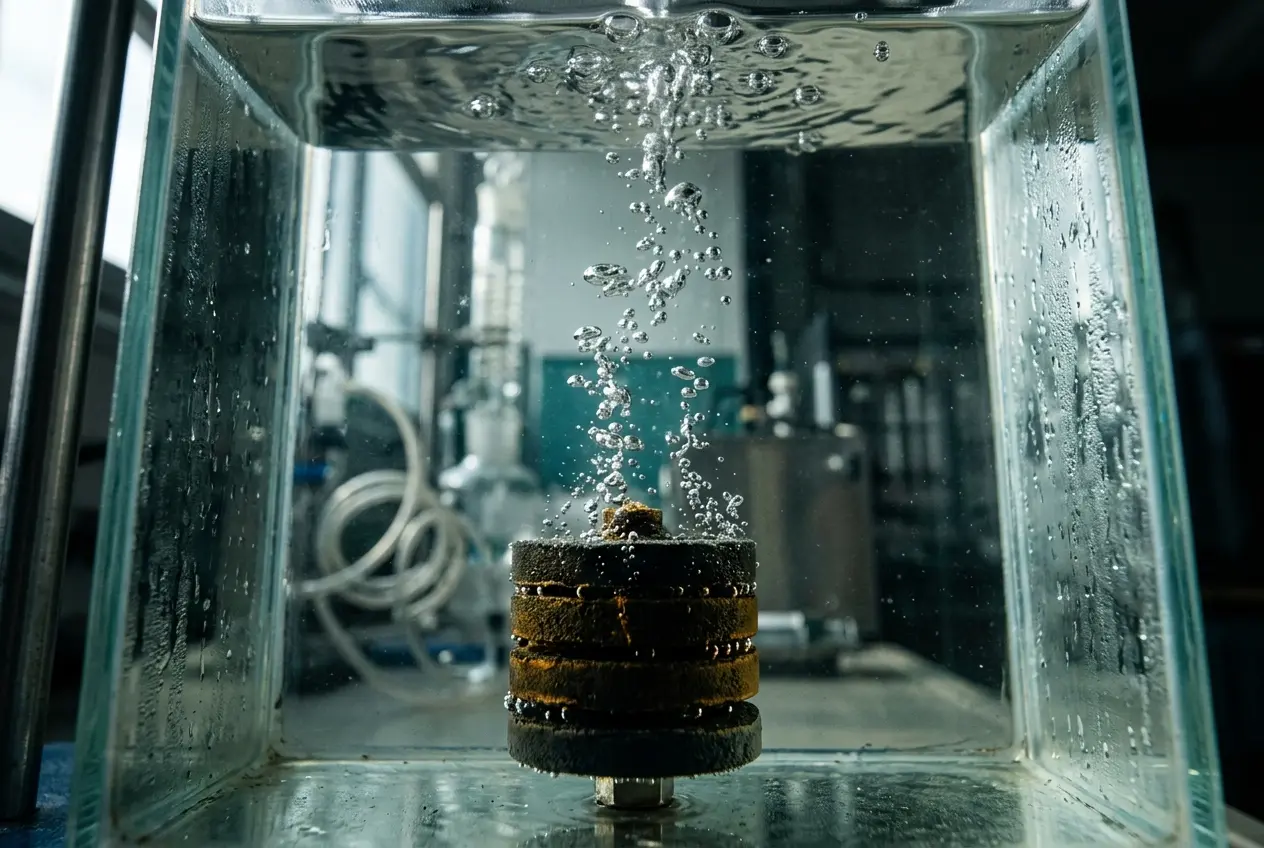
The Illinois-Toyota device skips the furnace. In the lab, an electrochemical cell shifts the pH of a saltwater solution back and forth. Made alkaline, it soaks up CO2 passing through it. Made acidic again, the gas bubbles back out, purified and ready for storage or reuse.
“What’s innovative about our work is that we use proton-intercalation electrodes in what we call a cation-compensated cell,” said Kyle Smith, a mechanical science and engineering professor at the University of Illinois Urbana-Champaign. “That design lets us operate in an alkaline range where CO2 is much more soluble, which is crucial for making direct air capture practical.”
Smith worked with Illinois graduate students Paul Rozzi and JeongA Lee, plus Toyota Research Institute of North America (TRINA, Toyota’s North American research arm) scientists Charles “Chip” Roberts and Tim Arthur. Their paper, a reversible proton-intercalation-mediated alkalization cycle, treats the pH swing the way engineers treat a power plant’s pressure-volume cycle, mapping it against dissolved carbon and potassium ion levels instead.
“By framing our process as a thermodynamic cycle in this particular space, we could see where energy was being wasted and how to redesign the cycle,” Lee said.
The Energy Bill Behind Every Ton of CO2 Removed
Direct air capture has a scale problem tied to an energy problem. CO2 sits far more diluted in open air than in a smokestack, so concentrating and releasing it takes real electricity or heat. Existing systems can burn through 2,000 to 3,000 kilowatt hours per tonne captured. Early full-scale plants coming online toward 2030 are projected to cost 400 to 1,000 dollars per tonne of net CO2 removed, according to Harvard’s Belfer Center for Science and International Affairs.
Those numbers shift by chemistry.
| Capture Method | How Energy Is Used | Example Project | Reported Cost |
|---|---|---|---|
| Solid sorbent (thermal) | Heat regenerates a solid filter that trapped CO2 | Climeworks’ Mammoth plant, Iceland | $1,000 to $1,300 per tonne today |
| Liquid solvent (thermal) | Heat up to 900°C releases CO2 from an alkaline solution | Carbon Engineering’s process, used by 1PointFive | Early estimate of $94 to $232 per tonne; real-world costs run higher |
| Electrochemical | Electricity drives a pH swing, no combustion heat | Illinois and Toyota’s lab cell; also Mission Zero, RepAir | Not yet established at scale; developers claim up to 95% efficiency |
The Illinois-Toyota cell sits in that third row, and it is the least proven of the group. It has run only at bench scale, with no published figures yet for cost or throughput.
Why Toyota Has a Stake in a University Lab
Toyota Motor North America funded the work alongside the Campus Research Board at the University of Illinois, through an Arnold O. Beckman Award, and the university’s Department of Mechanical Science and Engineering and Grainger College of Engineering.
Roberts and Arthur are not just funders on paper. Both are named co-authors on the study.
“Our work with Professor Smith and the U. of I. team on electrochemical direct air capture provides useful insights into how materials, electrochemistry and process design can be combined to address challenging CO2 separation problems,” Roberts said. “This type of early-stage research supports Toyota’s broader effort to explore innovative pathways toward long-term decarbonization.”
A carmaker bankrolling an atmospheric chemistry lab fits a pattern. Automakers are increasingly placing bets on energy technology well outside the assembly line. General Motors has been chasing a rival chemistry to loosen Tesla’s grip on grid-scale storage, and regulators are starting to hold carmakers responsible for what happens after the sale, too. Colorado’s newest rule makes automakers own dead EV batteries once a pack reaches the end of its life.
Interstream Mixing Remains Unsolved
The device relies on two liquid streams meant to stay apart, one drifting alkaline, one drifting acidic. In practice, they blend a little every time the flows switch, and that blending eats into efficiency.
“Interstream mixing is one of the biggest issues we’re dealing with now,” Rozzi said. “If we can limit that mixing or design around it, we can significantly improve both energy consumption and productivity.”
That gap between theory and practice separates a lab curiosity from something that could run for years without losing its edge over heat-based systems.
Is Electrochemical Capture Actually the Cheaper Path?
Not yet, but it is the path drawing fresh investment. Companies betting on electrochemistry over heat argue they can cut the energy penalty that keeps carbon removal expensive, and several have lined up new funding and industrial partners over the past two years.
- Mission Zero (United Kingdom): closed a 21.8 million pound funding round in 2024 to scale a proprietary electrochemical process aimed at cutting energy intensity below thermal-swing systems.
- RepAir and EnEarth (Greece): signed a June 2024 deal to capture CO2 electrochemically and store it in the Prinos saline aquifer near Kavala, one of the first direct air capture projects using offshore storage in the Mediterranean.
- Ucaneo and Siemens (Germany): partnered earlier this month on an electrochemical process modeled on the human lung, with Ucaneo targeting half a gigaton of CO2 captured annually by 2035.
- University of Illinois and Toyota: the newest entrant, still confined to a lab-bench cell built around potassium-stabilized manganese dioxide electrodes, with no published cost or scale-up figures yet.
Mission Zero itself has pushed back on the idea that any DAC pathway reaches rock-bottom costs soon, pointing instead to an ETH Zurich estimate of a 230 to 540 dollar range per tonne by 2050, even with rapid scaling.
A Rival Study Says Renewables Still Win
A peer-reviewed comparison published in Communications Sustainability modeled direct air capture against wind and solar across 22 U.S. grid regions from 2020 through 2050, spending the same dollar either way. The analysis found that renewable energy delivers greater combined climate and health benefit than direct air capture in nearly every scenario and region tested, with direct air capture closing the gap only under highly optimistic assumptions about future breakthroughs.
The researchers tested three benchmarks: today’s typical DAC performance, about 5,500 kilowatt hours and 1,000 dollars per tonne; a progress scenario at 1,500 kilowatt hours and 500 dollars; and a breakthrough case, at the extreme low end of published projections, of 800 kilowatt hours and 100 dollars a tonne.
The Illinois-Toyota device is aiming at exactly that breakthrough end of the range by cutting out heat altogether. It has not been tested at any scale that would produce a comparable kilowatt-hour or dollar figure of its own.
- Toyota’s Chip Roberts frames the project as early-stage work supporting the company’s long-term decarbonization strategy.
- The Communications Sustainability authors find renewable deployment beats direct air capture on combined climate and health benefit across nearly all scenarios and regions studied.
- Benjamin Sovacool, director of Boston University’s Institute for Global Sustainability, has cautioned that direct air capture technologies broadly sit at a very low technology readiness level.
The Device Still Lives Inside a Lab Beaker
Nothing about this study puts a plant in the ground. There is no pilot facility, no announced tonnage, no cost estimate the team is willing to publish yet. The interstream mixing losses Rozzi described remain unresolved, and the entire result rests on a single electrochemical cell run under lab conditions.
What the paper does establish is a different starting point for the energy math that has stalled DAC for years: a chemistry that swings between alkaline and acidic on electricity alone, with no furnace in the loop. Whether that translates into a real cost advantage will depend on solving the mixing problem, then building something bigger than a beaker.
For now, the only carbon dioxide this battery has captured has never left a laboratory bench in Urbana.
Frequently Asked Questions
Is the University of Illinois direct air capture device ready for commercial use?
No. The device described in the Environmental Science and Technology paper is a lab-bench electrochemical cell. Toyota’s Chip Roberts called it early-stage research, and the team has not published a captured-tonnage figure the way operating plants like Climeworks’ Iceland facility, which handles about 4,000 tonnes a year, do.
Who funded the direct air capture research at the University of Illinois?
Toyota Motor North America funded the work alongside the Campus Research Board at the University of Illinois through an Arnold O. Beckman Award, plus the university’s Department of Mechanical Science and Engineering and the Grainger College of Engineering.
Does the University of Illinois or Toyota own the patent on this technology?
The University of Illinois holds the rights. Kyle Smith is listed as inventor on U.S. Patent Application 18/713,023, which belongs to the university rather than to Toyota, despite Toyota’s funding role.
How much does direct air capture typically cost per ton of CO2 removed?
It depends on the technology, but every method remains expensive today. The U.S. Department of Energy’s Carbon Negative Shot initiative, launched around COP26, set a target of under 100 dollars per net metric tonne for removal that lasts at least 100 years, a mark no operating plant has reached.
How is this device different from Climeworks or Occidental’s direct air capture plants?
Occidental’s Stratos facility in Texas is designed to capture 500,000 tonnes a year once fully ramped up, and Climeworks already operates its Iceland plant today, both releasing CO2 with heat. The Illinois and Toyota device has only run as a single lab cell, and the researchers say unresolved mixing losses between its two liquid streams still stand between it and any real cost estimate.


Stock Futures Wobble as Trump’s Hormuz Blockade Meets Earnings Season

Chipotle Enters Mexico, the Market That Sank Taco Bell Twice

Samsung’s Galaxy Watch 9 and Watch Ultra 2 Bet on a Borrowed Chip

Pentagon Suspends CMMC Phase 2, Relieving Small Firms, Straining Assessors

PS5 Adds a Weekly Wrap-Up Widget While Recently Played Stays Broken

A Brazilian Gamer Sued Microsoft Over a Hacked Xbox Account, and Won

Volkswagen’s CEO Confirms 100,000 Jobs Are on the Table

Assassin’s Creed Black Flag Resynced Splits Handhelds by Price

Lorde Calls Smart Glasses ‘Not Sexy’ Right on Ray-Ban’s Own Stage

Nintendo Eyes a Switch 2 OLED Model as the Memory Crisis Bites

Halo Studios Reverses PS Plus for Halo: Campaign Evolved on PS5

Black Ops 1 and 2 PS5 Ports: $40 Price Tag Has Fans Uneasy

Matt Brown Dismisses Rousey and Paul’s MVP MMA Ratings Win Over UFC

Star Wars: Galactic Racer Is a Roguelite Racer With a Podracing Skin

Julius Randle Traded to Nets as Wolves Reclaim Cap Space for Dosunmu

Sega’s $49.99 Sonic Classic and Modern Bundles Hit Switch in October

Colombia Edge DR Congo as Muñoz Books World Cup Knockout Place

Douze Dixièmes Closes Five Months After MIO: Memories in Orbit

Warriors Take Yaxel Lendeborg, the Oldest Pick in the 2026 NBA Draft

Meta’s Muse Image Lets Anyone Use Your Instagram Photos in AI
-

 TECHNOLOGY3 years ago
How to Adjust a Bulova Watch Band – An Easy Guide
-

 News3 years ago
Fred Pentland: Athletic Bilbao’s English mentor who changed the essence of Spanish football
-

 FINANCE3 years ago
Tax Planning for Every Season: Guide to Maximizing Your Tax Benefits
-

 Education3 years ago
African Ministers New Education Plan
-

 BUSINESS3 years ago
What is Entrepreneurial Operating System? A Comprehensive Guide to EOS
-

 Education3 years ago
Innovate Your Learning Journey with Technology and Enhance Education
-

 News3 years ago
Russians formally out of World Athletics Championships
-

 BUSINESS3 years ago
Top 9 Most Expensive American Cities to Rent an Apartment