
News
GM’s Sodium-Ion Battery Push Aims at Tesla’s 82% Storage Grip
GM is building sodium-ion cells with Peak Energy for grid storage, but the first cells don’t arrive until 2028. Tesla still owns 82% of US installations.

General Motors unveiled a sodium-ion battery push on Tuesday, targeting the U.S. energy storage market, where Tesla was responsible for 82% of last year’s 57 GWh of installations. The bet is unusually slow for an automaker entering a fast-growing market: GM’s first sodium-ion cells won’t enter trial production until 2028, and the chemistry won’t reach commercial production for years after that.
Even with federal incentives gutted in the One Big Beautiful Bill Act, the Solar Energy Industries Association still expects U.S. battery installations to roughly double by 2030. Of the 57 GWh installed in 2025, Tesla was responsible for 82%, per industry data cited by TechCrunch. The remaining 18% is now the target for Ford, Redwood Materials, and a flock of venture-backed storage companies trying to wedge in before the buildout peaks.
Three Forces Are Pulling the Storage Market Higher
The U.S. stationary battery market doubled in the past two years, and three trends are now pulling it higher. The most obvious is the buildout of data centers for AI. Data center energy demand is expected to nearly triple by the end of the decade, and operators are turning to grid-scale batteries to absorb GPU-driven power fluctuations. The buildout is putting local grids under pressure at the planning stage, as Apatura’s 1bn Scotland data centre plan illustrates.
The second push comes from electrification of transportation, manufacturing, and HVAC, which adds load the grid has to balance hour by hour. The third is the policy reshuffle: federal incentives for storage were cut in the One Big Beautiful Bill Act, but SEIA still projects 110 GWh of annual installations by 2030, roughly double today’s pace. “Data centers are a big part of the growth, but even without data centers, it started to really pick up,” GM’s Kurt Kelty told TechCrunch.
The buildout is also spilling into adjacent markets, with mobile battery makers like Lightship, an electric RV company that has pivoted to portable storage for job sites, joining the chase. Capital is flooding in from grid-scale startups to home battery vendors, reshaping who gets to sell to whom.
SEIA’s market outlook puts the 2030 total at more than double the 2025 pace. The 2030 forecast is for 110 GWh of annual installations, and the market is now in the early stages of a multi-year buildout. The chemistry choices, the contract structures, and the supply chain are all being settled in real time.
- $1 billion: Base Power Series C raised in October to expand beyond Texas
- $232 million: Lunar Energy raise for home batteries
- 2 TWh/year: potential U.S. battery storage waste savings from passive sodium-ion, per Peak Energy
Tesla’s Grip, in Numbers
Of the 57 GWh of U.S. battery storage installed in 2025, Tesla accounted for 82% of installations. That share runs through its Megapack and Powerwall products, and the company has been selling storage products longer than any other automaker. The head start shows up in the financials.
Tesla’s annual revenue from energy generation and storage has doubled since 2023, the fastest growth in any segment of the company. Gross profits for the segment run at around 30%, about double what the company makes selling EVs and at least three times higher than typical automaker margins. No other automaker has a storage segment at the same scale, with the same margin, or with the same share of the U.S. market. The contrast with the rest of the auto industry is stark: GM’s gross margin over the last 15 years has averaged just over 11%.
Those two numbers are what pulled Ford into storage, and now GM. Ford already moved in by repurposing battery lines, and now GM is joining the market with its own bet on a new chemistry.
| Segment | Gross margin | Storage focus |
|---|---|---|
| Tesla energy storage | around 30% | Megapack, Powerwall |
| GM (15-year average) | just over 11% | Sodium-ion, LFP, Redwood |
What Tuesday’s Announcement Actually Contains
GM’s Tuesday announcement is structured in two parts: a near-term revenue play and a long-shot technology bet. The near-term piece is a deal to sell lithium iron phosphate (LFP) cells to LG Energy Solution, with the Ultium Cells venture beginning LFP production for LG’s commercial energy storage business. The bigger move is a partnership with Peak Energy, a U.S. sodium-ion storage startup founded in 2023 by veterans from Tesla, Enovix, and Apple. GM will develop the cell in its Michigan labs and retain exclusive manufacturing rights, with Peak integrating the cells into its own storage products; the first trial cells are expected in 2028.
GM also extended a partnership with Redwood Materials, the battery-recycling and energy-storage startup founded by former Tesla executive J.B. Straubel. Redwood already operates a 12 megawatt/63 megawatt-hour microgrid using second-life GM packs at a Crusoe data center in Sparks, Nevada, and GM has a pipeline of around 10,000 used packs it’s sending Redwood’s way. The automaker is buying a 7.2 MWh Redwood system for one of its Michigan plants, a setup the company estimates will save around $3 million over the installation’s lifetime.
The Sodium-Ion Bet, and the Partner Behind It
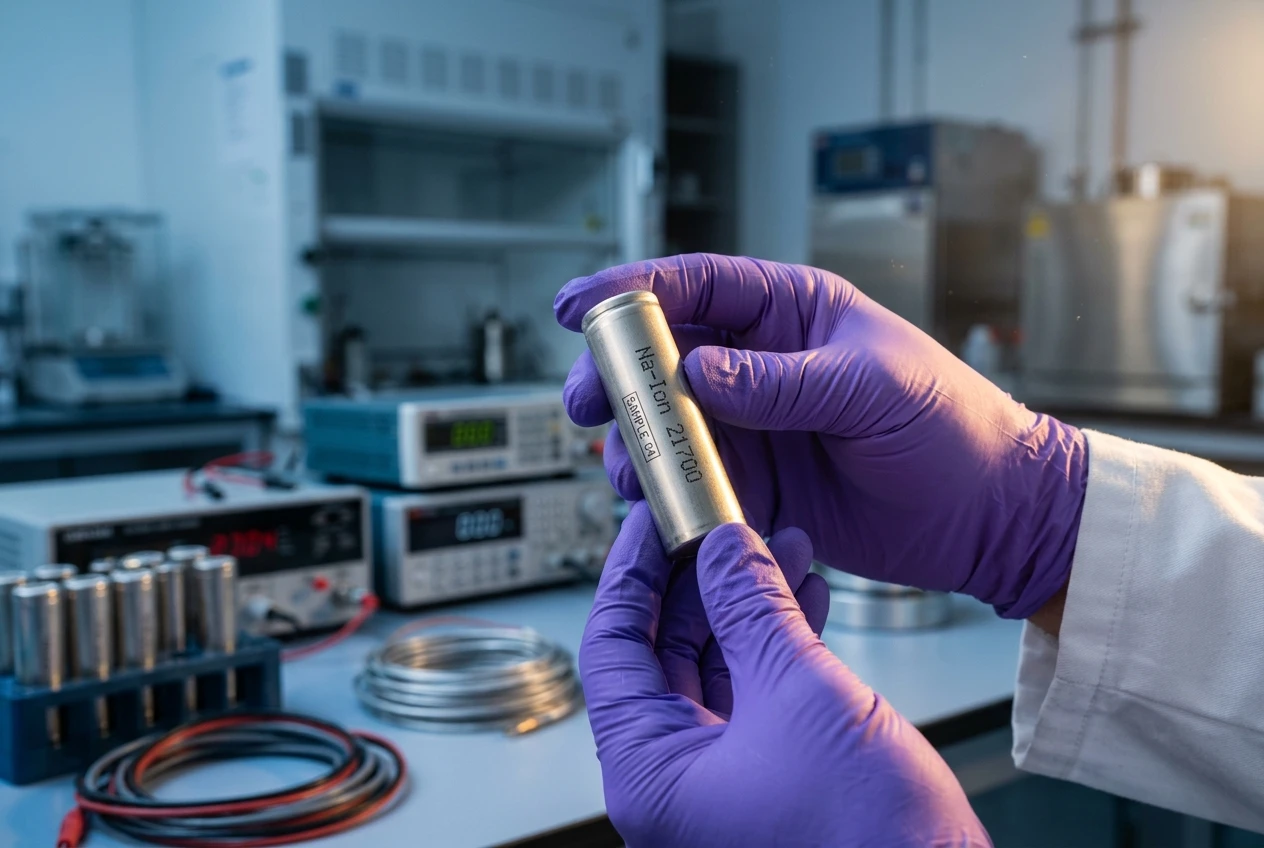
Sodium-ion works much like lithium-ion, swapping out the lithium for sodium, a far more abundant and cheaper element. The trade-off is energy density: sodium-ion cells have to be larger and heavier to store the same amount of electricity. That makes them a poor fit for cars, where every kilogram matters, but a strong fit for stationary storage, where the cabinet sits on a concrete pad and weight is irrelevant. Kelty’s case for sodium-ion builds the same argument from the angle of stationary storage economics.
Peak Energy has built its storage platform around the chemistry’s strengths, using passive cooling rather than active thermal management to eliminate the pumps, chillers, and fire-suppression hardware that drive up conventional LFP maintenance costs. Peak Energy’s 20% cost-cut claim lays out the math: the company’s sodium-ion system reduces energy storage costs by 20% and delivers more than 99% uptime. Outside of China, no automaker has announced plans to build sodium-ion cells.
The way we’re getting into the market is the easy way, through ESS. The performance characteristics are just what is needed in that market.
Sodium-ion is different from the chemistries China has cornered: the materials are cheap and abundant, and the supply chain is still being built, which gives U.S. automakers a chance to establish a foothold. China processes nearly all of the world’s cobalt, for example. “It gives us a path towards supply-chain resilience and low-cost materials,” GM business planning manager Andy Oury told TechCrunch. “Sodium-ion is very much in its infancy with the opportunity for the supply chain to grow anywhere people want to invest in it.”
The Argument for Moving Slowly
GM has a $900 million commitment to commercialize new battery chemistries, including a new development center, but the company has not disclosed the specific investment behind the energy-storage push. Kelty frames the patience as a feature rather than a bug: “We’re going to develop a family of cells that is appropriate for this market,” he said. The first sodium-ion cells are expected to enter trial production in 2028, and the GM press release notes the cells will be prototyped this year at the Wallace Battery Cell Innovation Center in Warren, Michigan. Sodium-ion is still early in its development curve, leaving headroom the company wants to use to its advantage.
Sodium-ion is a hedge for GM. The company is also developing a separate lithium-manganese-rich (LMR) chemistry for EVs, set to debut in 2028, with the promise of cutting the cost of a new EV by about 10% and bringing electric vehicles near parity with fossil-fuel vehicles. Repurposing lithium-ion capacity for storage now would risk leaving the company short of cells if EV demand returns, GM’s Andy Oury argued: “It’s one thing to build cells when there’s excess capacity. It’s another thing when we return to a high-growth mode and every new battery you want needs a new plant.”
What Could Go Wrong in the Wait
The risk in moving more deliberately than Tesla or Ford is that the AI bubble bursts, data-center construction slows, and the storage market cools before GM’s cells reach the market. The first sodium-ion cells are still years away from commercial production, and in the meantime, GM is selling LFP cells to LG, not the chemistry it sees as its long-term edge. Redwood’s chief commercial officer, Cal Lankton, told TechCrunch that data centers and industrial sites are “vastly different things” in how they use storage, a reminder that GM’s near-term Redwood deals are a different business from the long-term chemistry bet.
Paul Menson, GM’s director of energy storage commercialization, argues the bet will pay off even if the market cools.
No market grows indefinitely forever. That’s why you have to have the best product. Because if you have the best product, it doesn’t really matter what happens in the market contraction because you still have the best product.
The second concern is execution. Sodium-ion is still early in its development curve, with significant headroom for improvement but no guarantee GM can pull that improvement off inside a four-year development window. LFP took 25 years to mature, and the cost savings the company is counting on depend on sodium-ion beating LFP on cost, not just matching it. Kelty, for his part, says the company is “exploring other ways to get in the market faster” but offers no specifics on what those routes are or when they would arrive.
What the Competitive Set Looks Like
The sodium-ion announcement puts GM in an unusual spot. Outside of China, no automaker has announced plans to build sodium-ion cells, so the company is essentially racing the entire industry to a chemistry most rivals are not yet touching. In the near term, the competitive set is more familiar: Tesla’s Megapack and Powerwall, Ford’s repurposed battery lines, Redwood’s second-life packs, and a growing roster of venture-backed startups racing for utility and data-center contracts. The buildout is already reshaping grids at scale, as Matrix and EDF’s 500MW Scotland battery shows.
The startup field is the wild card. Base Power, Lunar Energy, and Lightship each took a different route into the storage business, and the ones that find a price-performance edge before 2028 will have a head start on selling the kind of customers GM is hoping to reach. Kelty’s framing is unapologetic: “We’re definitely going to try and go as fast as possible,” he said. The market is moving faster than that.
Frequently Asked Questions
Why is GM getting into energy storage?
GM is chasing the higher margins in grid-scale battery storage. Tesla’s energy generation and storage segment runs gross margins of around 30%, well above the just-over-11% margins GM has averaged over 15 years of car-making. U.S. EV sales have stagnated, and the storage market is doubling.
What is sodium-ion, and why does it matter?
Sodium-ion swaps lithium for sodium, a much cheaper and more abundant material. The cells are larger and heavier than lithium-ion, so they are a poor fit for cars but a strong fit for stationary storage. Peak Energy, GM’s partner, has built a system that uses passive cooling rather than active thermal management, and the company says it cuts storage costs by 20% compared to conventional systems.
When will GM’s sodium-ion cells be available?
GM’s first sodium-ion cells are expected to enter trial production in 2028 at the company’s Battery Cell Development Center, and commercial production is still further out. The cells are being prototyped in 2026 at the Wallace Battery Cell Innovation Center in Warren, Michigan.
Who is Peak Energy?
Peak Energy is a U.S.-based sodium-ion storage startup founded in 2023 by veterans from Tesla, Enovix, and Apple. GM is developing the sodium-ion cell in its Michigan battery labs and will retain exclusive manufacturing rights; Peak will integrate the cells into its own storage products. The deal is backed by a strategic investment from GM Ventures.
Why is Tesla dominant in storage?
Tesla was responsible for 82% of the 57 GWh of U.S. battery storage installed in 2025, largely through its Megapack and Powerwall products. The company has been selling storage products longer than any other automaker, and runs gross margins of around 30% on the segment, roughly double what it makes selling EVs.






Walmart’s $50 Million Opioid Settlement Closes Case Without Admission

California Sues Over $120 Million Morro Bay Wind Lease Buyout

Gilead Bixlenvo FDA Nod Opens Single Pill Path for Complex HIV Cases

Meta’s $18B Kids Deal Forever Shields Data Used to Spot Under-13s

Lettuce Outbreak Drove Record Cyclospora Spike Across 20 States

Amazon Shaves $20 Off M6 Mac Mini Before It Even Ships

SpaceX Louisiana Port Tests Debt Markets on Orbital AI Scale

Microsoft High Lifts Indexes as Small Caps Crack Support

Apple Replays 2015 Saturday Midnight Preorder for iPhone 18 Pro

Updated COVID Shots Clear FDA but Access Friction Hits High-Risk Groups

Take-Two CEO Pushes Netflix Subs for GTA 6 Extended Look

Destiny 2 Fans Unlock Vaulted Maps After Live Service Ends

Wildlands Free Update Hands Players the Tools They Already Invented

Quake Gets 19 Free Maps From MachineGames Quake Club

Quordle Monday Delivers Gavel Crush Speed Ethos Cleanly

Stripe Bid Shows PayPal Moat Cracked After Years of Slide

Tyson’s Five-Year Utah Plant Falls to Cattle Shortage Reckoning

Silver Lake Workday Talks Signal Private Floor for Software

Kennedy Lewis Takes Majority Control of The Greenbrier in $500M Deal

Best Buy Marks 60 Years With Sale That Echoes Its Audio Shop Roots
-

 TECHNOLOGY3 years ago
How to Adjust a Bulova Watch Band – An Easy Guide
-

 News3 years ago
Fred Pentland: Athletic Bilbao’s English mentor who changed the essence of Spanish football
-

 FINANCE3 years ago
Tax Planning for Every Season: Guide to Maximizing Your Tax Benefits
-

 Education3 years ago
African Ministers New Education Plan
-

 BUSINESS3 years ago
What is Entrepreneurial Operating System? A Comprehensive Guide to EOS
-

 Education3 years ago
Innovate Your Learning Journey with Technology and Enhance Education
-

 News3 years ago
Russians formally out of World Athletics Championships
-

 BUSINESS3 years ago
Top 9 Most Expensive American Cities to Rent an Apartment