
AUTOMOBILE
Colorado’s New Law Makes Automakers Own Dead EV Batteries
Colorado’s new SB26-003 law forces automakers to recycle dead EV batteries at no cost to salvage yards, with mineral recovery rules starting in 2031.

A working Tesla battery sitting on a shelf in Massachusetts carries exactly one recycling offer: negative $1,800. That is what Brian Bachand, chief executive of Westover Salvage Yard, would have to pay a recycler just to take a battery that still holds a charge. Across the state, Thomas Andrade, co-owner of Everett Auto Parts, counts himself lucky. His recycler will take two Chevy Volt batteries for free.
Colorado just decided that gap shouldn’t exist. A law signed in June 2026, known as SB26-003, requires automakers such as GM and Tesla, not salvage yards, to collect and recycle unwanted EV batteries at no cost, with mandatory mineral recovery rates arriving in 2031. Its bigger test may not be who pays. Its recovery targets quietly pick a winning recycling technology, and that could turn Colorado’s rulebook into the national default.
A Battery Priced at Negative $1,800
Selling parts is how a salvage yard survives. Engines, transmissions, body panels, all of it moves. EV batteries were supposed to be the biggest prize of all: they are packed with nickel, cobalt, manganese and lithium, shredded eventually into a dark powder called black mass that recyclers refine back into usable metal.
But that value only holds for certain chemistries. Frederick Bloomfield, an analyst at Benchmark Mineral Intelligence who tracks pricing along the recycling supply chain, calls the charge a recycler levies to accept scrap a gate fee. Right now, he says black mass prices track the swings in virgin mineral markets, and lithium iron phosphate, or LFP, batteries sit on the wrong side of that math. Gate fees for LFP scrap currently run $1.50 to $2 per kilogram in North America, on packs that can weigh half a ton or more before shipping costs are even added.
If I have to pay anybody to get an LFP battery, we don’t make any money.
David Klanecky, chief executive of Cirba Solutions, one of the country’s largest battery recyclers, put it that plainly. LFP cells last longer and cost less to build, which is exactly why automakers are shifting toward them. It’s also why there’s so little value left to recover once one dies.
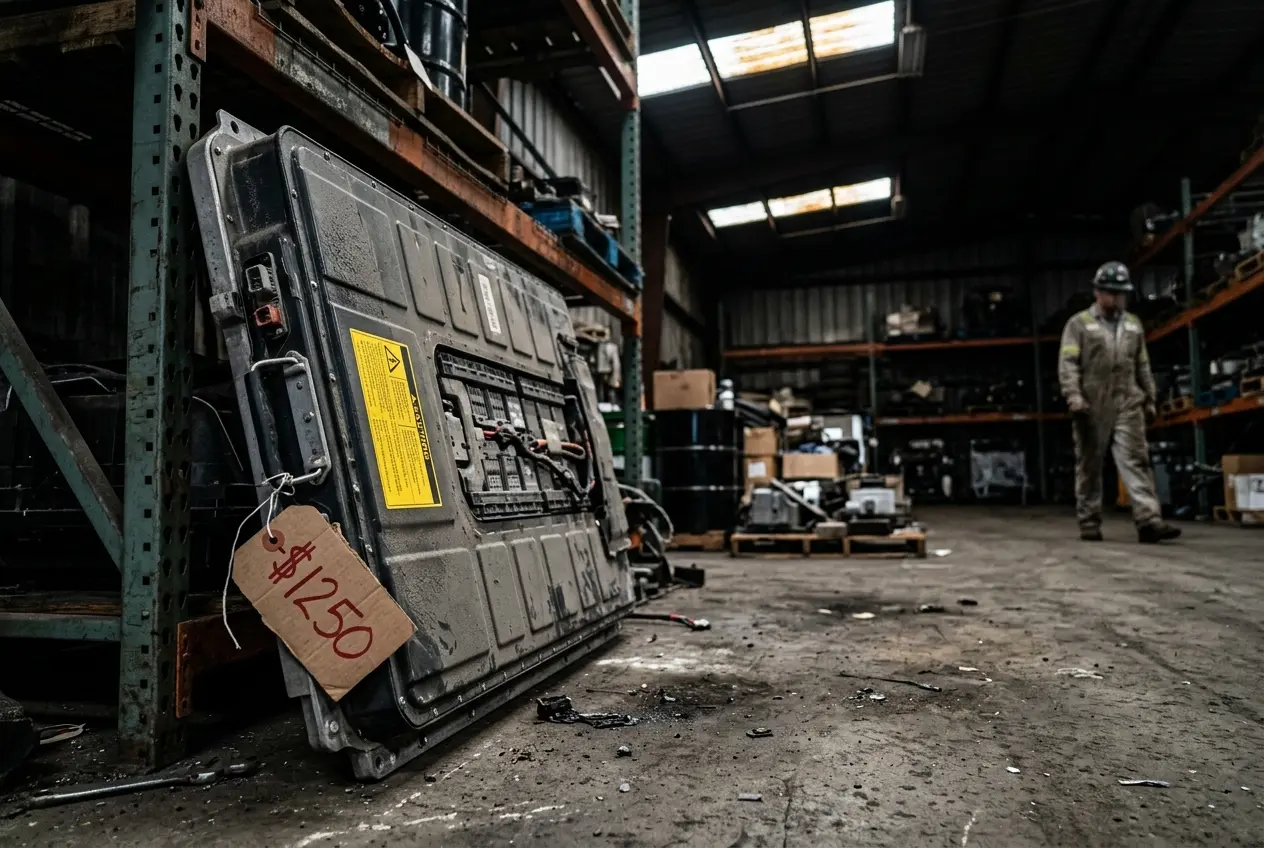
EVs Leave Salvage Yards Fewer Parts to Sell
Gas cars give salvage yards two dependable moneymakers. Emil Nusbaum, vice president of strategy and government affairs for the Automotive Recyclers Association (ARA), says engines and transmissions are the parts buyers want most for reuse and repair. Electric vehicles have neither. Just a motor with one moving part that almost never fails.
That leaves the battery to carry the entire bet. Nusbaum frames it as a coin flip every time an EV rolls onto the auction block: will it be a valuable asset for resale or repair, or a cost running into the thousands just to find it a responsible home.
At a General Motors event in San Francisco, executives sounded far more confident. GM announced new battery chemistries alongside plans to feed old EV packs back into the electrical grid, part of a push that includes a sodium-ion battery bet aimed at Tesla’s storage lead. Andy Oury, a battery engineer at GM, said recycling has flipped from an expense into a source of revenue for the company, since battery recyclers now pay for its cell-line scrap.
J.B. Straubel, founder and chief executive of Redwood Materials, was similarly upbeat. “Every year that goes by, every month that goes by, it’s getting more economical, it’s getting more competitive,” he said. Both men were describing an operation with the scale to negotiate freight rates and long-term contracts. A one-battery salvage yard has neither.
Colorado Puts the Bill on Automakers Instead
State Sen. Katie Wallace, a Democrat from Longmont, sponsored SB26-003 to close that gap. It isn’t Colorado’s first experiment with the idea. The state already runs producer-funded programs for tires, packaging and consumer electronics batteries, and a 2025 law, SB 25-163, set up the same framework for household battery types.
The new law extends that model to propulsion batteries specifically. Its core provisions:
- Landfill ban – disposing of propulsion batteries at a solid waste site becomes illegal starting July 1, 2029.
- No-cost pickup – automakers must collect unwanted batteries from dismantlers and waste facilities at no charge to those handlers.
- Mineral recovery rates – recyclers must recover 90% of cobalt and nickel and 50% of lithium by 2031, with lithium climbing to 80% by 2035.
- Labeling and reporting – batteries need standardized labels by mid-2029, and producers must file annual recovery reports with the state starting June 1, 2030.
The full mechanics, including how a producer’s initiation fee is calculated from its share of registered EVs, sit in the bill text approved by the Colorado legislature. Sen. Lisa Cutter, who co-sponsored the measure and pushed earlier battery and plastics bills, described the logic simply: there’s no magic trash fairy, so someone has to plan for what happens at end of life.
The Recovery Targets Are the Law’s Sharpest Edge
Plenty of states could have copied New Jersey’s 2024 law and stopped there. Colorado didn’t. By writing specific recovery percentages for cobalt, nickel and lithium into statute, rather than one blended recovery average, the law effectively rules out cruder recycling methods that recover less material for more emissions.
Danielle Spalding, senior vice president of corporate and external affairs at Cirba Solutions, helped shape that language and told Waste Dive it ensures scrap flows toward responsible recyclers rather than whoever offers the cheapest pickup. Daniel Zotos, director of state policy and public affairs for Redwood Materials, goes further: the law’s definition of a qualified recycler requires actual extraction, separation or refining. “Collection-only and transportation-only operators do not qualify,” he said. Every downstream obligation in the bill terminates at that one definition.
That is the quiet technology bet. Recyclers who can hit 90% and 50% recovery, using hydrometallurgical processing rather than smelting, become the only legal destination for Colorado scrap. If other states copy the numbers, as backers hope, that processing method becomes the national baseline by default.
- 200,000 electric vehicles are already registered in Colorado, the scale lawmakers cited to justify acting now.
- 330,000 vehicles reach end of life in the state every year, most funneled through automotive recyclers, according to the ARA.
- 27.3% of new Colorado vehicle sales were electric in the third quarter of 2025, the highest share of any state.
- $11.3 billion to $40.3 billion in total economic value U.S. battery recycling could generate once social and environmental benefits are counted, per RMI’s accounting of recycling’s hidden returns.
Jessica Dunn, a scientist with the Union of Concerned Scientists who worked on the bill, points to the long-term payoff: recycling could cover more than half of U.S. mineral demand by 2050. That’s the upside case. It depends entirely on enough recyclers surviving long enough to hit those targets.
Who Actually Supports This Law?
Automakers, recyclers, salvage operators and environmental groups all backed SB26-003, an unusually wide coalition for a bill that assigns automakers a new, open-ended financial obligation. The ARA supported it enthusiastically. Redwood and Cirba both praised it publicly. Even the trade group representing most U.S. automakers signed on, calling it balanced.
The Alliance for Automotive Innovation told Gov. Jared Polis that keeping battery minerals inside domestic supply chains is foundational to the country’s automotive industrial base. Part of that comfort comes from comparison: Colorado’s version is lighter on automakers than the European Union’s battery rules, the same regulation that already pushed Nintendo to pull the original Switch from European store shelves over battery removability requirements.
Polis signed the bill anyway with a two-page reservation attached. He suggested lawmakers revisit the language so automakers are only on the hook for batteries that auto recyclers actually handled properly, a carve-out that didn’t make the final text. It’s a small crack in an otherwise unified front, and it’s the kind of detail that tends to resurface once compliance deadlines get closer. The state’s Battery Stewardship Organization, overseen through the Colorado Department of Public Health and Environment’s stewardship program, will be the body that has to referee those disputes once collection begins.
The Law Doesn’t Start for Three More Years
None of this helps Bachand or Andrade today. The no-cost pickup requirement doesn’t start until July 2029. Until then, the LFP math stays broken, and it’s already making the rest of the supply chain skittish.
Joe Hearn, co-founder of the SHiFT vehicle retirement initiative, says shredders have gotten conservative about what loads they’ll even accept. “Our auto recycling partners have had loads refused and returned to them because there is an EV or hybrid in that load,” he said. Bloomfield adds that recycling capacity built a few years ago didn’t anticipate how fast cheap LFP packs would take over, leaving some plants looking ill-prepared for the batteries actually showing up now.
The gap isn’t just a Colorado problem, and it isn’t uniform. In Europe, where LFP volumes arrived earlier, gate fees for scrap LFP batteries have run as high as €3,000 to €4,000 a tonne, roughly double North America’s rate. Other states are watching Colorado’s approach rather than writing their own from scratch.
| State | Status | Key Provision |
|---|---|---|
| Colorado (SB26-003) | Signed June 3, 2026 | First law setting mineral-specific recovery rates: 90% cobalt/nickel and 50% lithium by 2031, 80% lithium by 2035 |
| New Jersey | First EV battery EPR law, enacted 2024 | Requires a collection plan but sets no mineral-specific recovery targets |
| Washington | Rules effective January 16, 2026 | Large-format EV battery collection not required until 2029 |
| Massachusetts, Illinois, Hawaii and others | In development | Programs still being designed, following New Jersey’s original template |
Dunn is betting the coalition behind Colorado’s bill travels better than the text of any single provision. “We see Colorado as the starting place,” she said.
Frequently Asked Questions
What counts as extended producer responsibility for batteries?
Extended producer responsibility, or EPR, requires the company that made and sold a product to fund its end-of-life recycling instead of leaving the cost to whoever ends up holding it. Colorado already used this model for tires and packaging before applying it to household batteries under 2025’s SB 25-163, then extending it to EV propulsion batteries this year.
When exactly does Colorado’s law take effect?
Labeling requirements begin in mid-2029, the same year the no-cost collection mandate and landfill ban start. Producers must file their first annual report on how batteries were collected and processed by June 1, 2030, and pay an initiation fee scaled to their share of all registered propulsion-battery vehicles in the state.
Can a used EV battery be reused instead of recycled?
Yes, and the law is built to favor that path first. A battery that no longer meets a car’s performance needs can often still handle years of stationary energy storage. Industry estimates put achievable second-life value around $116 per kilowatt-hour for a pack bought at 80% remaining capacity and run until it drops to 50%.
Do other states have similar EV battery laws?
New Jersey passed the first one in 2024, though it doesn’t set specific recovery targets. Washington’s rules phase in through 2029, and Massachusetts, Illinois and Hawaii are drafting their own. Globally, the U.S. is a late mover: China adopted EPR rules for batteries in 2016, South Korea in 2019, India in 2022, and the European Union in 2023.
Why is recycling an LFP battery a money loser?
Lithium iron phosphate batteries skip cobalt entirely and use less lithium per kilogram than nickel-based chemistries, which cuts recoverable black mass value by roughly 65% compared with nickel manganese cobalt (NMC) packs. That’s a steep enough drop that, without a law forcing someone else to cover the gap, recyclers often have to charge a fee just to break even.


Spotify Running Mode hits Android and revives its old tempo experiment

Galaxy Tab S12 Ultra Renders Keep the Notch Fans Hate

Novato Spinning Round House Sells With Six Neighbors for $3.3 Million

Crop Tour Finds Indiana and Nebraska Corn Yields Lagging 2025

Best Buy 60th sale brings Android deals back to its roots

American Airlines reverses seatback screen bet years too late

Iran Hormuz Strikes Force Gulf Oil Onto Costlier Paths

Plague Tale Prequel Day One Joins Game Pass Wave 2 as Witcher Exits

NBA 2K27 opens The City to everyone and rewrites career eras

iOS 26.6.1 Patches 29 Flaws as AI Forces Faster Apple Updates

Double Fine Cuts 23 Jobs Weeks After Xbox Independence

John Hight Exits Wizards After Digital Reckoning Hits

Day-One Big Walk Lifts PS Plus August Beyond Recycled AAA

Curtis Mead’s Red Sox Debut Ends With Fractured Wrist

Moesch and Dressel Rewrite Night One at 2026 U.S. Nationals

Red Sox Squander Hot Streak Chance in 4-3 Loss to Athletics

Boutte’s Quiet Camp Takeover Forces Patriots Receiver Choices

Take-Two CEO Pushes Netflix Subs for GTA 6 Extended Look

Halo Campaign Evolved Skulls Meet Death Barriers That Kill the Hunt

Wildlands Free Update Hands Players the Tools They Already Invented
-

 TECHNOLOGY3 years ago
How to Adjust a Bulova Watch Band – An Easy Guide
-

 News3 years ago
Fred Pentland: Athletic Bilbao’s English mentor who changed the essence of Spanish football
-

 FINANCE3 years ago
Tax Planning for Every Season: Guide to Maximizing Your Tax Benefits
-

 Education3 years ago
African Ministers New Education Plan
-

 BUSINESS3 years ago
What is Entrepreneurial Operating System? A Comprehensive Guide to EOS
-

 Education3 years ago
Innovate Your Learning Journey with Technology and Enhance Education
-

 BUSINESS3 years ago
Top 9 Most Expensive American Cities to Rent an Apartment
-

 News3 years ago
Russians formally out of World Athletics Championships