
News
New Jersey Meteorite’s Amino Acids Outshine NASA’s Bennu Haul
A meteorite that crashed through a New Jersey ceiling in 2024 shows richer amino acid chemistry than NASA’s $1.16 billion Bennu sample, scientists say.

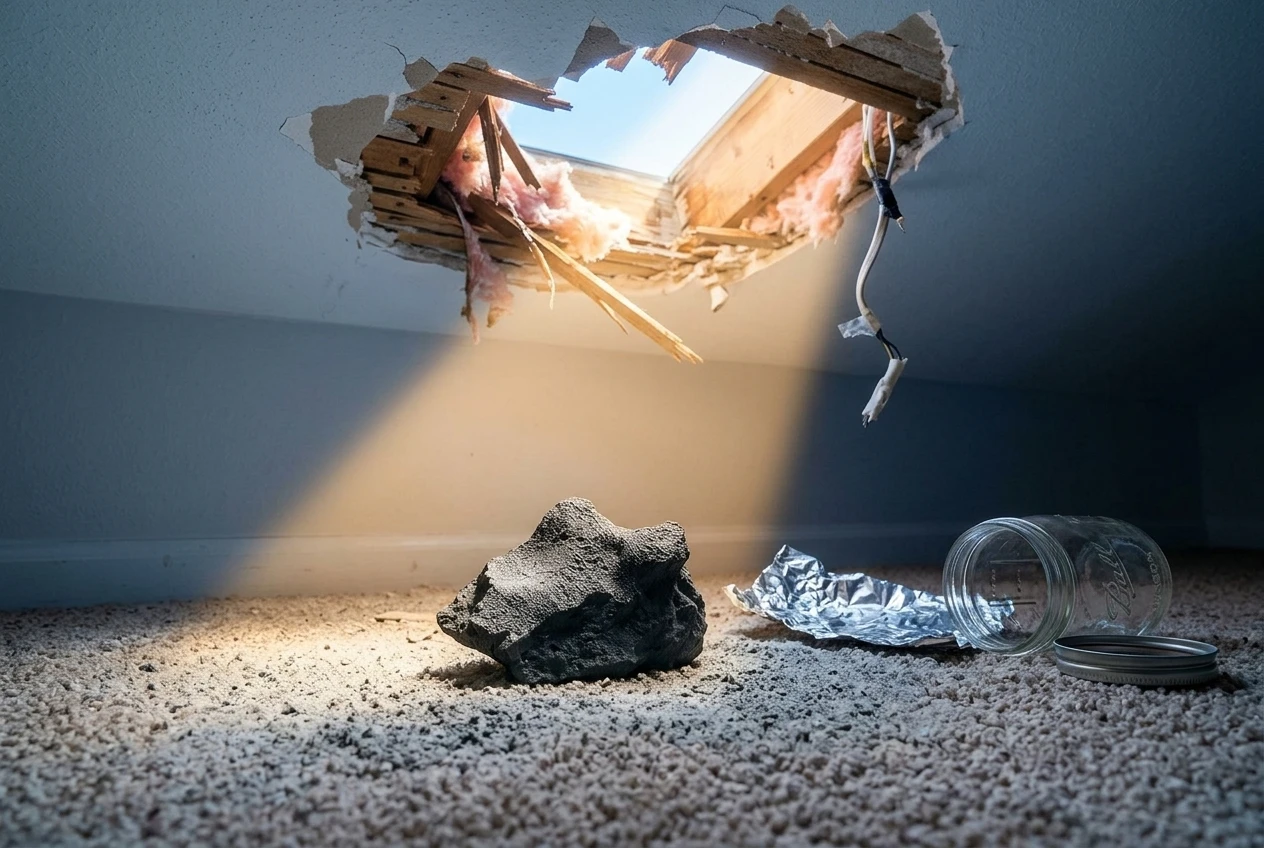
A fist-sized piece of asteroid tore through a bedroom ceiling in Hillsborough, New Jersey, on July 16, 2024. Scientists now say the rock preserved something NASA spent more than a billion dollars and seven years chasing across the solar system: pristine, brine-soaked chemistry that helped build the raw ingredients for life.
Researchers who spent nearly two years studying the fragment say its amino acid mix is even richer than what two multi-hundred-million-dollar spacecraft missions carried home from the asteroids Bennu and Ryugu. The rock, recovered by a homeowner with nothing more than dish gloves, aluminum foil and glass jars, turned out to be a CM1/2 carbonaceous chondrite, a primitive, carbon-rich meteorite class witnessed falling to Earth only twice in recorded history.
A Hole in the Ceiling Became a Sample Nobody Paid For
“I was at home at the time, heard a loud crash and found a hole in the ceiling of the master bedroom. I smelled a strong sulfur-like odor and saw many black fragments along with debris and black dust that covered my bed, carpet and surrounding areas,” the homeowner said, describing hearing a loud crash and finding a hole above his bed with black fragments and dust covering his bedroom.
The couple’s home started violently shaking at around 11:15 a.m. They live in Somerset County and asked not to be identified. He later admitted to a reporter, “Good thing I didn’t sleep in.”
The homeowners patched the roof of their house before rain fell that evening, a crucial step because the fragile meteor is porous and sucks in water from the air, Jenniskens said, and that quick thinking prevented the meteorite from being overly contaminated. Over the following weeks the couple gathered what would amount to about three pounds of extraterrestrial material, using disposable gloves, aluminum foil and glass jars on the advice of scientists.
What reached the ground was a fraction of what entered the sky. The meteoroid began as a rock the size of a heavy airline bag weighing roughly 110 pounds (50 kilograms). It was particularly fragile and broke apart about 22 miles (35.4 kilometers) aboveground. Rainfall likely caused any additional fragments that fell outside to disintegrate. Only the piece that punched through a New Jersey ceiling survived intact.
Doorbell Cameras and Airport Radar Tracked the Fall Home
Dozens of observers across five states reported the fireball to the American Meteor Society (AMS), a volunteer network built to catch exactly this kind of moment. Four data points nailed down its path.
- Northford, Connecticut – an AMS camera recorded the daytime fireball’s bright streak across the sky.
- Douglassville, Pennsylvania – a second AMS camera caught the object from a different angle, helping triangulate its trajectory.
- Wayne, New Jersey – a homeowner’s doorbell camera added a third vantage point close to where debris began falling.
- Newark Liberty International Airport – Doppler weather radar built to track storms instead detected a long cloud of falling pebbles stretching from Staten Island into New Jersey.
“The path traced back to low in the asteroid belt,” said Mike Hankey, operations manager at the AMS. Peter Jenniskens, the study’s lead author and a meteor astronomer at the SETI Institute, a nonprofit focused on the origins of life and the search for extraterrestrial intelligence, filled in the deeper history.
“Some time ago, a significant asteroid family was formed in a large collision and some 6 Myr ago a smaller collision destroyed one of these asteroids, from which a piece ended up in near-Earth orbit,” Jenniskens wrote. “That piece experienced heat/cold cycles from spinning in the sunlight and fragmented about 200,000 years ago. Then it still took that long to hit the small target of Earth.”
The Meteorite’s Matrix Hid Concentrated Alien Brine
Lab analysis classified the specimen as a CM1/2 carbonaceous chondrite, an intermediate classification between petrographic types CM1 and CM2.
- CM1/2 carbonaceous chondrite – a primitive, carbon-rich meteorite altered by liquid water to a degree between two known stages, heavily altered CM1 and moderately altered CM2. Hillsborough is only the 22nd observed CM-type fall in history, and just the second witnessed fall of a CM1/2 specimen, after the Kolang meteorite that fell in North Sumatra, Indonesia, in 2020.
Mike Zolensky, a meteoriticist at NASA’s Johnson Space Center in Houston, and colleague JangMi Han found small, salt-rich CM1 fragments embedded within the rock, suggesting they originated from a near-surface region of the parent asteroid where liquid water had evaporated and concentrated salts. Taken together, the evidence suggests the parent asteroid once held brines saltier than Earth’s oceans.
The rock held 1.8% carbon and 0.07% nitrogen by weight, with isotope ratios typical for CM-type meteorites. Isotope studies of carbon and nitrogen suggest that primitive carbonaceous chondrites, including CM types, delivered organic matter to the early Earth, said cosmochemist Queenie Chan of Royal Holloway, University of London, and biogeochemist Nana Ogawa of Japan’s Agency for Marine-Earth Science and Technology. Jenniskens and his coauthors laid out the full picture in the peer-reviewed brine chemistry analysis published this week.
Handling the rock felt nothing like handling stone. Holding a meteorite like it feels more like soil or clay that falls apart, rather than a solid rock, said Peter Brown, a physics and astronomy professor at Western University in Ontario who was not involved in the study. The discovery of brine on the asteroid is key, Brown said, calling it kind of a leftover of percolating water or ice.
The Rock That Outperformed a Billion-Dollar Mission
Danny Glavin, an astrobiologist at NASA’s Goddard Space Flight Center in Greenbelt, Maryland, and a study coauthor, put the comparison plainly.
The suite of amino acids in Hillsborough was even more diverse than those found in pristine samples returned from the carbon-rich asteroids Bennu and Ryugu.
Glavin said the suite of amino acids in Hillsborough was even more diverse than those found in pristine samples returned from Bennu and Ryugu. There are hundreds of amino acids in this meteorite, he added, and the majority of them do not occur naturally on Earth.
| Sample | How It Reached Earth | Time and Cost to Recover | What Scientists Found |
|---|---|---|---|
| Hillsborough meteorite | Crashed through a New Jersey bedroom ceiling | Hours, using gloves, foil and glass jars | Brine salts and an amino acid mix richer than Bennu or Ryugu |
| Winchcombe meteorite | Fell on a Gloucestershire family’s driveway | Under 12 hours, with UK scientists on scene | Hydrogen isotopes matching Earth’s ocean water |
| Bennu samples (OSIRIS-REx) | Grabbed by a robotic arm, flown home by spacecraft | Seven years, roughly $800 million to $1.16 billion | 14 of 20 protein amino acids and all five DNA and RNA nucleobases |
NASA’s own team says the core OSIRIS-REx science mission ran within a budget of $800 million over 14 years of the mission. Add the spacecraft’s bonus flyby of asteroid Apophis and the bill climbs toward the mission’s projected $1.16 billion price tag, spread across 15 years. The spacecraft’s sample collector gathered more than 120 grams of regolith from Bennu, delivered to Utah in September 2023, three years after touchdown.
The Bennu samples contained all five nucleobases found in DNA and RNA and 14 of the 20 amino acids that life uses to build proteins. A follow-up analysis found a previously undetected amino acid in Bennu, tryptophan, never before spotted in a meteorite or a returned sample. Hillsborough, recovered for the cost of a roll of foil, still came back more chemically diverse.
Hillsborough Joins a Short List of Pristine Falls
Britain saw a preview of this in 2021. The Winchcombe meteorite was widely observed by meteor camera networks, doorbell cameras and eyewitnesses, and roughly a third of its final recovered mass was collected within 12 hours of its fall. Of the roughly 602 grams eventually gathered, about 525 grams are now curated at the Natural History Museum in London. Its near-pristine hydrogen isotopic composition matched the terrestrial hydrosphere, adding evidence that carbonaceous asteroids helped deliver Earth’s water.
Even that fall may have had a rooftop near miss of its own. Researchers considered whether a second fragment came down on the Carrick family’s roof nearby, though a thorough search never turned up any matching piece.
Meteorites keep forcing this kind of rewrite of solar system history. One chunk of debris recently offered evidence of a shattered ancient planet, reshaping ideas about what once orbited in the asteroid belt. Not every space rock ends up in a research lab, either. A separate Martian meteorite is currently headed to auction with a presale estimate near $4 million, a reminder that the same kind of object can end up in a private vault instead of a museum case.
Where Is the Hillsborough Meteorite Today?
Some of the meteorite fragments will be curated at the American Museum of Natural History in New York City, where researchers continue comparing its salt minerals against the material NASA and Japan brought back from Bennu and Ryugu. Public visitors will eventually be able to see pieces of it in person.
“We are thrilled that nature delivered such a precious asteroid sample on our doorstep,” said Denton Ebel, a curator at the museum.
NASA scientists are still pulling new detail out of the rock. Analyses revealed microscopic fractures filled with sodium-rich material left behind by ancient brines, according to NASA’s account of the ongoing research. Those complementary studies are helping scientists build one of the clearest pictures yet of how primitive asteroids evolved chemically over billions of years, Jenniskens said.
The rock that broke through a Somerset County ceiling now sits under museum glass in Manhattan, close enough for anyone who heard that sonic boom two summers ago to go look it in the eye.


Mars’s Shimmering Dunes Double as a Record of a Vanished Atmosphere

Montclair Pulls $91 Million From Citizens Bank Over ICE Ties

How an Andean Mouse Conquers 22,000 Feet Without Boosting Its Blood

Vertu’s $6,880 Alphafold Bets on an AI Agent That Overreaches

IBM’s Historic Stock Crash Revives a Playbook From 1993

Quebec’s New Meteor Crater Named Uhackatik With Innu Input

Consumer Sentiment Rose 10% in July as Gas Prices Already Reversed

FCC Approves a Space Mirror Satellite Russia Already Tried and Lost

A 26-Year Hunt Ends as Astronomers Confirm Sugar in Deep Space

New Jersey Meteorite’s Amino Acids Outshine NASA’s Bennu Haul

Halo Studios Reverses PS Plus for Halo: Campaign Evolved on PS5

Black Ops 1 and 2 PS5 Ports: $40 Price Tag Has Fans Uneasy

Matt Brown Dismisses Rousey and Paul’s MVP MMA Ratings Win Over UFC

Star Wars: Galactic Racer Is a Roguelite Racer With a Podracing Skin

Julius Randle Traded to Nets as Wolves Reclaim Cap Space for Dosunmu

Sega’s $49.99 Sonic Classic and Modern Bundles Hit Switch in October

Colombia Edge DR Congo as Muñoz Books World Cup Knockout Place

Warriors Take Yaxel Lendeborg, the Oldest Pick in the 2026 NBA Draft

Douze Dixièmes Closes Five Months After MIO: Memories in Orbit

Warhammer Horus Heresy Super-Heavy Tanks Share a Plastic Chassis
-

 TECHNOLOGY3 years ago
How to Adjust a Bulova Watch Band – An Easy Guide
-

 News3 years ago
Fred Pentland: Athletic Bilbao’s English mentor who changed the essence of Spanish football
-

 FINANCE3 years ago
Tax Planning for Every Season: Guide to Maximizing Your Tax Benefits
-

 Education3 years ago
African Ministers New Education Plan
-

 BUSINESS3 years ago
What is Entrepreneurial Operating System? A Comprehensive Guide to EOS
-

 Education3 years ago
Innovate Your Learning Journey with Technology and Enhance Education
-

 News3 years ago
Russians formally out of World Athletics Championships
-

 BUSINESS3 years ago
Top 9 Most Expensive American Cities to Rent an Apartment