
News
Mars’s Shimmering Dunes Double as a Record of a Vanished Atmosphere
ESA’s Mars Express shows Kaiser Crater dunes frosted like liquid chrome, images that double as evidence of Mars’s ancient, thicker atmosphere.

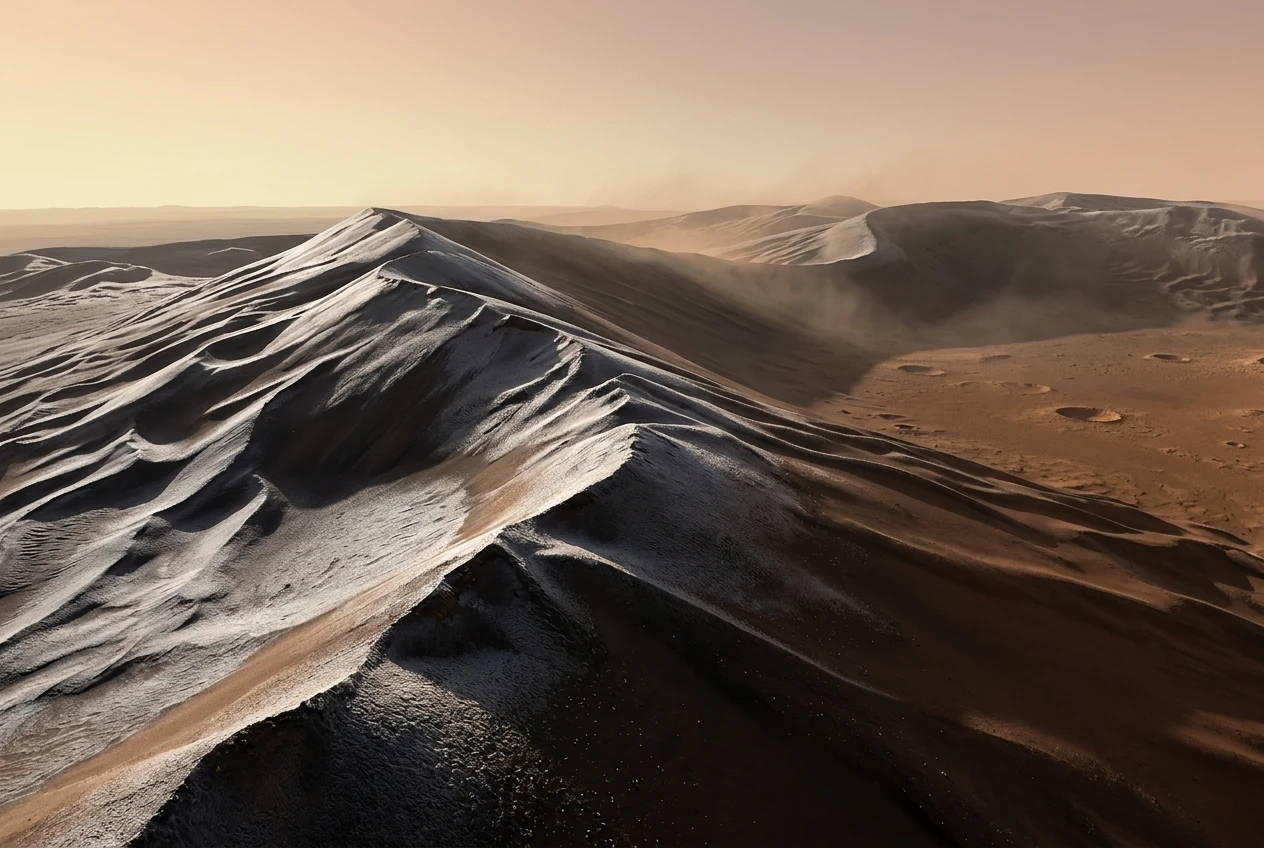
The European Space Agency (ESA) says its Mars Express orbiter just photographed a Kaiser Crater dune field that looks poured from liquid chrome. ESA says the shimmer comes from seasonal frost dusting dark volcanic sand, some of it stacked more than 100 meters, about 330 feet, above the surrounding floor.
Scientists reading those dunes see proof of a once-thicker Martian atmosphere, the very mystery NASA’s now-retired MAVEN orbiter spent eleven years trying to solve. MAVEN went silent in December and NASA declared the mission dead in June, just weeks before this image reached the public.
Seasonal Frost Turns Dark Sand Into a Chrome Illusion
ESA’s High Resolution Stereo Camera aboard Mars Express captured the scene on October 5, 2025, during orbit number 27461. ESA published images of the wind-sculpted dune field this month, nine months after the camera actually recorded it.
The scene sits in Noachis Terra, one of the oldest stretches of Martian ground, scarred by roughly four billion years of impacts. Kaiser Crater itself is enormous. NASA’s crater data puts it at 207 kilometers, 129 miles, wide. ESA’s own description of the same crater floor rounds to about 180 kilometers across and a couple of kilometers deep.
Sunlight explains the metal look. Dark, mineral-rich sand absorbs light while a thin coat of frost, mostly frozen carbon dioxide, reflects it back. The shine gathers most heavily on the dunes’ south-facing slopes, where the sun barely reaches during the Martian winter. NASA describes the crater’s bowl shape as a natural sand trap, holding onto material that wind cannot carry back out.
Dune Ridges Rise Higher Than a 30-Story Tower
Individual ridges climb more than 100 meters above the crater floor, roughly the height of a 30-story building, and some stretch on for several kilometers before merging into their neighbors. The field mixes two dune shapes: long transverse ridges and crescent-shaped barchan dunes, the same sickle form that piles up in the Sahara and the Namib on Earth.
None of this sand carries the rust that colors most of Mars. It is basaltic, rich in the volcanic minerals pyroxene and olivine, darker than the iron-oxide dust that earned the planet its nickname. Bare crater floor still shows through between the ridges, which is why researchers think the field works with a limited sand budget rather than an endless supply feeding in from outside.
A few numbers capture the scale:
- Ridge height – more than 100 meters, about 330 feet, above the surrounding floor
- Image resolution – roughly 17 meters per pixel, built from the HRSC’s nadir and color channels
- Coordinates – centered near 48 degrees south, 19 degrees east, in Mars’s southern highlands
Those numbers describe a dune field big enough that it could not have formed overnight, or under today’s weak Martian winds.
What Frozen Dunes Reveal About a Thicker, Wetter Mars
Modern Mars makes this kind of sculpting hard work. Its atmosphere carries roughly one percent of Earth’s sea-level pressure, too thin for wind to easily lift and carry sand the way it does at home. Kaiser Crater’s ridges are enormous anyway, which points scientists back toward a Mars with a far heavier sky.
Physical evidence backs that up. A 2018 study in the journal Icarus, built on gas trapped inside an ancient Martian meteorite, found that Mars carried a surface pressure of at least half a bar roughly four billion years ago, dense enough to support a warmer, wetter world. Rock tells a similar story closer to the present. NASA’s Curiosity rover found fossilized wind ripples inside Gale Crater in late 2024, later dated to about 3.6 billion years old, detailed in a study published in the journal Geology on March 27, as reported by Science. Steven Banham, the Imperial College London sedimentologist who led that study, said the rocks captured something rare: “We’ve preserved an instant in geological time.”
Where all that ancient air actually went is still argued over. Some researchers think it never left at all. MIT geologists proposed in 2024 that much of it sits locked inside Mars’s clay-covered crust rather than stripped away by the sun, one line of evidence behind Mars’s lost water and air trapped underground rather than lost to space entirely.
NASA’s Only Dedicated Atmosphere Watcher Just Went Dark
NASA’s MAVEN spacecraft, short for Mars Atmosphere and Volatile Evolution, launched in November 2013 and reached Mars the following year as the agency’s first mission built specifically to study the planet’s air. For more than 11 years it measured particles escaping into space and tracked how solar storms strip the atmosphere away, tying that loss directly to Mars’s shift from a once-habitable world into today’s cold desert.
The $582 million spacecraft went quiet on December 6, 2025, while passing behind Mars during a routine communications blackout, according to CBS News. When it should have re-emerged, NASA’s Deep Space Network heard nothing. Engineers later recovered fragments of telemetry showing MAVEN spinning at roughly 2.7 revolutions per minute, fast enough to drain its batteries and knock out its radio for good.
NASA formally declared the mission over on June 3, 2026, about six weeks before ESA released the Kaiser Crater dune images. The dead orbiter should keep circling Mars for another 50 to 100 years before it finally burns up in the atmosphere it spent over a decade studying.
The team is certainly broken up about this. But at the same time, we are incredibly proud of the science we’ve accomplished over the last decade.
Shannon Curry, MAVEN’s principal investigator and a scientist at the University of Colorado Boulder, said that of the mission’s end.
Who’s Left Watching Mars From Orbit?
Four orbiters now carry Mars’s science and communications workload since MAVEN’s loss: NASA’s Mars Odyssey and Mars Reconnaissance Orbiter, plus ESA’s Mars Express and Trace Gas Orbiter. Mars Express is the oldest of the four, flying since 2003, and its camera is what caught Kaiser Crater’s frozen shine in the first place.
ESA’s Trace Gas Orbiter, built mainly to sniff out methane and other trace gases in the Martian air, already carried the largest share of relay traffic between Earth and NASA’s surface rovers even before MAVEN went dark, and it now shoulders more of that load with MAVEN gone.
- Mars Odyssey – a NASA orbiter that helps relay data from Curiosity and Perseverance back to Earth
- Mars Reconnaissance Orbiter – carries the HiRISE camera that has separately photographed Kaiser Crater’s frost cycle
- Mars Express – ESA’s veteran orbiter since 2003, source of the new Kaiser Crater dune images
- Trace Gas Orbiter – ESA mission that already handled the largest share of Mars relay communications
No dedicated successor to MAVEN’s atmosphere watch has launched. NASA has instead pointed toward a commercially built Mars Telecommunications Network it hopes to have running sometime in the 2030s, aimed more at keeping data flowing than at continuing MAVEN’s specific science.
Other Frozen Fingerprints Scattered Across the Red Planet
Kaiser Crater has made headlines before. NASA’s Mars Reconnaissance Orbiter photographed the same dune field defrosting in December 2021, catching a mix of water and carbon dioxide ice breaking apart into dark streaks each Martian spring, streaks that get rerouted by the ripples already carved into the dune’s slopes.
Frost carves stranger shapes elsewhere on Mars. Around the south pole, trapped carbon dioxide gas builds up under a winter ice sheet until it bursts through in geyser-like jets that etch spider-shaped scars into the ground, some erupting at speeds up to 160 kilometers per hour and scattering dark fans of dust as wide as a kilometer.
| Feature | Location | Mission and Date | What It Shows |
|---|---|---|---|
| Metallic dune field | Kaiser Crater, Noachis Terra | Mars Express HRSC, October 2025 | Dark basalt dunes under carbon dioxide frost, sized for ancient stronger winds |
| Defrosting dune slopes | Kaiser Crater | MRO HiRISE, December 2021 | Water and carbon dioxide ice mix breaking into spring sand streaks |
| Araneiform spider terrain | Southern polar region | MRO HiRISE, ongoing since 2018 | Carbon dioxide geysers bursting through ice, carving spider-shaped vents |
| Fossilized climbing ripples | Gale Crater | Curiosity Mastcam, dated to 3.6 billion years old | Proof ancient winds once carried far more sediment than today |
Each feature formed under the same basic rule: Mars’s cold, thin air still finds ways to move material, freeze it, and carve it into shapes with no real match on Earth. Mars Express keeps flying its aging loop regardless, still turning out fresh camera passes over craters, canyons and dune fields that most people will only ever see from orbit.
Frequently Asked Questions
Is the Frost on Mars’s Dunes Water or Dry Ice?
It depends on the image and the orbiter. ESA describes the new Kaiser Crater view as mostly seasonal carbon dioxide frost, but NASA’s Mars Reconnaissance Orbiter photographed the same crater’s dunes in December 2021 and found the seasonal coating there was a mix of water ice and carbon dioxide ice together, not pure dry ice.
What Exactly Killed NASA’s MAVEN Spacecraft?
A rotation problem, according to NASA’s review board. MAVEN passed behind Mars normally on December 6, 2025, but when it should have re-emerged, recovered telemetry fragments showed it spinning at roughly 2.7 revolutions per minute, fast enough to point its solar panels away from the sun and drain its batteries before it could phone home.
What Happens to MAVEN’s Body Now That the Mission Is Over?
It stays in orbit. MAVEN’s project manager, Mike Moreau, has said the dead spacecraft will likely circle Mars for another 50 to 100 years before atmospheric drag finally pulls it down and it burns up, the same slow fate awaiting most defunct Mars orbiters.
Do the Dunes Inside Kaiser Crater Still Move Today?
In small ways, yes. MRO’s 2021 images caught dark streaks of sand sliding down partly defrosted dune slopes each Martian spring, as sunlight turns buried ice straight into gas, and those flows get diverted by the ripples already carved into the dune’s surface.
Will Another Spacecraft Replace MAVEN’s Atmosphere Studies?
Not yet, at least not as a dedicated science mission. NASA has pointed instead toward a commercially built Mars Telecommunications Network it hopes to have running sometime in the 2030s, aimed more at relay communications than at continuing MAVEN’s atmosphere research directly.


NFL Three-Strike Safety Fouls Now Pull Coaches and Clubs In

Browns Fans Tape Protest Signs to Jim Brown Statue Over Watson

Amazon Pixel 11 Deal Erases the $100 Hike for One More Day

Elden Ring on Switch 2 Turns Its Own Worst Label Into a Portable Win

Ternus Takes the Stage With Apple’s Foldable Debut

Ikea Xbox Yxstaby Turns Controller Thumbstick Into Home Furniture

Pokémon Center Turns Past Worlds Wins Into Bundles and a Pikachu Coin

NFL Scraps Pro Bowl Game to Restore Pure Player Honor

New Twitter.now Bets the Brand Musk Left Behind

Bella Mir’s Famous First Loss Meets the Accountant Who Won

Double Fine Cuts 23 Jobs Weeks After Xbox Independence

Day-One Big Walk Lifts PS Plus August Beyond Recycled AAA

John Hight Exits Wizards After Digital Reckoning Hits

Curtis Mead’s Red Sox Debut Ends With Fractured Wrist

Moesch and Dressel Rewrite Night One at 2026 U.S. Nationals

Red Sox Squander Hot Streak Chance in 4-3 Loss to Athletics

Boutte’s Quiet Camp Takeover Forces Patriots Receiver Choices

Take-Two CEO Pushes Netflix Subs for GTA 6 Extended Look

Halo Campaign Evolved Skulls Meet Death Barriers That Kill the Hunt

Wildlands Free Update Hands Players the Tools They Already Invented
-

 TECHNOLOGY3 years ago
How to Adjust a Bulova Watch Band – An Easy Guide
-

 News3 years ago
Fred Pentland: Athletic Bilbao’s English mentor who changed the essence of Spanish football
-

 FINANCE3 years ago
Tax Planning for Every Season: Guide to Maximizing Your Tax Benefits
-

 Education3 years ago
African Ministers New Education Plan
-

 BUSINESS3 years ago
What is Entrepreneurial Operating System? A Comprehensive Guide to EOS
-

 Education3 years ago
Innovate Your Learning Journey with Technology and Enhance Education
-

 News3 years ago
Russians formally out of World Athletics Championships
-

 BUSINESS3 years ago
Top 9 Most Expensive American Cities to Rent an Apartment