
News
FCC Approves a Space Mirror Satellite Russia Already Tried and Lost
The FCC licensed a satellite that beams sunlight at night, the same idea Soviet engineers tested in 1993 and abandoned after a 1999 mirror tore apart.

The Federal Communications Commission licensed a Hawthorne, California startup on July 9 to put a mirror in orbit and beam reflected sunlight onto the dark side of Earth. Reflect Orbital calls it a clean-energy breakthrough. A Russian program tried nearly the same machine three decades ago, and it ended with a torn sheet of Mylar tumbling into the atmosphere.
That history did not stop the agency from signing off. The FCC’s order grants a single two-year test license, brushes aside nearly two thousand public comments, and says flatly that what happens to the night sky is not its problem to solve.
A Two-Year License for One 18-Meter Mirror
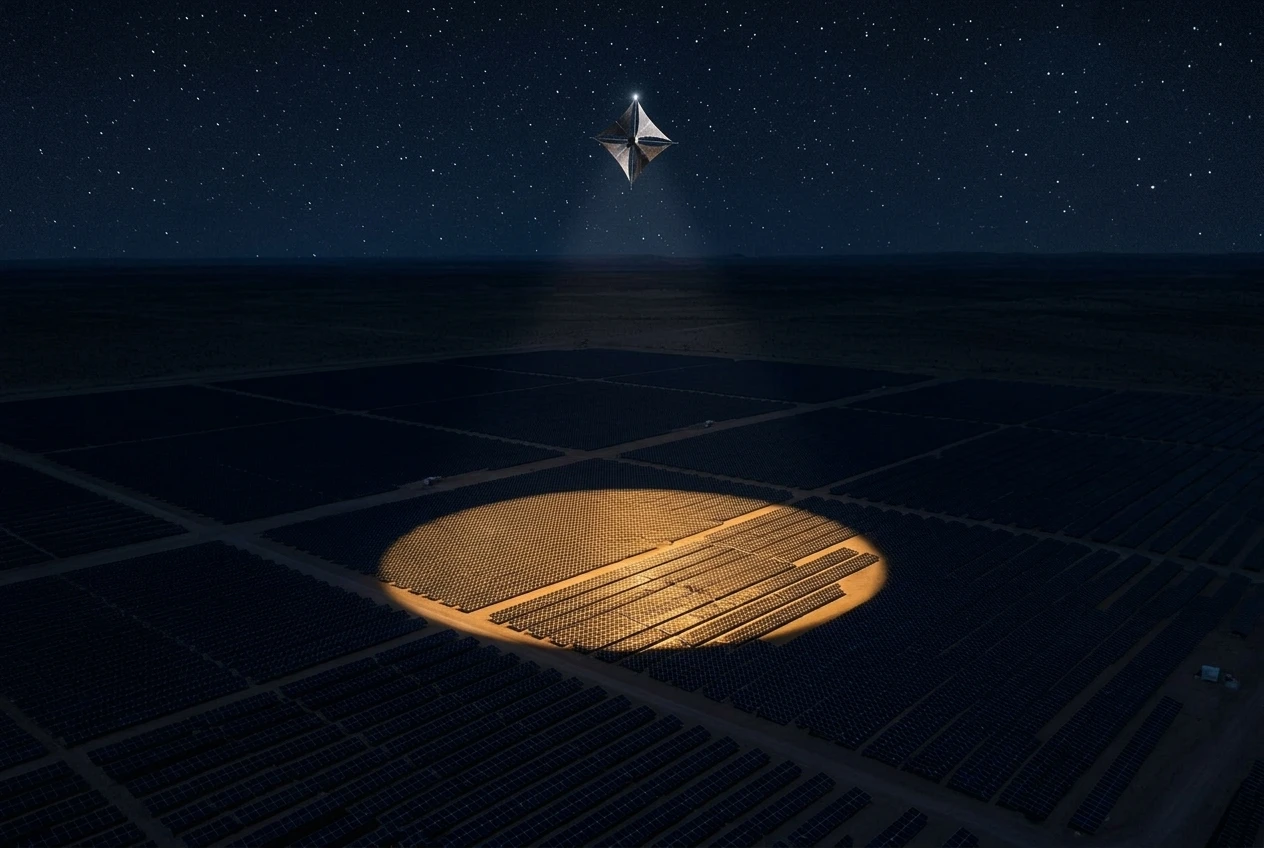
The satellite is called Eärendil-1, and the FCC’s Space Bureau formally authorized the launch of a satellite developed by Reflect Orbital that will deploy a thin-film reflector 18 meters on a side in low Earth orbit, reflecting sunlight to the ground. The spacecraft itself is compact. It is a 142-kilogram spacecraft scheduled to launch later this year into an orbit 600 to 650 kilometers in altitude, where it will deploy the reflector, or roughly the size of a dorm refrigerator carrying a fold-up sheet with more floor area than a house.
Once unfurled, the aluminized Mylar sheet weighs about 324 square meters, according to TechSpot, and the sheet itself weighs about 16 kilograms, or 35 pounds. It flies in a near-polar orbit and steers its beam electronically, motorized and steerable, with the company committed to keeping the reflected light visible only inside the targeted area, each pass painting its spot for a few minutes at a time.
The license comes with deadlines attached. Reflect Orbital has to post a bond and get the spacecraft flying quickly, or the whole authorization lapses; a launch deadline of July 9, 2032 sits in the order alongside an approved debris plan that relies on onboard propulsion and an eventual uncontrolled reentry. CEO Ben Nowack framed the approval as validation, saying this license is the first step toward rigorously testing our technology’s efficacy and the safeguards we have developed.
The FCC Calls the Night Sky Somebody Else’s Problem
Nearly every objection filed against Eärendil-1 got the same answer: not our department. The American Astronomical Society argued the application deserved different treatment, telling regulators this application is fundamentally different from those for telecommunications satellites because the entire point of the hardware is to be as bright as possible. The FCC disagreed and approved the license with conditions the same day it rejected the society’s petition.
Opposition came from more than one astronomy group and from ordinary citizens.
- The American Astronomical Society filed the only petition to deny that met the FCC’s formal filing requirements.
- The Asociación Argentina de Astronomía and the Sociedad Española de Astronomía lodged their own objections, though the agency treated both as informal comments rather than petitions.
- DarkSky International supplied the form letters behind roughly two-thirds of the individual submissions, according to the FCC’s own tally of the record.
- More than 1,800 people wrote in directly, on top of the organizational filings.
Samantha Lawler, an astronomer at the University of Regina in Saskatchewan, put it bluntly to The New York Times: “It’s terrifying to me that one country can change the night sky for everybody in the world.” She added that dark skies are something her research depends on, and that giant mirrors shining down would take that away.
It shows what gigantic holes there are in the regulatory framework for outer space and lets Reflect Orbital just sail on through one of those holes.
That is Lawler again, this time telling Scientific American what scared her about the ruling. Betty Kioko, an institutional affairs officer at the European Southern Observatory, was more clipped in her own statement: “For optical astronomy, this is an existential threat.” The FCC’s written order does not dispute any of that. It simply says the harm sits outside the statute the agency enforces, calling the astronomy fight unrelated to the Commission’s role in authorizing use of radiofrequency spectrum.
Russia Already Tried This, and the Mirror Tore
This is not a new idea. Soviet engineer Vladimir Syromyatnikov built the original version in the late 1980s, repurposing solar-sail hardware after interest in space propulsion cooled, and by 1993 he had actual results.
Znamya 2 flew first. Funded by a collection of Russian state-owned corporations, engineers built a 65-foot-wide sheet of mylar that unfurled from the Mir space station, sending a beam of light two to three times as bright as the moon sweeping across the Atlantic, Europe and into Russia. Cosmonauts aboard Mir had a better view than anyone on the ground, tracking the faint reflected glow moving across the surface below them. It worked, briefly, then burned up over Canada by design.
Success bred ambition, and ambition is where it fell apart. Engineers scaled the design up for a follow-up mission meant to prove the concept for good, a 25-meter reflector called Znamya 2.5. During deployment on February 4, 1999, the mirror caught on an antenna on the Progress spacecraft and ripped; after several failed attempts by Russian mission control to free it, the reflector was de-orbited and burned up on reentry. A contemporaneous dispatch put it plainly, reporting that Russian officials had decided to scrap the experiment rather than wait years to try again. Znamya 3, envisioned at 60 to 70 meters wide, never got built.
The abandoned Znamya 3 is worth dwelling on for a moment. Engineers hoped it would eventually illuminate a ten-square-mile area on Earth with a brightness nearly 100 times greater than moonlight, using a chain of satellites in high orbit. That is roughly the same hundredfold claim now attached to Reflect Orbital’s second generation of mirrors, the fleet the company hopes follows Eärendil-1 within a couple of years. The number survived the fall of one space program and resurfaced almost unchanged in another country’s pitch deck three decades later.
| Mission | Year | Mirror Size | Outcome |
|---|---|---|---|
| Znamya 2 | 1993 | About 20 meters (65 ft) | Deployed successfully, lit a moving patch over Europe for minutes, deorbited by plan |
| Znamya 2.5 | 1999 | 25 meters (82 ft) | Snagged on a Progress antenna and tore during deployment, program cancelled |
| Eärendil-1 | 2026 (planned) | 18 by 18 meters (60 ft) | FCC-licensed, awaiting a SpaceX Falcon 9 launch this year |
Stargazers who wait every August for the annual return of the Perseid meteor shower are exactly the audience astronomers say has the most to lose if orbital mirrors multiply the way Reflect Orbital plans.
What Do the Numbers on Sky Brightness Actually Show?
A peer-reviewed model published days before the FCC ruling found that a full Reflect Orbital fleet could make the night sky three to four times brighter over a major observatory, even when no mirror aims its beam there directly. Smaller fleets already do damage, and the paper’s author says the industry is approaching a line it should not cross.
The study came from Olivier Hainaut, an ESO astronomer, in research accepted for publication in Astronomy and Astrophysics. He modeled every proposed constellation at once, not just Reflect Orbital’s, and the results were stark: a fleet of 5,000 Reflect Orbital craft would raise sky brightness worldwide by up to 30%, and 50,000 craft would boost it by as much as 300%. Hainaut told Science that when you go above a certain number, it starts to be really bad, and he has described low Earth orbit as a “celestial seashore,” a shared resource that connectivity and astronomy both depend on.
The American Astronomical Society raised a narrower but stranger risk in its own filings: eye safety. The group told the FCC that Reflect Orbital’s own calculation suggests a telescope aperture larger than 12 inches, the kind many amateur astronomers and students already own, could cause eye damage if pointed at the satellite, and argued that math had never been peer-reviewed. The agency’s response was narrow too, calling it a small risk under unlikely circumstances and moving on.
Biologists frame the stakes differently. Researchers from Europe, the United States, Japan and Canada wrote to The Guardian that the scale of deployment being proposed “would represent a significant alteration of the natural night-time light environment at a planetary scale,” warning that disrupting the day-night cycle could scramble circadian rhythms, migration patterns and even ocean phytoplankton that anchor marine food chains.
Where the two sides split:
- Astronomers and policy scholars, including John Logsdon, professor emeritus at George Washington University’s Space Policy Institute, warn that a constellation of orbital mirrors like Reflect Orbital is planning might compromise the ability to view the night skies.
- Reflect Orbital counters through Nowack, who insists “we want to precisely control where our sunlight is going.”
- The FCC sits between them procedurally, approving the hardware while declaring the fight over its effects outside its jurisdiction to referee.
Selling Sunlight by the Hour
Reflect Orbital’s pitch is not really to photographers with a phone app, whatever the marketing suggests. The company has set its price at $5,000 for an hour of one mirror’s light, but only for customers who commit to 1,000 hours a year, a $5 million annual bill that puts it well beyond casual buyers.
Solar farms are the more plausible early customer, since panels that go dark at sunset represent lost revenue every single night. Emergency lighting for disaster response is the other use case Reflect Orbital advertises, though coordinating a satellite pass over a specific rescue site on short notice, and paying for the privilege, is a harder problem than the pitch implies.
That does not change what regulators are actually being asked to bless. Although Eärendil-1 is only a demonstration mission, Reflect Orbital has outlined plans to launch up to 1,000 larger satellites between 2026 and 2028, expanding to around 5,000 by 2030 and as many as 50,000 by 2035. Each generation is expected to be bigger and brighter than the last.
The Roadmap Runs Through 50,000 Satellites by 2035
Getting there is a manufacturing problem as much as a regulatory one. Scaling from a single test article to 50,000 spacecraft by 2035 implies thousands of new satellites every year for a decade, a build rate that dwarfs anything a commercial constellation has managed so far, Starlink included.
None of the follow-on satellites are covered by this license. The FCC was explicit that it evaluated one spacecraft, not a fleet, and that any larger deployment will need its own applications and its own record of public comment. Reflect Orbital has said separately that it intends to work with NASA, the National Science Foundation, and astronomers to build exclusion zones around observatories, an arrangement that depends entirely on the company’s cooperation rather than any rule the FCC can enforce.
Federal regulators outside the FCC are starting to notice the gap. The National Oceanic and Atmospheric Administration has floated a voluntary certification process for novel space activities that fall between existing agencies’ authority, and its space commerce office told a House Science Committee hearing that scientific impact, including light pollution, would factor into that review. Whether that framework arrives before Reflect Orbital’s next license application is an open question.
Reflect Orbital still has to post its surety bond by August 10, 2026, or the license it just spent a year fighting for lapses before a single satellite reaches orbit.
Frequently Asked Questions
Why is the satellite named Eärendil-1?
Eärendil comes from an Old English word for morning star, adopted by Reflect Orbital in the same spirit that led earlier aerospace projects toward Tolkien references. The name plays on the satellite’s job: appearing as a bright point of light where none should be.
Has an orbital mirror ever actually worked before?
Yes, once, briefly. Znamya 2’s 1993 test successfully swept a beam of reflected sunlight across Europe, and cosmonauts aboard Mir watched the glow track across the planet below them before the mirror deorbited as planned. No orbital mirror has completed a mission since.
What happens if Eärendil-1 fails to deploy correctly?
Reflect Orbital’s FCC-approved debris plan gives the satellite its own propulsion for collision avoidance and a rip-stop reflector design meant to tolerate small punctures. If the mission ends, whether by failure or by design, the plan calls for an uncontrolled atmospheric reentry within a year, similar to how Znamya 2 burned up after its own test decades earlier.
Is this the same light pollution problem caused by satellites like Starlink?
Not quite. Communications satellites such as Starlink reflect sunlight unintentionally, as a byproduct of their solar panels and hardware. Eärendil-1 is engineered to be as bright as possible on purpose, which astronomers argue makes its light pollution fundamentally harder to mitigate or avoid.
Does any international body regulate satellites like this one?
Not in practice. The Outer Space Treaty sets broad principles for activity in orbit, but no agency, in the United States or elsewhere, actively enforces limits on light pollution from satellites before harm occurs. Scientists say that leaves victims of lost telescope time with no real remedy, since penalties paid after the fact cannot recover data that was never collected.


Walmart’s $50 Million Opioid Settlement Closes Case Without Admission

California Sues Over $120 Million Morro Bay Wind Lease Buyout

Gilead Bixlenvo FDA Nod Opens Single Pill Path for Complex HIV Cases

Meta’s $18B Kids Deal Forever Shields Data Used to Spot Under-13s

Lettuce Outbreak Drove Record Cyclospora Spike Across 20 States

Amazon Shaves $20 Off M6 Mac Mini Before It Even Ships

SpaceX Louisiana Port Tests Debt Markets on Orbital AI Scale

Microsoft High Lifts Indexes as Small Caps Crack Support

Apple Replays 2015 Saturday Midnight Preorder for iPhone 18 Pro

Updated COVID Shots Clear FDA but Access Friction Hits High-Risk Groups

Take-Two CEO Pushes Netflix Subs for GTA 6 Extended Look

Halo Campaign Evolved Skulls Meet Death Barriers That Kill the Hunt

Wildlands Free Update Hands Players the Tools They Already Invented

Destiny 2 Fans Unlock Vaulted Maps After Live Service Ends

Quake Gets 19 Free Maps From MachineGames Quake Club

Quordle Monday Delivers Gavel Crush Speed Ethos Cleanly

Stripe Bid Shows PayPal Moat Cracked After Years of Slide

Tyson’s Five-Year Utah Plant Falls to Cattle Shortage Reckoning

Silver Lake Workday Talks Signal Private Floor for Software

Kennedy Lewis Takes Majority Control of The Greenbrier in $500M Deal
-

 TECHNOLOGY3 years ago
How to Adjust a Bulova Watch Band – An Easy Guide
-

 News3 years ago
Fred Pentland: Athletic Bilbao’s English mentor who changed the essence of Spanish football
-

 FINANCE3 years ago
Tax Planning for Every Season: Guide to Maximizing Your Tax Benefits
-

 Education3 years ago
African Ministers New Education Plan
-

 BUSINESS3 years ago
What is Entrepreneurial Operating System? A Comprehensive Guide to EOS
-

 Education3 years ago
Innovate Your Learning Journey with Technology and Enhance Education
-

 News3 years ago
Russians formally out of World Athletics Championships
-

 BUSINESS3 years ago
Top 9 Most Expensive American Cities to Rent an Apartment